
AI transforms how financial teams process bank statements, achieving up to 99% extraction accuracy while cutting processing time by approximately 80%. Manual methods expose organizations to costly errors, slow financial closes, and scaling challenges. Modern AI platforms handle diverse statement formats, encrypted PDFs, and multilingual documents with enterprise-grade security, delivering structured data ready for immediate use in accounting workflows.
Table of Contents
- Introduction To AI In Bank Statement Processing
- How AI Improves Accuracy And Speed In Bank Statement Processing
- Handling Diverse And Encrypted Bank Statement Formats
- Security And Compliance Considerations In AI-Powered Processing
- Common Misconceptions About AI In Bank Statement Processing
- Practical Integration Strategies For AI-Extracted Bank Statement Data
- Conclusion And Next Steps For Leveraging AI In Bank Statement Processing
- Explore AI-Powered Bank Statement Solutions
Key takeaways
| Point | Details |
|---|---|
| Accuracy boost | AI achieves up to 99% extraction accuracy, reducing costly manual entry errors by orders of magnitude. |
| Speed gains | Processing times drop by approximately 80%, enabling faster month-end closes and real-time reconciliation. |
| Format flexibility | Modern AI handles encrypted PDFs, 80+ languages, and diverse regional formats without manual intervention. |
| Enterprise security | Platforms comply with GDPR, SOC 2, and international standards to protect sensitive financial data. |
| Integration ease | API access and flexible exports (Excel, CSV, JSON, XML) fit seamlessly into existing ERP systems. |
Introduction to AI in bank statement processing
Financial teams waste countless hours manually extracting transaction data from bank statements, a process riddled with transcription errors and scaling limitations. Traditional methods require staff to review each line item, enter data into spreadsheets, and cross-check figures, consuming time better spent on analysis and strategic planning. AI document processing revolution eliminates these bottlenecks by automating extraction with machine learning algorithms trained on millions of financial documents.
AI-powered platforms recognize patterns across diverse statement layouts, extracting dates, amounts, descriptions, and account details with precision that surpasses human capabilities. These systems process documents in seconds rather than hours, freeing financial professionals to focus on reconciliation, forecasting, and decision support. The technology adapts to new formats through continuous learning, maintaining accuracy as banks update their statement designs.
Key advantages include:
- Elimination of manual data entry errors that corrupt financial records
- Processing capacity that scales instantly during peak periods like quarter-end
- Consistent accuracy regardless of document volume or complexity
- Immediate availability of structured data for downstream analysis
Financial teams adopting AI see immediate workflow improvements, with data flowing directly into accounting systems for reconciliation and reporting. The shift from manual to automated processing represents a fundamental upgrade in how organizations manage financial information.
How AI improves accuracy and speed in bank statement processing
AI platforms deliver measurable performance gains that transform financial operations. Practical examples of AI in banking demonstrate accuracy rates approaching 99%, a threshold that manual processes rarely achieve even with experienced staff. Machine learning models identify field boundaries, classify transaction types, and extract values with minimal error, learning from corrections to improve over time.
Processing speed improvements reach 80% or more compared to manual methods. Tasks that consumed hours now complete in minutes, accelerating monthly closes and enabling real-time visibility into cash positions. Financial teams report completing reconciliations days faster, with data ready for analysis immediately after statement receipt.
AI processing platforms help avoid costly reconciliation errors that lead to financial misstatements and penalties, evidenced by case studies showing 30-50% reduction in audit adjustments post-AI implementation. Automated extraction eliminates typos, transposed digits, and missed line items that plague manual workflows. Confidence scoring flags uncertain extractions for human review, creating a safety net that combines AI speed with human judgment.
“The combination of machine precision and human oversight creates a processing workflow that’s both faster and more accurate than either approach alone.”
Key performance benefits include:
- Near-perfect field extraction reducing downstream reconciliation time
- Instant processing of batch uploads during high-volume periods
- Continuous model improvement as systems learn from user corrections
- Audit trails documenting every extraction decision for compliance purposes
Pro Tip: Configure confidence thresholds to automatically route low-confidence extractions to reviewers, balancing automation speed with accuracy assurance.
AI models train on diverse datasets encompassing millions of statement variations, building pattern recognition capabilities that generalize across institutions and formats. This extensive training enables accurate extraction even from unfamiliar layouts encountered for the first time.

Handling diverse and encrypted bank statement formats
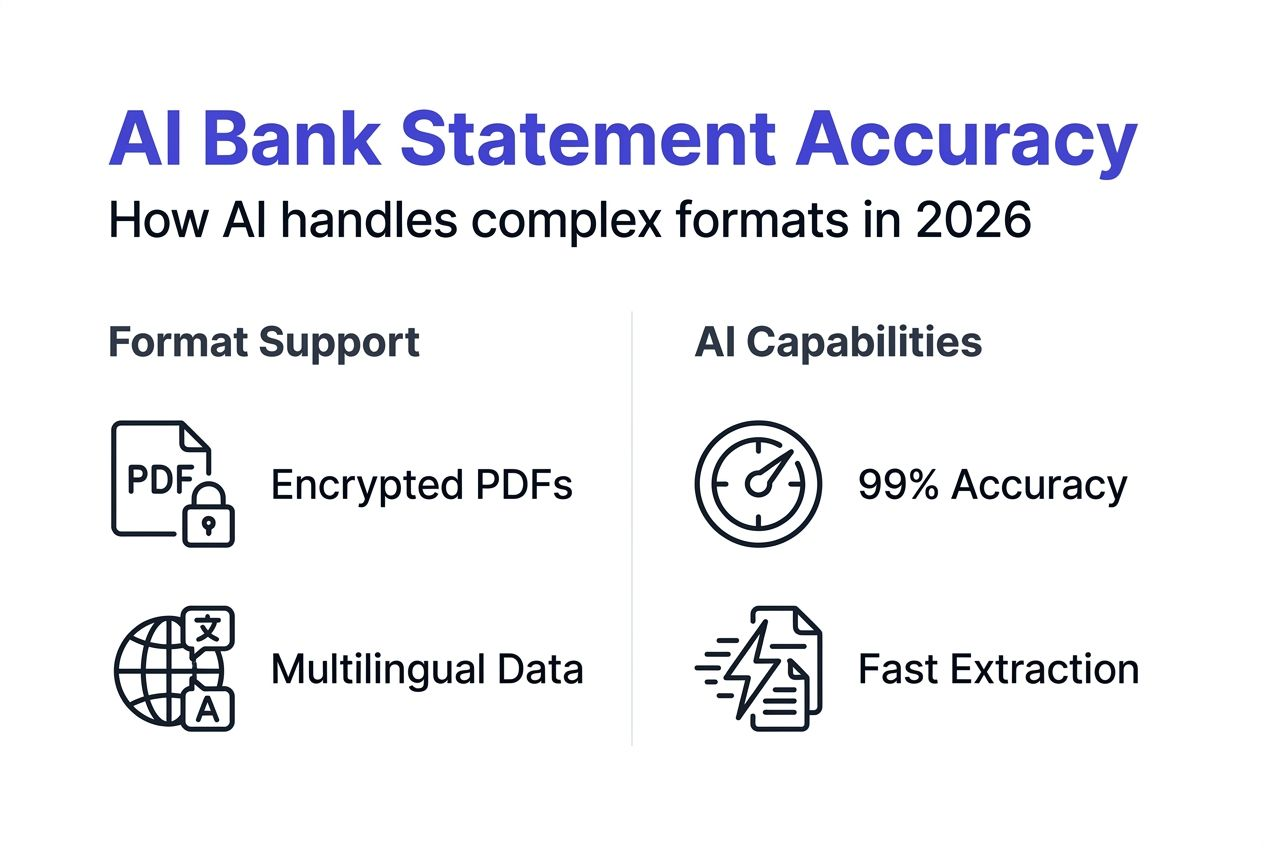
Global financial operations demand processing capabilities that span languages, currencies, and regional formatting conventions. Modern AI platforms support over 80 languages, automatically detecting and processing statements in languages from English and Spanish to Mandarin and Arabic. Regional date formats (MM/DD/YYYY vs DD/MM/YYYY), currency symbols, and decimal separators are recognized and standardized without manual configuration.
Password-protected and encrypted PDF statements pose no barrier to AI processing. Systems securely decrypt documents during extraction, maintaining security protocols throughout the workflow. This capability eliminates the manual step of unlocking files before processing, a time-consuming task when handling hundreds of statements monthly.
OCR technology explained reveals how AI adapts to varying statement layouts across financial institutions. Each bank uses unique formatting, column arrangements, and header designs, yet machine learning models extract data accurately regardless of these differences. The technology handles:
- Multi-column layouts with varying field positions
- Statements combining text and tabular data
- Documents with logos, watermarks, and graphical elements
- Low-quality scans or phone photos requiring image enhancement
| Format Challenge | AI Capability |
|---|---|
| Encrypted PDFs | Secure decryption and processing maintaining compliance |
| Multilingual statements | Automatic language detection across 80+ languages |
| Regional formatting | Recognition of diverse date, number, and currency formats |
| Poor scan quality | Image enhancement and intelligent character recognition |
| Mixed layouts | Adaptive extraction handling tabular and free-text sections |
This versatility proves essential for organizations operating across borders or managing accounts with multiple banking partners. AI eliminates the need for format-specific templates or preprocessing steps, processing any statement type through a single unified workflow.
Security and compliance considerations in AI-powered processing
Bank statements contain sensitive financial information requiring stringent protection during processing and storage. AI-powered financial document platforms comply with global data security standards (e.g., GDPR, SOC 2) to protect sensitive bank statement information during processing and storage. Regulatory compliance with AI demands encryption, access controls, and audit logging meeting or exceeding traditional processing security standards.
Enterprise platforms implement multiple security layers:
- End-to-end encryption for data in transit and at rest
- Role-based access controls limiting document visibility to authorized personnel
- Audit trails recording all processing activities for compliance verification
- Data residency options ensuring information stays within required jurisdictions
- Regular security assessments and penetration testing validating defenses
SOC 2 Type II certification demonstrates platforms maintain rigorous controls over security, availability, processing integrity, confidentiality, and privacy. GDPR compliance ensures European financial data receives protection meeting EU standards, with clear data handling policies and user consent mechanisms.
“Security in AI processing isn’t an afterthought but a foundational requirement, with platforms designed from the ground up to protect sensitive financial information.”
Platforms minimize data exposure by processing documents in isolated environments, deleting source files after extraction when configured, and limiting data retention to user-defined periods. Multi-factor authentication, single sign-on integration, and IP whitelisting provide additional access security layers for enterprise deployments.
Financial teams gain transparency into exactly how their data is handled, with detailed security documentation and compliance certifications available for review. For more information on ISO information security standards, organizations can verify the frameworks governing AI platform security practices.
Common misconceptions about AI in bank statement processing
Skepticism about AI capabilities often stems from outdated assumptions or misunderstandings about how modern systems operate. One prevalent myth suggests AI cannot reliably handle diverse statement formats, but current machine learning models adapt effectively to layout variations through extensive training on millions of document examples. AI in finance accuracy transforms document processing by learning patterns rather than relying on rigid templates.
Another misconception positions AI as a job replacement technology threatening financial professional roles. Reality shows AI complements human expertise by automating repetitive data extraction while financial staff focus on analysis, exception handling, and strategic decision-making. Organizations implementing AI typically redeploy staff to higher-value activities rather than reducing headcount.
Key myth corrections include:
- Myth: AI requires perfect document quality to function. Reality: Modern OCR handles poor scans, phone photos, and low-resolution images through enhancement algorithms.
- Myth: AI systems are black boxes offering no transparency. Reality: Platforms provide confidence scores and highlight uncertain extractions for human review.
- Myth: Implementation requires months of training and configuration. Reality: Cloud-based AI platforms often process documents accurately from day one with minimal setup.
- Myth: AI cannot learn organization-specific requirements. Reality: Systems adapt through feedback, improving accuracy on custom fields and unique formats over time.
The synergy of human-AI collaboration produces superior results compared to either approach alone. AI delivers speed and consistency while humans apply judgment to exceptions, validate unusual patterns, and maintain oversight of automated processes. This hybrid model maximizes efficiency without sacrificing accuracy or control.
Pro Tip: Start with a hybrid review process where AI handles initial extraction and staff verify results, gradually expanding automation as confidence in system accuracy grows.
Financial teams embracing AI discover technology that augments rather than replaces their capabilities, enabling them to process higher volumes with greater accuracy while focusing expertise where it delivers maximum value.
Practical integration strategies for AI-extracted bank statement data
Successful AI adoption requires thoughtful integration with existing accounting workflows and systems. Bank statement processing guide principles apply whether implementing standalone AI tools or enterprise platforms. Follow these steps for smooth deployment:
-
Evaluate API integration options: Modern AI platforms offer RESTful APIs enabling direct connections between extraction engines and ERP systems, accounting software, or custom applications. API integration eliminates manual file transfers, automatically feeding extracted data into downstream systems.
-
Select appropriate export formats: Choose structured outputs matching your workflow needs. Excel works for manual review processes, CSV for bulk imports, JSON for application integration, and XML for legacy system compatibility. Bank statement parsing accuracy automation improves when data flows directly into target systems without reformatting.
-
Implement confidence-based routing: Configure the AI platform to flag extractions below defined confidence thresholds for human review. High-confidence data flows straight through while uncertain items receive manual verification, balancing automation speed with accuracy assurance.
-
Train staff on hybrid workflows: Financial teams need clear processes defining when to trust AI outputs and when to apply human judgment. Training should cover confidence score interpretation, exception handling procedures, and feedback mechanisms that improve AI accuracy over time.
-
Monitor performance metrics: Track extraction accuracy, processing time, exception rates, and user feedback to identify improvement opportunities. Regular monitoring reveals patterns in misclassified transactions or format issues requiring model updates.
-
Establish feedback loops: Most AI platforms improve through user corrections. When staff fix extraction errors, those corrections train the model to avoid similar mistakes, creating continuous accuracy improvements over deployment lifetime.
Integration complexity varies based on existing infrastructure, but cloud-based AI platforms minimize technical barriers through pre-built connectors for popular accounting systems. Organizations without development resources can leverage no-code integration tools or work with platform vendors offering implementation support.
For additional insights, explore AI document processing insights covering integration patterns, best practices, and case studies from organizations that have successfully deployed automated extraction workflows.
Conclusion and next steps for leveraging AI in bank statement processing
AI fundamentally improves bank statement processing through superior accuracy approaching 99%, processing speeds 80% faster than manual methods, and robust security meeting global compliance standards. Financial teams gain immediate productivity benefits while reducing error rates that compromise data integrity and audit readiness.
Piloting an AI solution represents the strategic first step toward realizing these advantages. Start with a limited document set, validate accuracy against current processes, and expand automation as confidence builds. Cloud platforms minimize implementation risk through rapid deployment and subscription pricing that scales with usage.
Integrating AI advances broader finance digital transformation initiatives, positioning organizations to leverage automated data for real-time analytics, forecasting, and strategic decision-making. The technology shift from manual to intelligent processing creates competitive advantages through faster closes, better data quality, and freed capacity for value-added analysis.
Explore AI-powered bank statement solutions
Ready to experience the accuracy and efficiency gains discussed throughout this article? AI-powered bank statement conversion platforms transform PDF statements into structured Excel and CSV files within seconds, maintaining up to 99% extraction accuracy while protecting your data through enterprise-grade security and compliance certifications.
Modern solutions handle encrypted files, multilingual statements, and diverse formats without manual preprocessing. API integrations connect directly to your accounting systems, eliminating file transfers and accelerating reconciliation workflows. Flexible export options ensure compatibility with existing processes while enabling gradual automation expansion as your team builds confidence in AI capabilities.
FAQ
What accuracy levels can financial teams expect from AI bank statement processing?
Leading AI platforms achieve up to 99% extraction accuracy on bank statements, significantly outperforming manual data entry which typically averages 96-98% accuracy even with experienced staff. Accuracy varies slightly based on statement quality and format complexity, but confidence scoring identifies uncertain extractions for human review.
Can AI handle encrypted or password-protected bank statements securely?
Modern AI platforms process encrypted and password-protected PDFs seamlessly while maintaining security protocols throughout extraction. Systems decrypt documents in secure processing environments, extract required data, and delete temporary files according to defined retention policies, ensuring sensitive information remains protected.
Does implementing AI require significant changes to existing accounting systems?
Most AI platforms offer API integrations and flexible export formats (Excel, CSV, JSON, XML) that fit into existing workflows without major system changes. Cloud-based solutions typically deploy within days rather than months, with pre-built connectors for popular accounting software minimizing technical implementation requirements.
Will AI in bank statement processing replace financial professionals?
AI automates repetitive data extraction tasks but enhances rather than replaces financial professional roles. Staff redirect time from manual entry to higher-value activities like reconciliation analysis, exception investigation, and strategic planning. Organizations implementing AI typically redeploy rather than reduce financial team capacity.
Recommended
- Role of AI in Accounting: Automate Documents for Accuracy - BankStatementFlow Blog
- 7 Practical Examples of AI in Banking for Accuracy - BankStatementFlow Blog
- Blog - BankStatementFlow | AI Document Processing Insights
- Bank Statement Digitization: Streamlining Financial Workflows - BankStatementFlow Blog