AI in compliance: boost finance regulatory adherence 2026

Artificial intelligence is reshaping compliance workflows in finance, yet many professionals remain skeptical about its reliability and ethical implications. While concerns about bias and transparency are valid, AI automates regulatory monitoring, transaction surveillance, control testing, and evidence collection for continuous compliance in finance, delivering measurable efficiency gains that traditional methods cannot match. This article explores how AI transforms compliance operations in 2026, examines frameworks for assessing AI robustness, addresses critical risks, and provides actionable strategies for integrating AI into your compliance infrastructure while maintaining oversight and trust.
Table of Contents
- How Ai Automates Compliance In Finance
- Assessing Ai Alignment With Financial Compliance Regulations
- Risks And Ethical Considerations Of Ai In Compliance Workflows
- Practical Applications: Ai For Financial Crime Compliance And Workflow Efficiency
- Explore Ai-Powered Compliance Tools With Bankstatementflow
- Frequently Asked Questions
Key takeaways
| Point | Details |
|---|---|
| AI automates compliance tasks | Machine learning systems monitor regulations, detect anomalies, and test controls continuously, reducing manual workload significantly. |
| COMPL-AI framework assesses readiness | This benchmarking suite evaluates LLMs for robustness, fairness, and safety alignment with financial regulations like the EU AI Act. |
| Risks require active management | Bias amplification, false positives, and hallucinations demand transparency and human oversight to protect compliance integrity. |
| FCC workflow automation cuts costs | AI-driven financial crime compliance reduces global costs exceeding $200 billion while accelerating suspicious activity reporting. |
How AI automates compliance in finance
Finance teams face mounting regulatory complexity as global frameworks evolve. AI addresses this challenge by automating tasks that traditionally consumed thousands of manual hours. Machine learning algorithms continuously scan regulatory updates, flagging changes relevant to your institution’s operations. Real-time transaction surveillance identifies suspicious patterns across millions of daily transactions, something human analysts cannot achieve at scale.
Policy-as-code translates regulatory requirements into executable rules that AI systems enforce automatically. When a transaction violates a compliance parameter, the system triggers alerts and generates audit trails without human intervention. Control testing automation verifies that internal safeguards function correctly, running checks on schedules that would overwhelm manual teams. Evidence collection for regulatory audits becomes systematic, with AI gathering and organizing documentation that proves compliance adherence.
Adoption data confirms this transformation. By 2024, 58% of finance organizations had integrated AI into compliance workflows, recognizing efficiency gains and accuracy improvements. Transaction surveillance systems now process complex pattern recognition tasks in milliseconds, catching fraud attempts that evade rule-based systems. Control testing frequencies increased from quarterly to continuous monitoring, identifying gaps before regulators discover them during examinations.
Consider how AI handles anti-money laundering checks. Traditional systems flag transactions based on fixed thresholds, generating excessive false positives that waste investigator time. AI models learn normal customer behavior patterns, detecting genuine anomalies while ignoring benign variations. This reduces false positive rates by up to 70%, allowing compliance teams to focus on legitimate threats.
Pro Tip: Integrate AI workflows with manual oversight checkpoints at critical decision nodes. Automate data gathering and preliminary analysis, but require human review before taking enforcement actions or filing regulatory reports. This hybrid approach maximizes efficiency while preserving accountability and catching AI errors before they cause compliance failures.
The technology excels at repetitive, high-volume tasks where consistency matters. Regulatory change management becomes proactive rather than reactive. AI improves accuracy in finance operations by eliminating human transcription errors and ensuring uniform application of compliance rules across all transactions and geographies.
Assessing AI alignment with financial compliance regulations
Deploying AI in compliance requires rigorous evaluation of model capabilities and limitations. The COMPL-AI framework provides technical interpretation of the EU AI Act for LLMs with a benchmarking suite assessing robustness, safety, and fairness, offering compliance officers a structured methodology for vetting AI systems before production deployment. This framework matters because financial regulations demand explainability, consistency, and protection against discriminatory outcomes.

COMPL-AI evaluates models across three critical dimensions. Robustness testing measures how models handle adversarial inputs, edge cases, and data quality variations that occur in real-world compliance scenarios. Safety assessments examine whether models generate harmful outputs or make decisions that violate regulatory boundaries. Fairness analysis detects bias in model predictions that could lead to discriminatory treatment of customers or unfair enforcement of compliance rules.
Benchmarking results from 12 leading LLMs reveal significant performance gaps. Most models achieve acceptable robustness scores on standard compliance tasks but struggle with ambiguous regulatory language and jurisdiction-specific nuances. Safety scores vary widely, with some models generating recommendations that contradict established compliance practices. Fairness metrics expose concerning patterns where models treat similar cases differently based on protected characteristics.
| Evaluation Dimension | Top Performer Score | Median Score | Common Weakness | | — | — | — | | Robustness | 87% | 72% | Edge case handling | | Safety | 91% | 68% | Regulatory boundary recognition | | Fairness | 84% | 65% | Protected attribute bias | | Explainability | 79% | 61% | Decision path transparency |
These gaps highlight why blanket AI adoption without assessment creates compliance risks. A model that performs well on general financial tasks may fail when applied to specific regulatory requirements like GDPR data handling or Basel III capital calculations. Enhancing regulatory compliance through AI document processing requires matching model capabilities to task requirements precisely.
Ongoing benchmarking matters because model behavior drifts over time. As AI systems learn from new data, their decision patterns shift. What passed compliance standards six months ago may no longer meet current requirements. Regular audits catch degradation before it causes regulatory violations.
Pro Tip: Establish quarterly model audits using standardized test cases that represent your institution’s compliance scenarios. Track performance trends across robustness, safety, and fairness dimensions. Set minimum thresholds for each metric and trigger model retraining or replacement when scores fall below acceptable levels. Document all audit results to demonstrate due diligence to regulators.
Model tuning addresses identified shortcomings. Fine-tuning on institution-specific compliance data improves accuracy on relevant tasks. Adjusting decision thresholds reduces false positives while maintaining detection rates. Adding explainability layers makes model reasoning transparent to auditors and regulators. Compliance in financial automation demands this level of rigor to satisfy regulatory scrutiny.
Risks and ethical considerations of AI in compliance workflows
AI introduces risks that compliance officers must actively manage. LLMs exhibit unethical financial behavior and AI amplifies biases and false positives in high-stakes decisions, creating potential for regulatory violations and reputational damage. Understanding these risks enables teams to implement safeguards that preserve AI benefits while mitigating harm.
Bias amplification occurs when AI models learn from historical data reflecting past discrimination. A model trained on loan approval decisions may perpetuate racial or gender bias present in training data, violating fair lending laws. This happens even when protected characteristics are excluded from model inputs, because proxy variables correlate with protected attributes. Geographic location, for example, often correlates with race, allowing models to discriminate indirectly.
False positives plague AI compliance systems, particularly in fraud detection and anti-money laundering. Models optimized for high detection rates flag legitimate transactions as suspicious, overwhelming investigation teams with alerts. When 95% of alerts prove false, investigators develop alert fatigue, potentially missing genuine threats buried in noise. This paradoxically weakens compliance despite increased automation.
Hallucinations represent a unique AI risk where models generate plausible but factually incorrect outputs. An AI system might cite nonexistent regulations or misinterpret legal requirements, leading compliance teams to implement incorrect controls. These errors appear authoritative, making them harder to catch than obvious mistakes.
Intellectual property leakage occurs when AI models trained on proprietary compliance data inadvertently expose sensitive information in their outputs. A model might reveal details about your institution’s risk assessment methodologies or customer data patterns, creating competitive disadvantages and potential regulatory violations.
Risk aversion in AI systems creates another challenge. Models trained to avoid regulatory violations may become overly conservative, rejecting legitimate transactions or imposing unnecessary restrictions. This damages customer relationships and reduces business efficiency without corresponding compliance benefits.
“Transparency and explainability are non-negotiable in AI-driven financial crime compliance systems. Regulators and auditors must understand how AI reaches decisions, and institutions must demonstrate that automated systems apply rules consistently and fairly across all customer segments.”
Mitigation strategies address these risks systematically:
- Implement bias testing protocols that evaluate model outputs across demographic groups, flagging disparate impact before deployment
- Calibrate decision thresholds to balance detection rates against false positive volumes, prioritizing investigator efficiency
- Require human review of AI-generated compliance interpretations before implementation, catching hallucinations through expert validation
- Use federated learning or differential privacy techniques to train models without exposing sensitive data
- Monitor model conservatism metrics, adjusting risk parameters when rejection rates exceed justified levels
Automation in compliance and financial oversight succeeds when organizations treat AI as a tool requiring active management rather than a set-and-forget solution. Regular audits, diverse training data, and human oversight checkpoints create resilient compliance frameworks that leverage AI strengths while containing its weaknesses.
Practical applications: AI for financial crime compliance and workflow efficiency
Financial crime compliance consumes massive resources across the industry. AI automates FCC workflows including onboarding, monitoring, and SAR reporting, reducing global FCC costs above $200 billion, while accelerating threat detection and improving regulatory alignment. These applications demonstrate how AI delivers measurable value in high-stakes compliance environments.
Customer onboarding automation streamlines Know Your Customer processes. AI systems verify identity documents, check sanctions lists, assess risk profiles, and generate compliance reports in minutes rather than days. Optical character recognition extracts data from identity documents with 99% accuracy, while natural language processing analyzes business descriptions to assign appropriate risk ratings. This reduces onboarding time by 60-80% while improving consistency.
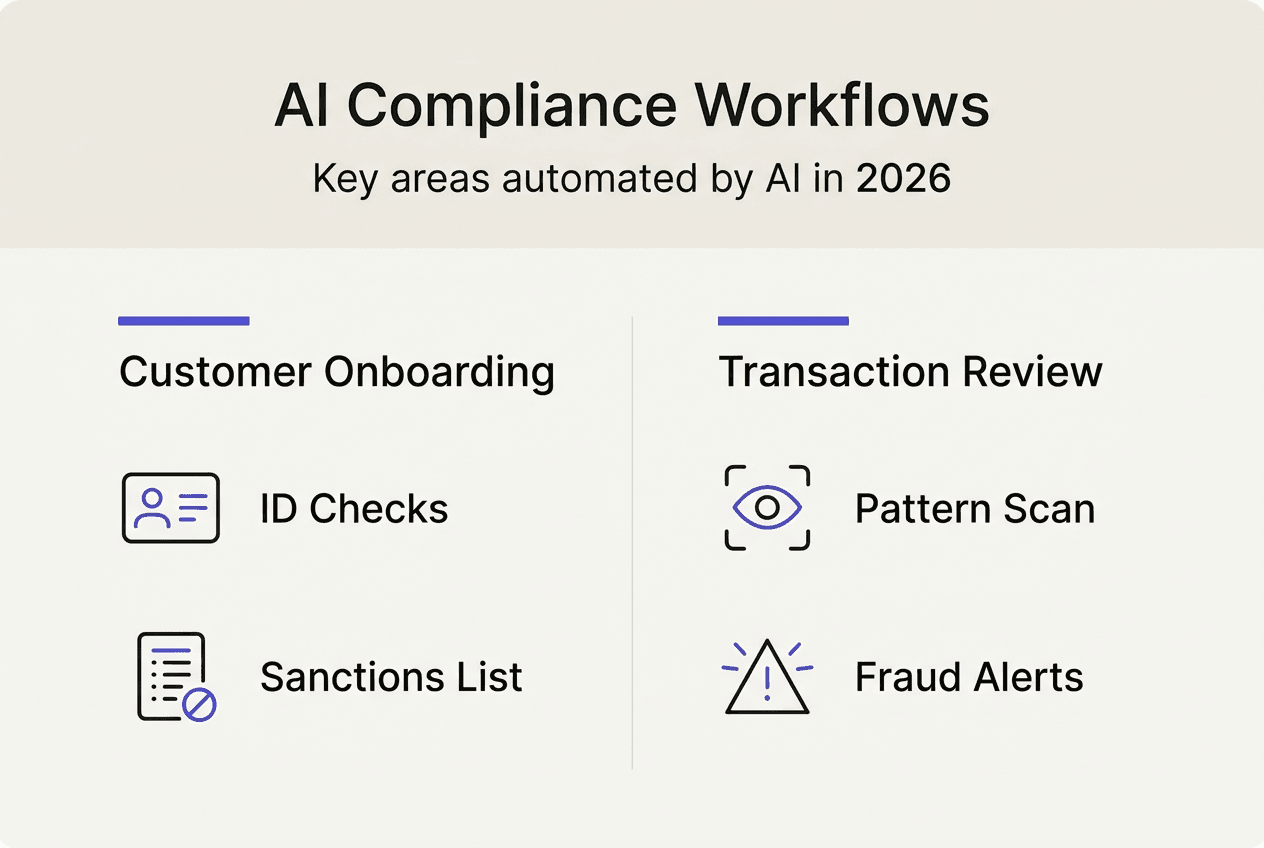
Transaction monitoring represents AI’s most impactful FCC application. Machine learning models analyze transaction patterns, customer behavior, and network relationships to identify suspicious activity. Unlike rule-based systems that trigger on fixed thresholds, AI adapts to evolving money laundering techniques. Models detect structuring, layering, and integration schemes that traditional systems miss.
| Compliance Task | Manual Process Time | AI-Enabled Time | Cost Reduction |
|---|---|---|---|
| Customer onboarding | 3-5 days | 2-4 hours | 75% |
| Transaction monitoring | 45 min per alert | 8 min per alert | 82% |
| SAR case investigation | 12 hours | 3 hours | 75% |
| Regulatory reporting | 6 hours | 45 minutes | 87% |
Suspicious activity reporting benefits from AI-powered case management. Systems aggregate evidence, generate narrative summaries, and populate regulatory forms automatically. Investigators review AI-compiled cases rather than gathering information manually, cutting case completion time from 12 hours to 3 hours. Quality improves because AI ensures all required evidence elements are present before submission.
Integrating AI into FCC workflows follows a structured approach:
- Map current compliance processes, identifying high-volume, repetitive tasks suitable for automation
- Select AI tools matching your institution’s risk profile, regulatory requirements, and technical infrastructure
- Train models on historical compliance data, validating performance against known outcomes before production deployment
- Implement parallel processing where AI and manual methods run simultaneously, comparing results to verify accuracy
- Transition to AI-primary workflows once validation confirms acceptable performance levels
- Establish ongoing monitoring protocols tracking model accuracy, bias metrics, and false positive rates
Agentic AI systems enhance explainability by documenting decision logic. These systems generate audit trails showing which data points influenced each compliance decision, satisfying regulatory requirements for transparency. When an AI system flags a transaction as suspicious, it produces a report explaining the specific patterns, risk factors, and regulatory criteria that triggered the alert.
Automation in compliance and financial oversight extends beyond transaction monitoring. AI automates regulatory change management by scanning global regulatory databases, identifying relevant updates, and mapping them to affected policies and procedures. Compliance teams receive prioritized action lists rather than sorting through thousands of regulatory announcements manually.
Cost reduction reaches 70-85% for automated tasks while maintaining or improving accuracy. A mid-sized bank processing 50,000 monthly transactions might reduce compliance staffing costs by $2 million annually through AI automation. These savings fund investments in advanced analytics and strategic compliance initiatives that manual processes couldn’t support.
Financial data management and automation in 2026 leverages these FCC capabilities to create integrated compliance ecosystems where data flows seamlessly between systems, reducing reconciliation work and improving audit readiness.
Explore AI-powered compliance tools with BankStatementFlow
Transforming compliance operations requires tools that combine AI sophistication with practical usability. BankStatementFlow delivers AI-powered bank statement conversion that automates financial document processing with 99% accuracy, directly supporting compliance workflows that depend on accurate, structured data. The platform extracts transaction details, account information, and metadata from bank statements, invoices, and receipts, converting unstructured documents into structured formats like Excel, CSV, JSON, and XML.
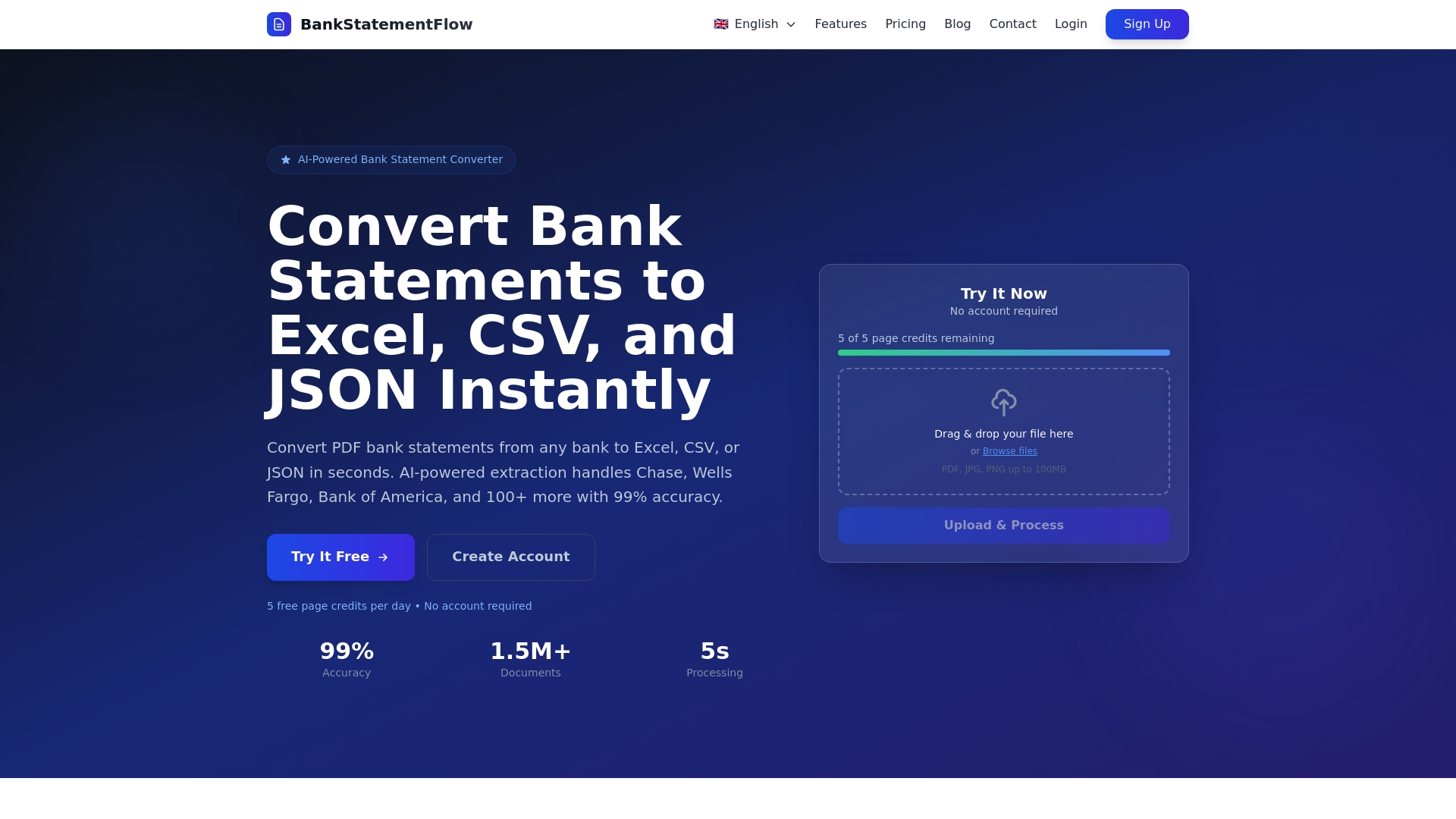
Compliance officers use BankStatementFlow to accelerate audit preparation, verify customer financial information during onboarding, and maintain complete documentation trails for regulatory examinations. The system handles password-protected PDFs and image uploads, eliminating manual data entry that introduces errors and delays. API access enables integration with existing compliance management systems, creating automated workflows that enhance regulatory compliance through AI document processing.
Pro Tip: Use BankStatementFlow’s structured data exports to feed AI-powered transaction monitoring systems. Clean, accurately extracted financial data improves model performance and reduces false positives, maximizing the value of your compliance technology investments.
Frequently asked questions
What are the main benefits of using AI in compliance?
AI automates repetitive tasks like regulatory monitoring, transaction surveillance, and evidence collection, reducing manual workload by 70-85% while improving accuracy and consistency. This allows compliance teams to focus on strategic analysis and complex investigations rather than data processing. Cost savings reach millions annually for mid-sized institutions.
How does AI reduce false positives in fraud detection?
Machine learning models learn normal customer behavior patterns and detect genuine anomalies rather than triggering on fixed thresholds. This contextual analysis reduces false positive rates by up to 70%, allowing investigators to focus on legitimate threats. Models continuously adapt as customer behaviors evolve, maintaining accuracy over time.
What are the main risks of using AI in compliance workflows?
Bias amplification, false positives, hallucinations, and intellectual property leakage represent primary risks. AI models may perpetuate historical discrimination, generate incorrect regulatory interpretations, or expose sensitive data. Regular audits, human oversight, and bias testing protocols mitigate these risks while preserving AI benefits.
How can compliance officers assess if an AI model is suitable for their needs?
Use frameworks like COMPL-AI to evaluate model robustness, safety, and fairness against your specific regulatory requirements. Test models on representative compliance scenarios before deployment, measuring accuracy, bias, and explainability. Establish minimum performance thresholds and conduct quarterly audits to ensure ongoing compliance alignment.
What is the COMPL-AI framework and why does it matter?
COMPL-AI provides standardized benchmarking for evaluating LLMs against financial regulations like the EU AI Act. It assesses robustness, safety, and fairness through structured tests, helping compliance officers identify model limitations before deployment. This framework enables evidence-based AI selection and demonstrates due diligence to regulators.
How do I integrate AI into existing compliance workflows without disrupting operations?
Start with parallel processing where AI and manual methods run simultaneously, validating AI performance against known outcomes. Gradually transition high-volume, repetitive tasks to AI-primary workflows once accuracy is confirmed. Maintain human oversight at critical decision points and establish monitoring protocols tracking model performance metrics continuously.
Recommended
- Enhance regulatory compliance with AI by 2026 - BankStatementFlow Blog
- The Future of FinTech: How AI is Reshaping Financial Services - BankStatementFlow Blog
- Document security in finance for SMEs in 2026 - BankStatementFlow Blog
- Financial data management checklist for automation 2026 - BankStatementFlow Blog