Role of automation in financial reporting: boost speed

Financial teams lose hundreds of hours each month to manual data entry, reconciliation errors, and report generation delays. Up to 70% time savings can be achieved in financial reporting tasks through automation. This guide explains how automation transforms financial reporting by enhancing accuracy, accelerating cycles, and freeing teams to focus on strategic analysis.
Table of Contents
- Understanding Financial Reporting Automation: Definitions And Scope
- How Automation Enhances Financial Reporting Mechanisms
- Challenges And Misconceptions In Financial Reporting Automation
- Comparing Manual Vs Automated Financial Reporting Processes
- Implementation Best Practices For Financial Reporting Automation
- Leveraging Automation For Strategic Financial Excellence
- Explore AI-Powered Tools To Streamline Your Financial Reporting
Key takeaways
| Point | Details |
|---|---|
| Automation transforms efficiency | Reduces manual tasks by 30-70%, allowing finance teams to focus on strategic analysis and decision-making. |
| Accuracy increases dramatically | AI-powered tools achieve up to 99% accuracy in data extraction and processing, minimizing costly errors. |
| Real-time insights emerge | Automated systems enable continuous reporting and proactive anomaly detection for faster responses. |
| Implementation requires strategy | Success depends on assessing workflows, training teams, and integrating with existing systems thoughtfully. |
| Compliance strengthens automatically | Consistent audit trails and standardized processes support regulatory requirements and audit readiness. |
Understanding financial reporting automation: definitions and scope
Financial reporting automation uses artificial intelligence, robotic process automation (RPA), and machine learning to streamline repetitive finance tasks. Automated financial reporting tools reduce manual processes like data entry, reconciliation, and report generation, allowing teams to focus on analysis. Instead of spending hours copying data between systems, finance professionals can redirect energy toward interpreting results and driving business decisions.
Automation applies to numerous financial workflows:
- Data extraction and entry: AI pulls transaction details from bank statements, invoices, and receipts without human intervention.
- Bank reconciliation: Systems match transactions across accounts automatically, flagging discrepancies for review.
- Report generation: Monthly financial statements, variance analyses, and compliance reports generate on demand.
- Audit trail creation: Every data change logs automatically with timestamps and user attribution.
- Forecasting and planning: Machine learning models predict cash flow patterns and identify trends.
Successful automation requires integration with enterprise resource planning (ERP) systems, accounting software, and financial planning and analysis (FP&A) platforms. When properly connected, these tools create seamless data flows that eliminate duplicate entry and reduce version control issues. Understanding the future of fintech AI helps finance leaders anticipate which capabilities will matter most as technology evolves.
The scope extends beyond simple task replacement. Modern automation platforms learn from historical patterns, adapt to new document formats, and continuously improve accuracy. This dynamic capability differentiates today’s solutions from rigid rule-based systems of the past. For finance teams, this means less time fixing automation failures and more confidence in output quality.
How automation enhances financial reporting mechanisms
Automation delivers measurable improvements across accuracy, speed, compliance, and insight generation. Human error rates in manual data entry typically range from 1-5%, but AI-powered extraction achieves near 99% accuracy when properly trained. This precision matters enormously when a single transposed digit can cascade into material misstatements.
Speed improvements transform monthly close cycles. Tasks that previously required three days of manual work now complete in hours. Real-time financial reporting enables proactive decision-making by integrating AI-powered forecasts and anomaly detection. Instead of discovering problems weeks after month-end, finance teams spot irregularities as they occur.
Compliance becomes systematic rather than reactive. Automation creates comprehensive audit trails automatically, documenting every data transformation and calculation. Regulatory reporting that once demanded dedicated resources now generates with minimal manual intervention. The consistency of automated processes reduces the risk of procedural variations that auditors flag.
Key enhancements include:
- Error reduction: Validation rules catch issues before they propagate through reports.
- Continuous monitoring: Systems track key metrics constantly, alerting teams to threshold breaches.
- Standardization: Reports follow uniform formats and calculation methods across periods.
- Scalability: Processing capacity grows without proportional headcount increases.
Pro Tip: Start by automating your most repetitive task with the highest error rate. Quick wins build organizational confidence in automation and demonstrate ROI clearly.
The shift from periodic to continuous reporting represents a fundamental change in how finance operates. Teams move from historians recording past events to analysts interpreting current trends and predicting future outcomes. This strategic elevation only becomes possible when automation handles routine processing reliably. Understanding the role of AI in accounting helps teams maximize these capabilities.
Challenges and misconceptions in financial reporting automation
Despite clear benefits, organizations face real obstacles when implementing automation. Data quality issues create the most common problems, as automation amplifies existing data flaws. Legacy systems with inconsistent formats or incomplete records require cleanup before automation delivers reliable results. Integration complexity increases when connecting multiple platforms that weren’t designed to communicate.
Skill gaps within finance teams slow adoption. Many professionals lack experience with automation tools and feel uncertain about configuring workflows or interpreting AI outputs. This discomfort sometimes manifests as resistance disguised as technical concerns. Change management becomes as critical as technology selection.
Common misconceptions create unnecessary hesitation:
- Job elimination fears: Automation complements rather than replaces finance professionals, shifting work toward higher-value analysis.
- Security risks: Modern platforms strengthen controls through consistent application of rules and comprehensive logging.
- Loss of control: Proper implementation increases visibility into processes through detailed audit trails.
- Excessive cost: Cloud-based solutions offer subscription pricing that scales with usage, eliminating large upfront investments.
Pro Tip: Address skill gaps early with targeted training programs. Teams confident in using automation tools adopt new capabilities faster and troubleshoot issues independently.
Integration challenges deserve particular attention. Finance systems often accumulate over decades, creating complex landscapes where data resides in incompatible formats across multiple platforms. Successful automation requires mapping these data flows carefully and establishing reliable connections. Rushing integration leads to data inconsistencies that undermine confidence in automated outputs.

Regulatory compliance concerns sometimes delay automation projects. Teams worry about audit trail adequacy or whether automated processes will satisfy examiners. In reality, automation typically strengthens compliance through financial automation by enforcing consistent procedures and creating detailed documentation automatically. Engaging auditors early in implementation addresses concerns proactively.
Comparing manual vs automated financial reporting processes
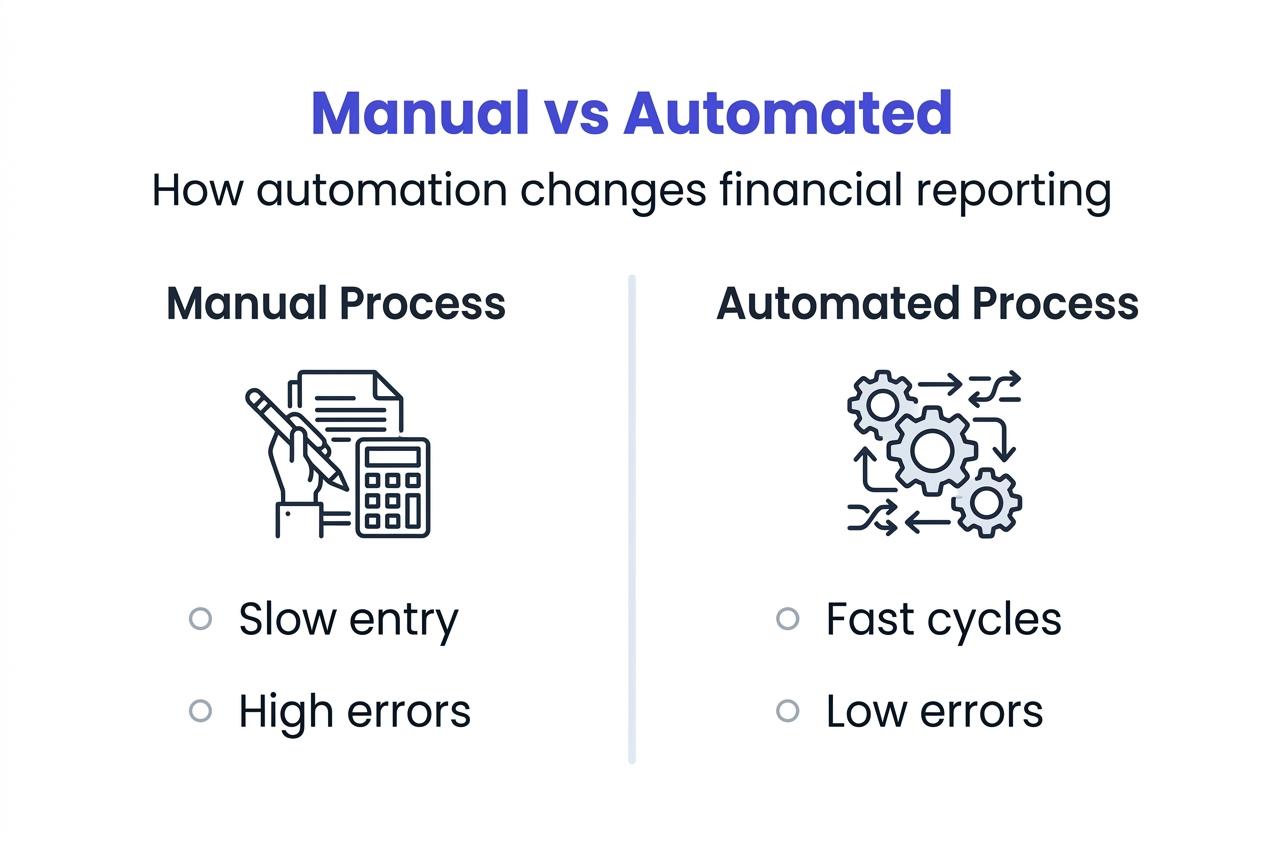
Direct comparison reveals the magnitude of improvement automation delivers. The table below contrasts traditional manual methods with modern automated approaches across key dimensions.
| Aspect | Manual Process | Automated Process |
|---|---|---|
| Data entry | Staff manually key information from documents, averaging 2-5% error rates | AI extracts data automatically with 99% accuracy, processing hundreds of documents per hour |
| Reconciliation | Analysts compare records line by line, taking days for complex accounts | Systems match transactions instantly, flagging exceptions for human review |
| Report generation | Teams compile data from multiple sources, format manually, verify calculations | Reports generate on demand with consistent formatting and automatic calculation |
| Cycle time | Monthly close typically requires 5-10 business days | Time savings of 30-70% reduce cycles to 2-4 days with continuous improvement |
| Scalability | Additional volume requires proportional headcount increases | Processing capacity expands without linear cost growth |
| Audit readiness | Manual compilation of support documentation before audits | Comprehensive audit trails maintained automatically with full traceability |
| Analytics capability | Limited by time available after completing routine tasks | Real-time dashboards and predictive models enable proactive insights |
The shift from manual to automated processes fundamentally changes how finance teams allocate time. Instead of spending 70% of effort on data processing and 30% on analysis, automation reverses this ratio. Teams invest more energy in interpreting results, identifying opportunities, and supporting strategic decisions.
Scalability advantages become apparent during growth periods or acquisitions. Manual processes struggle when transaction volumes double, requiring expensive headcount additions. Automated systems absorb increased volume with minimal incremental cost, maintaining consistent processing times and quality standards.
Error reduction impacts extend beyond immediate corrections. Manual errors often require extensive investigation to trace root causes and verify corrected values throughout interconnected reports. Automated validation catches issues at the point of entry, preventing downstream complications. This containment saves substantial remediation effort.
Understanding machine learning in fintech reveals how these systems continue improving over time. Unlike static manual procedures, machine learning models refine accuracy as they process more documents and receive feedback on edge cases.
Implementation best practices for financial reporting automation
Successful automation requires methodical planning and execution. Teams that rush implementation often encounter avoidable problems that damage confidence and delay benefits. Following structured best practices increases success probability significantly.
-
Assess current workflows thoroughly: Document existing processes in detail, identifying bottlenecks, error-prone steps, and time-consuming tasks. Quantify baseline performance metrics to measure improvement objectively.
-
Prioritize automation opportunities: Rank tasks by potential impact, implementation complexity, and strategic value. Start with high-volume, repetitive processes that follow consistent rules.
-
Develop aligned strategy: Ensure automation plans support broader business objectives and comply with regulatory requirements. Strategic planning and training minimize risks while maintaining compliance with financial regulations.
-
Select appropriate technology: Evaluate platforms based on integration capabilities, scalability, accuracy, and vendor support. Prioritize solutions that connect seamlessly with existing systems.
-
Pilot implementations carefully: Test automation on limited scope before full deployment. Use pilot results to refine configurations and address unexpected issues.
-
Train teams comprehensively: Provide hands-on training covering both technical operation and strategic thinking about automation’s role. Build internal expertise to reduce vendor dependence.
-
Monitor and optimize continuously: Track performance metrics, gather user feedback, and adjust workflows based on results. Automation should improve steadily over time.
Pro Tip: Create a cross-functional automation team including finance staff, IT specialists, and business stakeholders. Diverse perspectives prevent blind spots and ensure solutions meet real operational needs.
Change management deserves dedicated attention throughout implementation. Communicate clearly about how automation will affect individual roles and career paths. Emphasize opportunities for skill development and higher-value work. Address concerns transparently rather than minimizing legitimate questions about transitions.
Data governance becomes increasingly important as automation scales. Establish clear ownership for data quality, define validation standards, and implement monitoring to catch degradation early. Poor data quality undermines even the most sophisticated automation.
Integration planning must account for system interdependencies. Map how data flows between platforms, identify potential failure points, and design fallback procedures. Robust automation compliance and financial oversight requires understanding these connections thoroughly.
Maintaining compliance throughout implementation prevents costly retrofitting. Engage auditors and compliance officers during planning to address requirements proactively. Document how automated processes satisfy regulatory standards and preserve audit trail adequacy.
Leveraging automation for strategic financial excellence
Automation fundamentally transforms financial reporting from a backward-looking compliance function into a forward-looking strategic asset. By eliminating routine manual tasks, finance teams gain capacity to focus on interpreting results, identifying trends, and supporting critical business decisions. The combination of enhanced accuracy, accelerated cycles, and real-time insights creates competitive advantages that extend far beyond operational efficiency.
Organizations that embrace automation position themselves to respond faster to market changes, allocate resources more effectively, and maintain tighter financial controls. The shift from periodic reporting to continuous monitoring enables proactive management rather than reactive problem-solving. As business complexity increases and regulatory requirements evolve, automation becomes essential rather than optional for maintaining agility and competitiveness in financial management.
Explore AI-powered tools to streamline your financial reporting
Ready to experience the accuracy and speed improvements automation delivers? BankStatementFlow’s AI-powered platform automates bank statement processing with up to 99% accuracy, eliminating manual data entry and reconciliation delays.
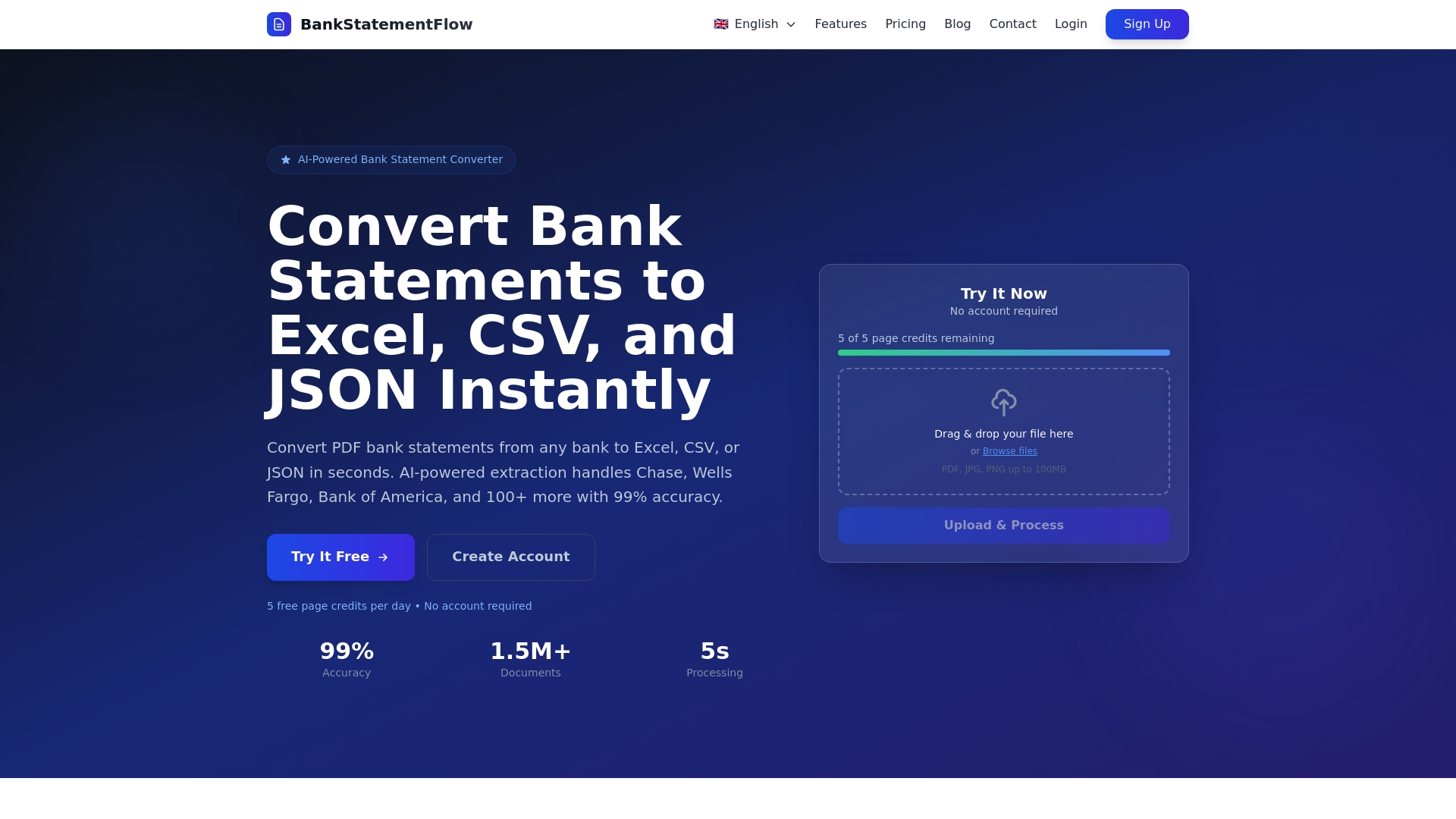
Our tools convert PDF bank statements to Excel and CSV formats instantly, integrating seamlessly with your existing financial workflows. Whether you need a comprehensive bank statement converter online or a specialized PDF bank statement to CSV converter, our platform handles password-protected files, multiple languages, and regional formats effortlessly. Start automating your financial document processing today and redirect your team’s energy toward strategic analysis instead of repetitive data tasks.
Frequently asked questions
What is financial reporting automation and how does it work?
Financial reporting automation uses AI, RPA, and machine learning to handle repetitive tasks like data entry, reconciliation, and report generation without manual intervention. These systems integrate data from multiple finance platforms, apply validation rules automatically, and generate consistent reports on demand, reducing cycle times by 30-70% while improving accuracy.
Does automation in financial reporting replace finance professionals?
Automation complements rather than replaces finance professionals by eliminating routine manual tasks. This shift frees teams to focus on strategic analysis, business partnering, and decision support activities that require human judgment. Finance roles evolve toward higher-value work as automation handles repetitive processing.
What are the biggest challenges when implementing financial reporting automation?
Data quality issues, legacy system integration complexity, and staff skill gaps represent the most common implementation challenges. Success requires strategic planning that addresses these obstacles through data cleanup, careful integration design, and comprehensive training programs. Strong data governance and change management significantly improve adoption outcomes.
How does automation improve compliance and audit readiness?
Automation creates comprehensive audit trails automatically, documenting every data transformation, calculation, and user action with timestamps. Consistent application of rules eliminates procedural variations that create compliance risks. The improved accuracy and traceability of automated processes strengthen regulatory reporting and reduce audit preparation time substantially.
Recommended
- Trends in Financial Automation 2026: What CFOs Need - BankStatementFlow Blog
- Role of Automation in Compliance: Transforming Global Financial Oversight - BankStatementFlow Blog
- Why Automate Bank Statement Processing: Real ROI - BankStatementFlow Blog
- 7 Key Bank Statement Automation Benefits for Analysts - BankStatementFlow Blog