Optimize secure financial data workflows with automation

Financial professionals managing sensitive data face a perfect storm: regulations tighten, data volumes explode, and manual processes buckle under pressure. Balancing compliance with GLBA, PCI DSS, and GDPR while maintaining workflow efficiency creates operational bottlenecks that cost time and money. Automation offers a way forward, but only when implemented with robust security and governance frameworks. This guide provides a practical roadmap to transform your financial data workflows through AI-powered automation, permanent PII redaction, and modern pipeline architectures that deliver both speed and compliance.
Table of Contents
- Understanding The Challenges Of Secure Financial Data Workflows
- Preparing Your Secure Financial Data Workflow: Tools And Frameworks
- Implementing Automated, Compliant Financial Data Workflows: Step By Step
- Troubleshooting Common Challenges And Verifying Workflow Effectiveness
- Discover AI-Powered Financial Document Processing Solutions
Key takeaways
| Point | Details |
|---|---|
| Secure ingestion with AI | AI-powered PII detection and permanent redaction ensure compliance from the start |
| ELT over ETL pipelines | Modern ELT architectures reduce processing time by 67.9% while cutting infrastructure costs |
| AI accuracy benchmarks | Frontier models achieve 96.5% field match rates, outperforming manual processing |
| Zero trust architecture | Multi-tenant cloud systems with granular access controls enhance data security |
| Balanced redaction strategy | Proper governance optimizes compliance without over-redacting critical audit data |
Understanding the challenges of secure financial data workflows
Financial workflows operate under intense regulatory scrutiny. Workflows include secure ingestion, AI-powered PII detection and permanent redaction, validation/reconciliation, and routing with granular access controls to ensure compliance with GLBA, PCI DSS, GDPR. Each regulation imposes specific requirements for data protection, audit trails, and breach notification that demand technical precision.
Manual processing introduces significant risk. Human reviewers miss PII in complex documents, create inconsistent redaction patterns, and struggle to maintain audit trails across thousands of transactions. Error rates compound when staff handle multiple document formats, languages, and regional variations simultaneously. The cost of compliance failures extends beyond fines to reputational damage and customer trust erosion.
Validation and reconciliation present their own challenges. Financial data must match across systems, accounts must balance, and discrepancies require investigation before routing to downstream processes. Manual reconciliation consumes hours of professional time while introducing keystroke errors and oversight gaps. When you factor in password-protected PDFs, poor scan quality, and handwritten annotations, the complexity multiplies.
“The challenge isn’t just processing documents faster. It’s maintaining accuracy and compliance at scale while reducing the manual burden on financial teams.”
Automation addresses these pain points but introduces new considerations. Over-redaction removes data needed for audits and analysis. Under-redaction exposes sensitive information and violates regulations. Finding the balance requires sophisticated AI models trained on financial documents, clear governance policies, and continuous monitoring. Legacy systems compound the problem by limiting integration options and forcing workarounds that create security vulnerabilities.
Your financial document processing checklist must address these challenges systematically. Start by mapping current workflows to identify bottlenecks, then prioritize automation opportunities based on volume, error rates, and compliance risk. The goal is building a secure foundation that scales with your organization’s growth.
Preparing your secure financial data workflow: tools and frameworks
Successful automation starts with mature data governance. Organizations with mature frameworks yield 28.7% faster reporting and €3.4M annual compliance savings, while legacy systems hinder 72% of banks. These frameworks define data ownership, establish quality standards, and create accountability for compliance outcomes. Without governance, automation amplifies existing problems rather than solving them.
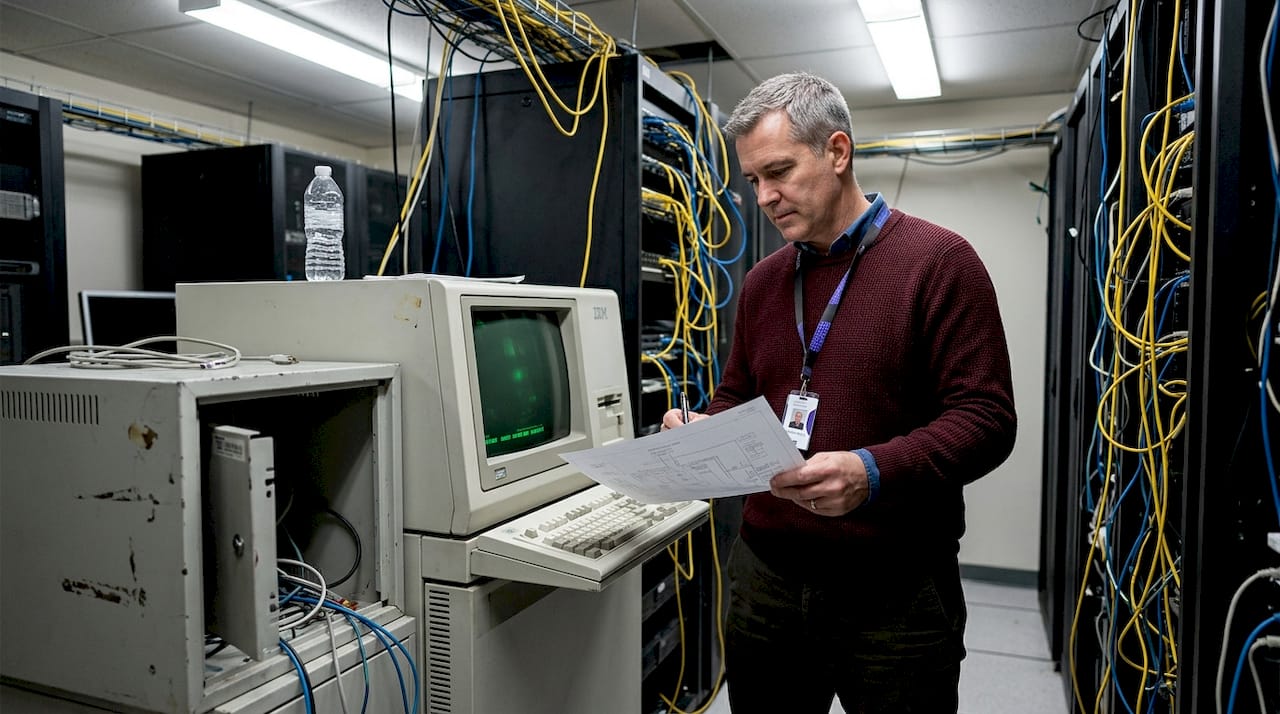
Legacy IT systems create significant barriers. Mainframe architectures, proprietary databases, and point-to-point integrations limit flexibility and increase maintenance costs. Modern cloud platforms offer elastic scaling, built-in security controls, and API-first architectures that support automation. Migrating from legacy systems requires careful planning but pays dividends in reduced operational overhead and faster innovation cycles.
Choosing between ETL and ELT architectures fundamentally shapes your workflow capabilities. Traditional ETL extracts data, transforms it in a staging area, then loads it into target systems. ELT loads raw data first, then transforms it in the destination environment. ELT enables faster processing, more flexible analytics, and better handling of unstructured financial documents. The transformation happens where compute resources are most abundant, reducing bottlenecks.
| Architecture | Best For | Processing Speed | Cost Efficiency |
|---|---|---|---|
| ETL | Structured data, legacy systems | Moderate | Higher infrastructure costs |
| ELT | Unstructured documents, real-time analytics | 67.9% faster | 52.6% cost savings |
| Hybrid | Mixed environments during migration | Variable | Depends on implementation |
Secure cloud architectures employ zero trust principles. Every access request requires verification, regardless of network location or previous authentication. Encryption protects data at rest and in transit. Multi-tenant systems use logical isolation to prevent cross-contamination between customer environments. These controls meet regulatory requirements while supporting scalability.
Define clear policies before implementing automation. Specify data retention periods based on regulatory requirements and business needs. Document redaction rules that balance privacy protection with audit trail preservation. Establish approval workflows for exceptions and edge cases. Create incident response procedures for potential breaches or compliance violations. These policies guide automation configuration and provide guardrails for AI decision making.
Pro Tip: Document your current state thoroughly before automation. Map every touchpoint where humans interact with financial data, measure processing times, and calculate error rates. This baseline lets you measure improvement and justify automation investments to stakeholders.
Your technology stack should support regulatory compliance with AI through native features rather than bolt-on solutions. Look for platforms offering API access, webhook notifications, and audit logging built into core functionality. Integration capabilities determine how easily you can connect document processing to accounting systems, data warehouses, and reporting tools.
Implementing automated, compliant financial data workflows: step by step
Building your automated workflow requires systematic execution across five critical phases. Each step builds on the previous one, creating a secure pipeline from document ingestion to final data delivery.
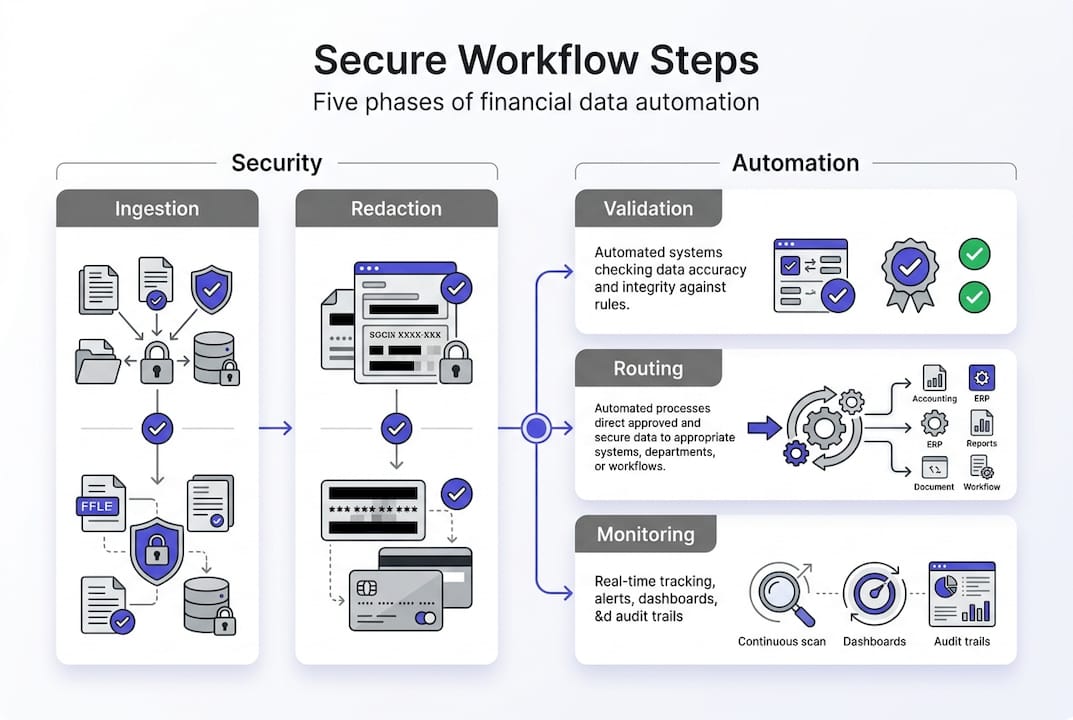
Step 1: Implement secure ingestion with AI-powered PII detection. Configure your system to accept documents through multiple channels like email, API uploads, and direct file transfers. Apply preprocessing to improve scan quality through denoising and deskewing algorithms. Deploy AI models trained specifically on financial documents to identify and permanently redact PII including social security numbers, account numbers, and personal addresses. Log every redaction action with timestamps and confidence scores for audit purposes.
Step 2: Adopt ELT pipelines for flexibility and performance. The shift from ETL to ELT pipelines in financial services shows ETL usage dropped from 87.3% in 2018 to 39.5% in 2023, enabling 67.9% reduction in processing time, handling 389% data volume increase, and 52.6% infrastructure cost savings. Load raw document data into your cloud data warehouse first, then apply transformations using SQL and distributed computing. This approach handles variable document formats better than rigid ETL schemas.
Step 3: Validate extracted data with AI-driven reconciliation. Frontier models achieve 96.5% field match rate in financial spreading compared to an 89% human baseline, with 90% accuracy in financial retrieval using structured data. Configure automated checks that compare extracted values against expected ranges, verify mathematical relationships like debits equaling credits, and flag anomalies for human review. Set confidence thresholds that balance automation rates with accuracy requirements.
Step 4: Route validated data with granular access controls. Implement role-based permissions that restrict data access based on job function and need to know principles. Use encryption for data in transit between systems. Apply field-level security that masks sensitive information from users who need aggregate data but not individual details. Create audit trails tracking who accessed what data and when.
Step 5: Monitor workflow performance and update governance policies. Establish dashboards showing processing volumes, error rates, and compliance metrics. Review flagged exceptions regularly to identify patterns requiring model retraining or policy adjustments. Schedule quarterly governance reviews to incorporate regulatory changes and business requirement updates. Use feedback loops to continuously improve AI accuracy.
| Pipeline Type | Processing Time | Data Volume Capacity | Infrastructure Cost | Real-Time Analytics |
|---|---|---|---|---|
| Traditional ETL | Baseline | Baseline | Baseline | Limited |
| Modern ELT | 67.9% faster | 389% increase | 52.6% lower | Native support |
Pro Tip: Start with a pilot program processing one document type before expanding to your entire workflow. Bank statements or invoices work well as initial candidates because they have consistent structures and high volumes. Use pilot results to refine configurations and build internal expertise before tackling more complex documents.
Integration with existing systems determines automation success. Connect your AI in accounting workflow to general ledgers, ERP platforms, and business intelligence tools through APIs. Design error handling that gracefully manages connection failures and data format mismatches. Build monitoring that alerts staff when integration issues require intervention.
The accuracy improvements from AI accuracy in finance transform operational efficiency. Reduced manual review time frees financial professionals for higher-value analysis. Lower error rates decrease reconciliation cycles and audit preparation time. Faster processing enables more frequent reporting and better decision making.
Troubleshooting common challenges and verifying workflow effectiveness
Even well-designed workflows encounter obstacles. Poor scan quality, handwritten notes, fine print/disclaimers, complex tables, and multi-format inconsistencies require preprocessing through denoising, deskew, domain heuristics, and confidence thresholds. Addressing these edge cases systematically prevents them from derailing your automation.
Scan quality issues manifest as blurred text, skewed pages, and low contrast between text and background. Implement preprocessing pipelines that apply adaptive thresholding, perspective correction, and contrast enhancement before OCR processing. These techniques dramatically improve character recognition accuracy. For documents with severe quality issues, configure fallback workflows that route to manual review rather than producing garbage data.
Handwritten notes and annotations require specialized handling. Train AI models on datasets including handwritten financial notations, or route documents with handwriting to hybrid workflows combining OCR with manual verification. Set confidence thresholds that automatically flag low-confidence extractions for human review. This balanced approach maintains high throughput while preventing errors.
Multi-format variance challenges automation when banks, credit card companies, and financial institutions use different layouts for similar documents. Build template libraries that map common formats to standardized extraction rules. Use machine learning models that generalize across format variations rather than relying on rigid template matching. Update templates regularly as institutions modify their document designs.
Verifying workflow effectiveness requires comparing performance against industry benchmarks. Finance process automation benchmarks show AP invoices achieve 60-80% touchless processing, bank reconciliation reaches 80-95% auto-match rates, AR cash application hits 70-90%, and account reconciliations achieve 60-80% auto-certification. Use these targets to gauge your automation maturity and identify improvement opportunities.
| Process | Touchless Rate | Auto-Match Rate | Typical Accuracy |
|---|---|---|---|
| AP Invoice Processing | 60-80% | Not applicable | 95%+ |
| Bank Reconciliation | Not applicable | 80-95% | 98%+ |
| AR Cash Application | 70-90% | Not applicable | 93%+ |
| Account Reconciliation | 60-80% | Not applicable | 96%+ |
Create a systematic review process for flagged exceptions. Assign experienced staff to investigate low-confidence extractions, validate AI decisions against source documents, and provide feedback for model improvement. Track exception categories to identify patterns requiring targeted solutions. Use exception data to prioritize preprocessing enhancements and model retraining efforts.
Continuous model retraining maintains accuracy as document formats evolve and business requirements change. Schedule monthly reviews of model performance metrics including precision, recall, and F1 scores. Collect new training examples from production data, focusing on edge cases and previously unseen formats. Retrain models using expanded datasets and validate improvements before production deployment.
Pro Tip: Build a feedback loop where staff reviewing exceptions can flag incorrect AI decisions with one click. Aggregate this feedback into retraining datasets automatically. This crowdsourced approach to model improvement scales better than relying on data science teams to manually curate training examples.
Understanding OCR technology explanation helps troubleshoot extraction issues. Modern OCR combines computer vision, natural language processing, and domain-specific models to extract structured data from unstructured documents. When OCR fails, the root cause typically involves image quality, unusual fonts, or layout complexity rather than fundamental technology limitations.
Monitoring AI document accuracy over time reveals performance trends. Track accuracy by document type, source, and processing date. Investigate sudden accuracy drops that might indicate format changes or data quality issues. Celebrate accuracy improvements to build team confidence in automation.
Discover AI-powered financial document processing solutions
Transforming your financial workflows requires tools purpose-built for the challenges you face. BankStatementFlow delivers AI-powered automation that converts complex financial documents into structured data with up to 99% accuracy. Our platform handles password-protected PDFs, poor-quality scans, and multi-language documents without manual intervention.
Start with our PDF bank statement conversion tool to automate your highest-volume workflow. Extract transaction details, account balances, and metadata into Excel or CSV formats ready for immediate analysis. The credit card statement to Excel converter streamlines expense tracking and reconciliation with automated categorization. For inventory management, our PDF inventory to Excel converter transforms stock reports into actionable data.
Every tool includes API access for seamless integration with your existing systems. Enterprise security features protect sensitive data through encryption, access controls, and audit logging. Flexible export options support downstream processes across accounting, analytics, and reporting platforms. Reduce manual effort, eliminate errors, and accelerate your financial close cycles.
FAQ
What are the key benefits of transitioning from ETL to ELT pipelines in finance?
ELT pipelines in financial services enable 67.9% reduction in processing time, 52.6% infrastructure cost savings, and better handling of increased data volumes. They support real-time analytics by transforming data in the destination environment where compute resources scale elastically. ELT architectures handle unstructured financial documents more effectively than rigid ETL schemas, reducing the need for complex transformation logic before loading.
How does AI improve accuracy in financial document processing?
Frontier AI models achieve 96.5% field match rate and 90%+ accuracy in financial data extraction tasks, outperforming human baselines of 89%. Machine learning algorithms trained on millions of financial documents recognize patterns humans miss and maintain consistency across high-volume processing. AI reduces manual review requirements while accelerating workflows, letting financial professionals focus on analysis rather than data entry.
What strategies ensure compliance when automating financial data workflows?
Implement zero trust architectures, AI-driven PII redaction with audit trails, and granular routing controls to meet GLBA, PCI DSS, GDPR requirements. Apply encryption for data in transit and at rest, use role-based access controls limiting data exposure, and maintain comprehensive audit logs tracking every access and modification. Regular governance reviews ensure policies adapt to evolving regulations and business requirements.
What touchless processing rates should financial teams target?
Industry benchmarks show AP invoices reach 60-80% touchless rates, bank reconciliation achieves 80-95% auto-match, and AR cash application hits 70-90%. These targets represent mature automation implementations with well-tuned AI models and effective exception handling. Start by measuring your current baseline, then incrementally improve through preprocessing enhancements, model retraining, and workflow optimization.
How do you handle edge cases like handwritten notes in financial documents?
Configure hybrid workflows that combine AI extraction with manual review for documents containing handwriting. Set confidence thresholds that automatically flag low-confidence extractions for human verification. Apply preprocessing techniques including contrast enhancement and noise reduction to improve recognition accuracy. Build feedback loops where manual reviewers train AI models on previously unseen handwriting styles, gradually expanding automated handling capabilities.
Recommended
- Financial data management checklist for automation 2026 - BankStatementFlow Blog
- Financial document processing checklist for automation 2026 - BankStatementFlow Blog
- What is financial document automation? A 2026 guide - BankStatementFlow Blog
- Blog - BankStatementFlow | AI Document Processing Insights