Role of Automation in Compliance: Transforming Global Financial Oversight

Managing financial document compliance across multiple countries rarely feels straightforward for multinational compliance officers. The growing web of differing regulations, constant changes, and tight deadlines can overwhelm even the most experienced teams. Artificial Intelligence technologies now offer practical solutions by automating repetitive tasks, improving data accuracy, and supporting real-time regulatory controls. This guide helps you understand how automation redefines compliance processes for more efficient, secure, and adaptable financial oversight in global operations.
Table of Contents
- Defining Automation In Compliance Processes
- Key Technologies Driving Compliance Automation
- Global Regulatory Requirements And Challenges
- Real-World Applications In Financial Document Management
- Mitigating Risks And Ensuring Data Accuracy
- Comparing Manual Versus Automated Compliance
Key Takeaways
| Point | Details |
|---|---|
| Importance of Automation | Compliance automation enhances the efficiency and accuracy of regulatory processes by reducing manual intervention and minimizing human errors. |
| Technological Integration | Key technologies like Machine Learning and Natural Language Processing are essential to develop adaptive compliance frameworks. |
| Complex Regulatory Landscape | Organizations face multifaceted regulatory challenges that require continuous learning and technological adaptability. |
| Proactive Compliance Strategies | Successful compliance hinges on shifting from reactive monitoring to proactive risk management strategies. |
Defining Automation in Compliance Processes
Compliance automation represents a transformative approach to managing regulatory requirements through advanced technological solutions. At its core, this strategy involves using artificial intelligence and machine learning technologies to streamline complex administrative processes that traditionally required extensive manual intervention.
Governments and financial institutions are increasingly adopting AI technologies for administrative support, recognizing their potential to address several critical challenges:
- Reducing manual data processing times
- Minimizing human error in regulatory documentation
- Enabling more accurate predictive analysis
- Handling large, complex datasets efficiently
- Providing scalable compliance monitoring solutions
Modern compliance automation goes beyond simple task replacement. It involves sophisticated intelligent process automation that can interpret complex regulatory requirements, validate documentation, and make nuanced decisions with remarkable precision. These systems leverage natural language processing and machine learning algorithms to understand contextual information, compare documents against regulatory standards, and flag potential compliance risks in real-time.
Automation transforms compliance from a reactive administrative function into a proactive, strategic organizational capability.
The technological infrastructure supporting compliance automation typically includes several interconnected components:
- Data extraction tools
- Machine learning algorithms
- Regulatory rule mapping systems
- Decision support engines
- Reporting and audit trail mechanisms
Artificial Intelligence plays a pivotal role in this ecosystem, enabling systems to learn from historical data, adapt to changing regulatory landscapes, and continuously improve their accuracy and efficiency. AI adoption in government functions demonstrates how these technologies can dramatically enhance administrative processes across multiple domains.
Pro tip: Start by mapping your current compliance workflows and identifying repetitive, rules-based tasks that are prime candidates for automation.
Key Technologies Driving Compliance Automation
Compliance automation is powered by a sophisticated array of cutting-edge technologies that transform traditional regulatory oversight into intelligent, adaptive systems. These technologies work in concert to create more robust, efficient, and responsive compliance frameworks across financial and governmental sectors.
The core technologies driving this transformation include advanced machine learning techniques, which enable organizations to develop increasingly sophisticated approaches to regulatory management. Key technological components include:
- Machine Learning Algorithms: Capable of detecting complex patterns and anomalies
- Robotic Process Automation (RPA): Streamlining repetitive compliance tasks
- Large Language Models (LLMs): Interpreting complex regulatory documentation
- Anomaly Detection Systems: Identifying potential compliance risks in real-time
- Natural Language Processing: Understanding and parsing regulatory text
Artificial Intelligence has become particularly transformative in compliance automation, enabling systems to move beyond static rule-based approaches. These intelligent systems can now learn from historical data, adapt to changing regulatory landscapes, and make nuanced decisions that previously required extensive human intervention.
Compliance technologies are evolving from reactive monitoring to proactive risk management strategies.
The technological infrastructure supporting compliance automation includes several sophisticated mechanisms:
- Intelligent data extraction tools
- Advanced algorithmic risk assessment engines
- Real-time monitoring and alerting systems
- Comprehensive audit trail generation
- Adaptive learning and predictive modeling capabilities
Moreover, AI governance frameworks have emerged as critical components, ensuring that these powerful technologies are implemented ethically and transparently. These frameworks help organizations manage potential risks related to bias, operational failures, and regulatory compliance while maintaining the highest standards of technological integrity.
Pro tip: Prioritize technologies that offer transparent decision-making processes and robust explainability features to build trust in your compliance automation strategy.
Global Regulatory Requirements and Challenges
The landscape of global financial regulation has become increasingly complex, characterized by rapidly evolving regulatory landscapes that demand unprecedented levels of adaptability from financial institutions. Navigating this intricate environment requires a nuanced understanding of the multifaceted challenges facing compliance professionals worldwide.
Key regulatory challenges facing global organizations include:
- Increasing regulatory fragmentation across different jurisdictions
- Complex and frequently changing compliance requirements
- Divergent international data protection standards
- Heightened cybersecurity and operational resilience expectations
- Complex anti-money laundering and financial crime prevention rules
Regulatory Complexity stems from multiple interconnected factors, including geopolitical tensions, economic volatility, and technological disruption. Financial institutions must develop sophisticated governance frameworks that can rapidly adapt to changing supervisory priorities and emerging regulatory expectations.
Successful global compliance strategies require continuous learning and technological agility.
The primary dimensions of global regulatory challenges can be categorized into several critical areas:
- Prudential regulatory variations
- Cross-border compliance coordination
- Technology-driven regulatory expectations
- Operational risk management
- Data protection and privacy compliance
Moreover, financial institutions face increasingly complex regulatory environments that demand unprecedented levels of technological integration and strategic foresight. The intersection of political, economic, and technological shifts creates a dynamic regulatory landscape that requires continuous monitoring and proactive adaptation.

Pro tip: Develop a centralized compliance intelligence system that can track and synthesize regulatory changes across multiple jurisdictions in real-time.
Real-World Applications in Financial Document Management
Financial document management has been revolutionized by intelligent automation technologies that transform traditionally labor-intensive processes. Intelligent document processing systems are now capable of handling complex workflows with unprecedented accuracy and efficiency across various financial sectors.
Key applications of document automation include:
- Automated loan application processing
- Tax form extraction and validation
- Contract review and data verification
- Compliance documentation management
- Fraud detection and risk assessment
Financial Workflows have dramatically changed with the integration of advanced technologies. Organizations can now process massive volumes of documents with remarkable speed, reducing manual intervention and minimizing human error. These systems combine artificial intelligence with strategic human oversight to ensure maximum accuracy and compliance.
Automation transforms document management from a cost center to a strategic business capability.
The practical implementation of document automation spans multiple critical areas:
- Rapid data extraction from complex financial documents
- Intelligent classification of document types
- Automated compliance verification
- Real-time risk assessment
- Seamless multi-system document integration
Moreover, large language models are enhancing financial document workflows, enabling more sophisticated multi-step reasoning and analysis. These advanced systems can now interpret complex financial documentation with a level of nuance previously achievable only through extensive human expertise.
The following table summarizes how advanced technologies impact financial document management:
| Technology Type | Key Benefit | Example Application |
|---|---|---|
| Machine Learning Algorithms | Detects fraud and risk patterns | Automated loan review |
| Robotic Process Automation | Reduces manual data entry workloads | Tax form validation |
| Natural Language Processing | Analyzes complex legal documentation | Contract compliance checks |
| Large Language Models | Interprets and classifies documents | Multi-step document approval |
Pro tip: Implement a phased automation strategy that begins with low-complexity documents and progressively expands to more intricate financial workflows.
Mitigating Risks and Ensuring Data Accuracy
Data accuracy and risk mitigation have become paramount in the era of complex financial regulations and rapidly evolving technological landscapes. Machine learning-based automation processes are transforming how organizations approach compliance, offering unprecedented capabilities for early risk detection and error reduction.
Key strategies for mitigating risks in financial document management include:
- Implementing robust data governance frameworks
- Utilizing advanced anomaly detection algorithms
- Establishing multi-layered verification processes
- Conducting continuous compliance monitoring
- Creating comprehensive audit trails
Risk Management requires a holistic approach that combines technological sophistication with strategic oversight. Automated systems now provide intelligent screening mechanisms that can identify potential compliance issues faster and more accurately than traditional manual reviews.
Effective risk mitigation is not about eliminating risk entirely, but about creating adaptive, intelligent systems that can anticipate and respond to emerging challenges.
The comprehensive risk mitigation approach typically involves multiple interconnected components:
- Advanced data validation algorithms
- Real-time compliance monitoring systems
- Intelligent anomaly detection mechanisms
- Automated cross-referencing protocols
- Comprehensive documentation and reporting frameworks
Moreover, robust data governance frameworks are critical in maintaining data integrity and supporting regulatory compliance. These frameworks ensure that organizations can maintain high standards of data accuracy, security, and availability across complex financial ecosystems.
Pro tip: Develop a comprehensive risk assessment matrix that integrates automated monitoring with human expertise to create a multi-layered compliance strategy.
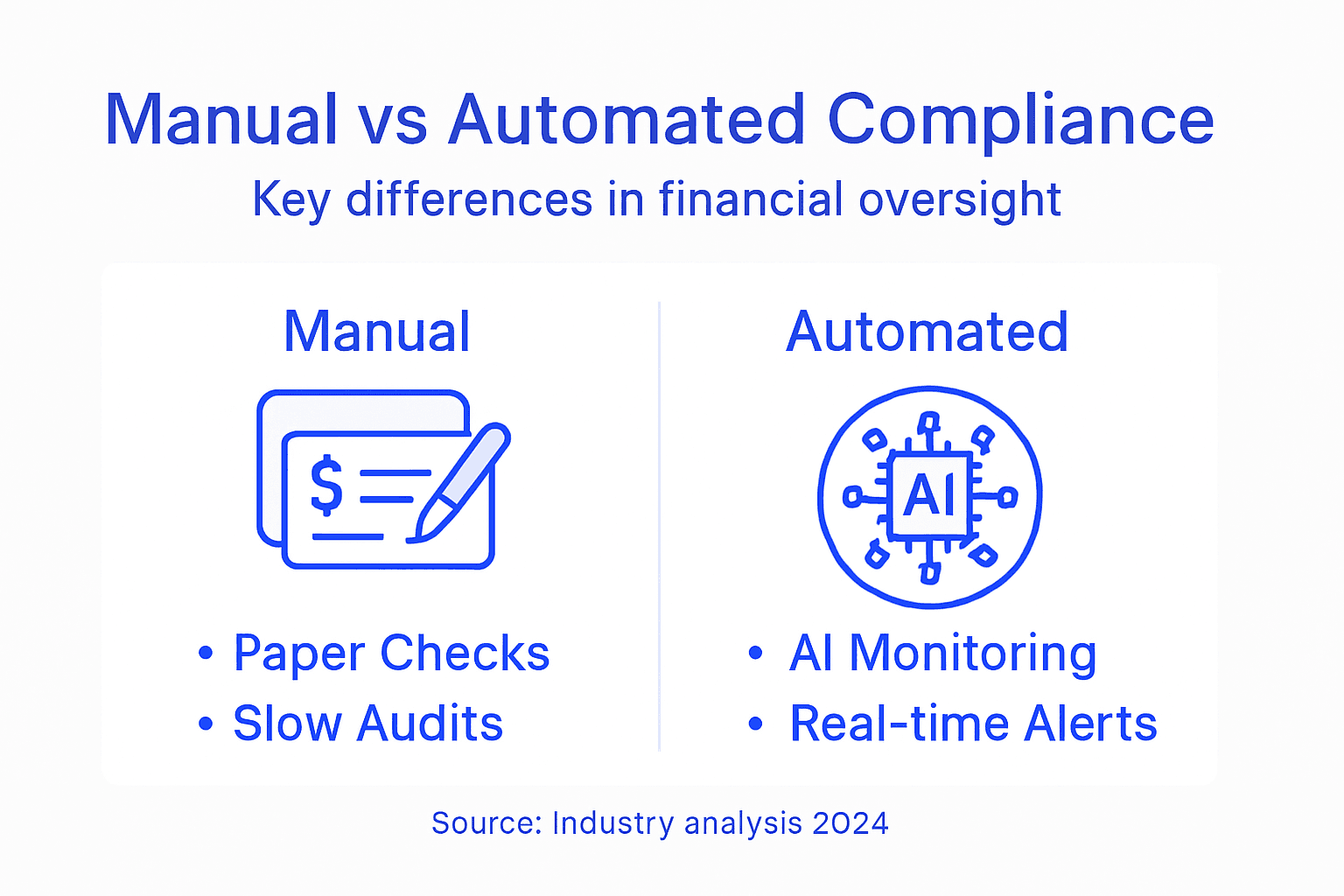
Comparing Manual Versus Automated Compliance
The landscape of financial compliance is undergoing a fundamental transformation, driven by the limitations of traditional manual processes and the emergence of advanced automation technologies. Manual compliance approaches are rapidly becoming obsolete in an increasingly complex regulatory environment that demands speed, precision, and adaptability.
Key differences between manual and automated compliance include:
- Error rates and accuracy levels
- Processing speed and efficiency
- Resource allocation and cost
- Scalability of compliance efforts
- Real-time monitoring capabilities
Compliance Methodologies represent a critical battleground where technological innovation is reshaping organizational strategies. Manual processes are characterized by labor-intensive documentation, periodic audits, and static rule enforcement, which inherently create significant risks and inefficiencies.
Automation transforms compliance from a reactive cost center into a strategic, intelligent organizational capability.
The comparative analysis of manual versus automated approaches reveals several critical dimensions:
Here is a comparison of manual and automated compliance approaches:
| Aspect | Manual Compliance | Automated Compliance |
|---|---|---|
| Error Rate | Higher due to human mistakes | Lower with AI-driven checks |
| Processing Speed | Slow and labor-intensive | Fast and scalable |
| Adaptability | Difficult with new regulations | Easily adapts with updates |
| Audit Trail Quality | Fragmented and paper-based | Comprehensive digital records |
- Time required for compliance tasks
- Potential for human error
- Complexity of regulatory interpretation
- Adaptability to changing regulations
- Comprehensive documentation and audit trails
Moreover, AI-powered compliance methods dramatically improve operational efficiency by reducing human intervention, minimizing errors, and creating more robust, dynamic compliance frameworks that can quickly adapt to evolving regulatory landscapes.
Pro tip: Start your automation journey by identifying repetitive, rule-based compliance tasks that are most prone to human error and have clear, standardized processes.
Accelerate Your Compliance Transformation with AI-Powered Financial Document Automation
The article highlights the increasing complexity of global compliance and the urgent need for intelligent automation to reduce manual errors and scale operations efficiently. If your organization struggles with extracting and structuring data from diverse financial documents like bank statements and invoices while keeping pace with evolving regulatory demands, BankStatementFlow offers a proven solution. Our advanced machine learning algorithms deliver up to 99 percent accuracy and rapid processing that can turn unstructured documents into actionable data formats such as Excel, CSV, JSON, or XML.

Discover how you can enhance risk mitigation and ensure data accuracy by leveraging automation designed for financial teams and accounting firms worldwide. Visit BankStatementFlow to start optimizing your compliance workflows today and see why intelligent document processing is essential for transforming global financial oversight. Learn more about our features and integration options at BankStatementFlow. Don’t let manual compliance bottlenecks hold you back from achieving strategic agility.
Frequently Asked Questions
What is compliance automation in financial processes?
Compliance automation refers to the use of advanced technologies like artificial intelligence and machine learning to streamline regulatory requirements and reduce the need for manual intervention in administrative tasks.
How do advanced technologies enhance compliance automation?
Technologies such as machine learning algorithms, robotic process automation, and natural language processing enhance compliance automation by improving accuracy, speeding up processing times, and enabling real-time monitoring for potential compliance risks.
What are the key advantages of automating compliance processes?
The key advantages of automating compliance processes include reduced error rates, increased processing efficiency, scalability of compliance efforts, and the ability to adapt quickly to changing regulations, thus transforming compliance into a proactive organizational capability.
What challenges do organizations face when implementing compliance automation?
Organizations face challenges such as regulatory fragmentation, rapidly evolving compliance requirements, and the need for continuous monitoring and adaptation to new regulations. Effective governance frameworks are essential to manage these complexities.
Recommended
- Staying Compliant: Financial Automation and Regulatory Requirements - BankStatementFlow Blog
- Trends in Financial Automation 2026: What CFOs Need - BankStatementFlow Blog
- 7 Key Bank Statement Automation Benefits for Analysts - BankStatementFlow Blog
- How to Automate Financial Documents for Fast, Accurate Data - BankStatementFlow Blog