Machine Learning in Fintech: Transforming Document Processing

Manual review of complex financial reports slows down even the most skilled teams, leaving Canadian, American, and British analysts searching for smarter solutions. Machine learning offers a way to turn massive amounts of financial data into valuable insights, helping firms automate tedious document tasks with speed and accuracy. By applying powerful techniques like neural networks and ensemble models, financial professionals can achieve new levels of precision in processing records and managing risks in today’s global marketplace. For those ready to lead, adopting these data-driven methods opens doors to efficient, actionable results.
Table of Contents
- Defining Machine Learning in Fintech Today
- Core Machine Learning Models and Techniques
- Automating Financial Document Processing Tasks
- Key Use Cases in Accounting and Finance
- Risks, Compliance, and Implementation Challenges
Key Takeaways
| Point | Details |
|---|---|
| Machine Learning as a Transformative Technology | Machine learning enables improved data analysis and decision-making in fintech, driving operational efficiency and predictive modeling. |
| Core Applications in Finance | Key use cases include credit risk assessment, fraud detection, and personalized customer services, which enhance financial decision-making. |
| Automation of Document Processing | Machine learning significantly reduces processing times and increases accuracy in financial document tasks compared to traditional methods. |
| Addressing Implementation Challenges | Successful deployment requires a focus on data quality, regulatory compliance, and ethical AI development to mitigate risks. |
Defining Machine Learning in Fintech Today
Machine learning represents a transformative technology that is rapidly reshaping financial services, enabling sophisticated data analysis and intelligent decision-making processes. Advanced algorithms in fintech allow systems to learn from historical financial data without explicit programming, creating powerful predictive models that enhance operational efficiency.
At its core, machine learning in fintech focuses on developing intelligent systems capable of extracting meaningful insights from complex financial datasets. These systems leverage multiple advanced techniques to solve critical challenges in banking and financial services:
- Credit risk assessment and prediction
- Fraud detection and prevention
- Customer segmentation and personalization
- Investment portfolio optimization
- Automated financial recommendations
The technology operates through sophisticated probabilistic models that analyze vast quantities of historical financial information, identifying patterns and trends human analysts might overlook. Deep learning techniques and advanced classification algorithms now enable financial institutions to create more accurate risk management frameworks and personalized service offerings.
Machine learning transforms raw financial data into strategic intelligence, turning information into actionable insights that drive competitive advantage.
Beyond traditional applications, machine learning is expanding into more nuanced domains of financial services. Innovative data-driven models now support complex processes like customer behavior prediction, real-time transaction monitoring, and intelligent investment strategies.
Pro tip: When exploring machine learning solutions, prioritize platforms offering transparent model interpretability and robust data privacy protections.
Core Machine Learning Models and Techniques
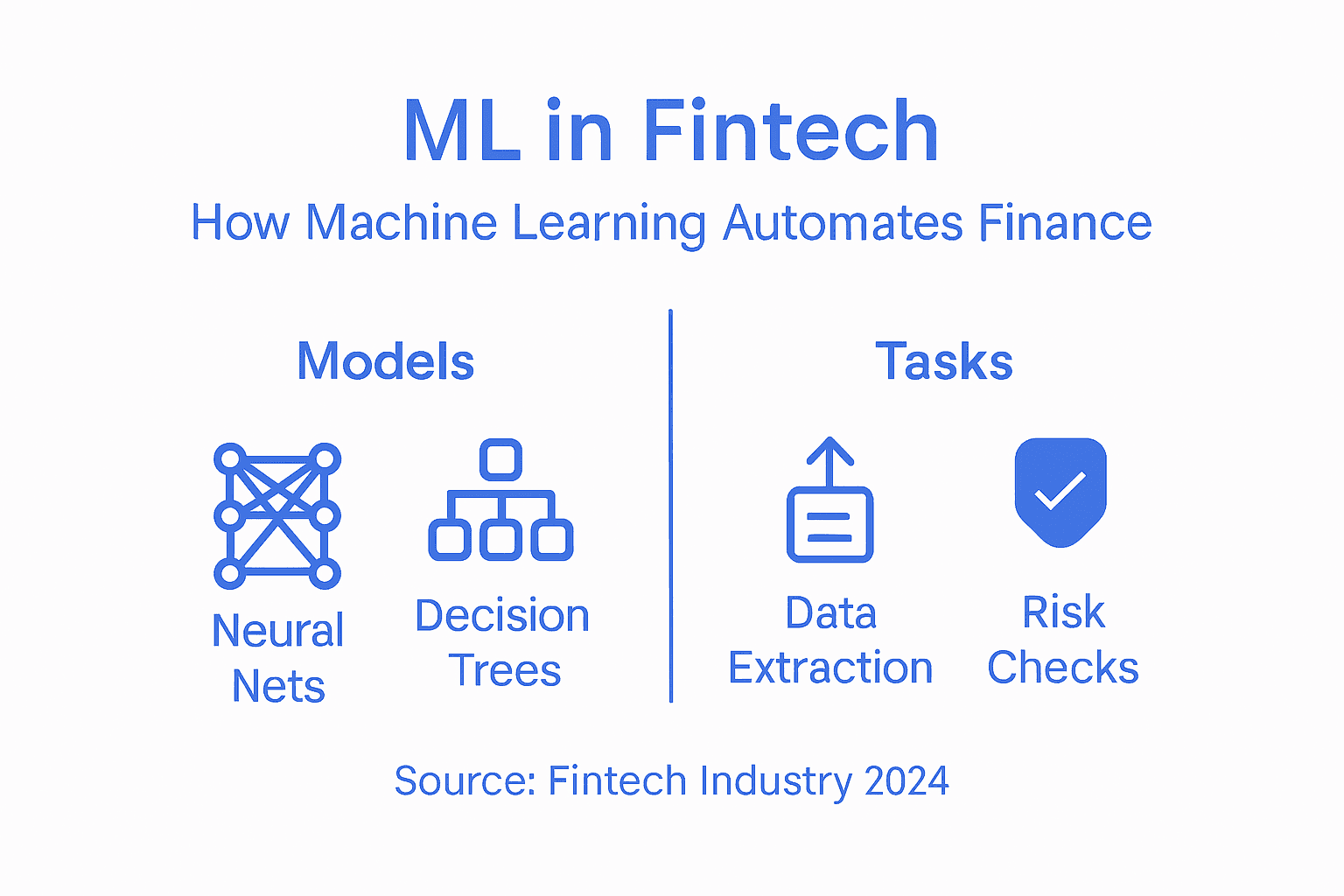
Fintech organizations leverage a sophisticated array of machine learning models to transform complex financial data into actionable insights. Experimental design techniques enable financial analysts to develop robust predictive frameworks that significantly enhance decision-making capabilities across various domains.
The core machine learning techniques utilized in financial technology can be categorized into several critical approaches:
- Supervised Learning Models
- Penalized linear regression
- Decision trees
- Neural network architectures
- Ensemble Learning Methods
- Random Forest Regression
- Gradient boosting techniques
- Stacking and blending algorithms
- Dimension Reduction Techniques
- Principal Component Analysis (PCA)
- Factor analysis
- Singular value decomposition
Each model brings unique strengths to financial analysis. Advanced regression techniques like Random Forest Regression are particularly powerful in addressing complex challenges such as loan default prediction and fraud detection. These models excel at handling non-linear relationships and managing high-dimensional financial datasets.
Machine learning models are not just analytical tools - they are strategic assets that transform raw financial data into predictive intelligence.
Neural networks represent another cutting-edge approach, offering unprecedented capabilities in pattern recognition and complex financial forecasting. By mimicking human brain neural structures, these models can uncover intricate patterns in market behavior, investment trends, and risk assessment that traditional statistical methods might miss.
Here’s a comparison of key machine learning models used in fintech and their typical applications:
| Model Type | Typical Application | Key Strength |
|---|---|---|
| Penalized Linear Regression | Credit risk scoring | Handles multicollinearity |
| Random Forest Regression | Fraud detection, loan default | Manages non-linear data |
| Neural Networks | Investment forecasting | Detects complex patterns |
| Principal Component Analysis (PCA) | Market trend analysis | Reduces data dimensionality |
Pro tip: Always validate machine learning models using cross-validation techniques and maintain a robust testing framework to ensure consistent performance and reliability.
Automating Financial Document Processing Tasks
Financial document processing represents a critical area where machine learning delivers transformative capabilities. Requirement engineering for ML systems enables organizations to develop sophisticated automated workflows that dramatically reduce manual data entry and processing time.
The automation of financial document tasks encompasses several key operational domains:
- Invoice Processing
- Automatic data extraction
- Validation against internal records
- Seamless accounting integration
- Compliance Document Analysis
- Regulatory requirement scanning
- Risk assessment automation
- Verification of legal documentation
- Transaction Record Management
- Rapid data categorization
- Anomaly detection
- Comprehensive financial reporting
Advanced machine learning techniques dramatically improve document processing efficiency by enabling rapid analysis of complex financial records. These models can extract critical information from invoices, loan applications, and transaction documents with unprecedented accuracy, reducing processing times from hours to minutes.
Machine learning transforms document processing from a time-consuming manual task into a streamlined, intelligent workflow.
The integration of machine learning in document automation goes beyond simple data extraction. Neural networks and sophisticated algorithms can now interpret contextual nuances, understand complex financial terminology, and make intelligent decisions about document classification and data relevance.

Below is a summary of how machine learning improves financial document processing compared to traditional methods:
| Aspect | Traditional Processing | ML-Driven Automation |
|---|---|---|
| Speed | Hours to days | Minutes per document |
| Accuracy | Prone to manual errors | High precision data capture |
| Scalability | Labor intensive | Easily handles large volumes |
| Context Understanding | Limited to templates | Adapts to complex language |
Pro tip: Implement a phased approach to machine learning document automation, starting with pilot projects in low-risk document categories to build organizational confidence and technical expertise.
Key Use Cases in Accounting and Finance
Machine learning is revolutionizing accounting and finance through powerful, intelligent applications that transform traditional operational approaches. Credit scoring algorithms now leverage sophisticated data analysis techniques that go far beyond traditional risk assessment methods, enabling more inclusive and accurate financial decision-making.
The key use cases for machine learning in accounting and finance span multiple critical domains:
- Risk Management
- Advanced credit risk modeling
- Fraud detection systems
- Predictive financial risk analysis
- Operational Efficiency
- Automated invoice processing
- Expense management optimization
- Real-time financial reporting
- Financial Inclusion
- Alternative credit scoring
- Personalized financial services
- Reducing systemic financial bias
Financial anomaly detection represents another transformative application, with machine learning models achieving unprecedented accuracy in identifying suspicious transactions and potential financial irregularities. These intelligent systems can analyze complex patterns across millions of transactions, flagging potential issues with remarkable precision.
Machine learning transforms financial analysis from retrospective reporting to predictive intelligence, enabling proactive decision-making.
The integration of machine learning extends beyond traditional financial metrics. Neural networks and advanced algorithms now interpret complex financial behaviors, providing insights that human analysts might overlook. This technological evolution enables more nuanced, contextual understanding of financial risks and opportunities.
Pro tip: Develop a comprehensive data governance strategy that ensures high-quality, diverse data inputs to maximize the effectiveness of machine learning financial models.
Risks, Compliance, and Implementation Challenges
Implementing machine learning in fintech requires navigating a complex landscape of technical and ethical challenges. Algorithmic bias and ethical concerns represent critical considerations that demand proactive management and sophisticated governance frameworks to ensure responsible technological deployment.
The primary implementation challenges include:
- Data Quality and Governance
- Ensuring comprehensive data integrity
- Managing diverse data sources
- Establishing robust validation protocols
- Regulatory Compliance
- Meeting cross-jurisdictional requirements
- Maintaining transparency in decision-making
- Documenting model decision processes
- Ethical AI Development
- Preventing discriminatory model behaviors
- Implementing fairness metrics
- Creating accountability mechanisms
Requirements engineering for machine learning demands an iterative approach that bridges technical capabilities with regulatory expectations. Financial institutions must develop flexible frameworks that can adapt to evolving technological and legal landscapes.
Responsible machine learning implementation requires continuous monitoring, transparent methodologies, and a commitment to ethical technological development.
Successful implementation necessitates interdisciplinary collaboration, bringing together data scientists, compliance officers, and legal experts to create holistic strategies that balance innovation with regulatory compliance. This approach ensures that machine learning solutions remain both cutting-edge and ethically sound.
Pro tip: Develop a comprehensive AI governance framework that includes regular bias audits, transparent model documentation, and clear escalation protocols for potential ethical concerns.
Unlock Seamless Financial Document Processing with AI
The article highlights how machine learning is revolutionizing financial document processing by turning time-consuming manual tasks into fast, accurate, and scalable workflows. If your team struggles with invoice processing, compliance document analysis, or managing large volumes of complex financial records, this challenge is exactly where advanced AI solutions like BankStatementFlow excel. Key pain points such as manual errors, slow processing speeds, and limited context understanding can be addressed effectively with specialized machine learning algorithms designed to automate data extraction and classification.

Experience the power of a platform built for the specific demands of financial document automation. BankStatementFlow offers accuracy rates up to 99 percent and can handle a wide range of document types including password-protected PDFs and photos. With flexible export options compatible with Excel, CSV, JSON, and XML, and enterprise-grade security features, it transforms your unstructured documents into actionable, structured data faster than ever before. Visit BankStatementFlow today to reduce manual effort, increase accuracy, and embrace intelligent automation in your financial workflows.
Frequently Asked Questions
What is machine learning in fintech?
Machine learning in fintech refers to the application of advanced algorithms and intelligent systems to analyze complex financial data and make predictive decisions without explicit programming. It enhances efficiency in various financial processes and services.
How does machine learning improve document processing in finance?
Machine learning automates financial document processing by enabling rapid data extraction, validation, and classification. It significantly reduces manual efforts and processing times, transforming time-consuming tasks into efficient workflows.
What are the key benefits of using machine learning for financial document automation?
The key benefits include increased speed, enhanced accuracy in data capture, improved scalability for handling large volumes of documents, and a better understanding of complex financial terminology and context.
What challenges should organizations consider when implementing machine learning in document processing?
Organizations should be aware of challenges like data quality and governance, regulatory compliance, and the need for ethical AI development to ensure transparent and responsible deployment of machine learning technologies.
Recommended
- Why Automate Document Processing for Finance Teams - BankStatementFlow Blog
- 7 Practical Examples of AI in Banking for Accuracy - BankStatementFlow Blog
- The Future of FinTech: How AI is Reshaping Financial Services - BankStatementFlow Blog
- The AI Document Processing Revolution: How BankStatementFlow is Changing Business - BankStatementFlow Blog