AI in Finance: Unlocking Unmatched Accuracy

Large stacks of financial paperwork can still slow down even the most organized corporate finance offices. With the rapid pace of reporting deadlines, accuracy and speed are more important than ever for CFOs and financial analysts. AI-driven document processing empowers financial teams to transform unstructured data into clean, actionable information, unlocking intelligent pattern recognition for complex documents and enabling greater precision at every stage of financial reporting.
Table of Contents
- AI-Driven Document Processing Defined
- Key Technologies Transforming Financial Accuracy
- Real-World Applications in Financial Workflows
- Ensuring Compliance and Security with AI
- Practical Challenges and Implementation Risks
Key Takeaways
| Point | Details |
|---|---|
| AI-Driven Document Processing | This technology enhances financial workflows by automating the extraction and classification of data from documents, improving accuracy and efficiency. |
| Predictive Analytics and Machine Learning | These technologies provide financial institutions with better forecasting abilities and risk assessment, enabling more informed decision-making. |
| Regulatory Compliance and Security | AI is essential in ensuring compliance with regulations and enhancing security through real-time monitoring and fraud detection mechanisms. |
| Implementation Challenges | Financial institutions face challenges such as high costs and data quality issues, which require strategic planning and governance frameworks for successful AI integration. |
AI-Driven Document Processing Defined
AI-driven document processing represents a transformative approach to handling financial documents, leveraging advanced machine learning techniques to extract, classify, and analyze information with unprecedented accuracy. By utilizing sophisticated algorithms, this technology can automatically transform unstructured financial documents into structured, actionable data formats.
The core of AI-driven document processing lies in its ability to understand complex document layouts through intelligent pattern recognition. Traditional methods relied on rigid template-based approaches, but modern AI techniques can now dynamically interpret diverse document structures. Intelligent document intelligence frameworks enable financial teams to process documents with remarkable precision across multiple formats and languages.
Key capabilities of AI-driven document processing include:
- Automatic document classification
- Precise data extraction from printed and handwritten texts
- Real-time information validation
- Multi-language support
- Seamless integration with existing financial workflows
Machine learning models power these systems, continuously improving their accuracy by learning from each processed document. Unlike static rule-based systems, AI approaches can adapt to variations in document design, handwriting styles, and formatting nuances.
Pro tip: Start with a pilot project using a small, representative sample of your financial documents to validate AI document processing performance before full-scale implementation.
Key Technologies Transforming Financial Accuracy
Financial accuracy has been fundamentally reshaped by cutting-edge AI technologies that provide unprecedented precision and insight. Advanced machine learning applications are revolutionizing how financial institutions process, analyze, and interpret complex data streams, enabling more intelligent decision-making.
The most transformative technologies driving financial accuracy include:
- Predictive Analytics: Utilizing sophisticated algorithms to forecast financial trends
- Machine Learning Classification: Automatically categorizing and interpreting financial documents
- Natural Language Processing: Extracting meaningful insights from unstructured text data
- AI-Driven Risk Assessment: Dynamically evaluating potential financial risks with greater nuance
These technologies go beyond traditional computational methods by incorporating adaptive learning mechanisms. Advanced AI systems can now recognize intricate patterns, detect anomalies, and provide nuanced insights that human analysts might overlook. By continuously learning from new data, these technologies enhance their predictive capabilities and accuracy over time.
Generative AI and intelligent agents are emerging as particularly powerful tools in financial accuracy. They can simulate complex financial scenarios, generate predictive models, and provide real-time insights that dramatically improve decision-making processes across risk management, portfolio optimization, and fraud detection.
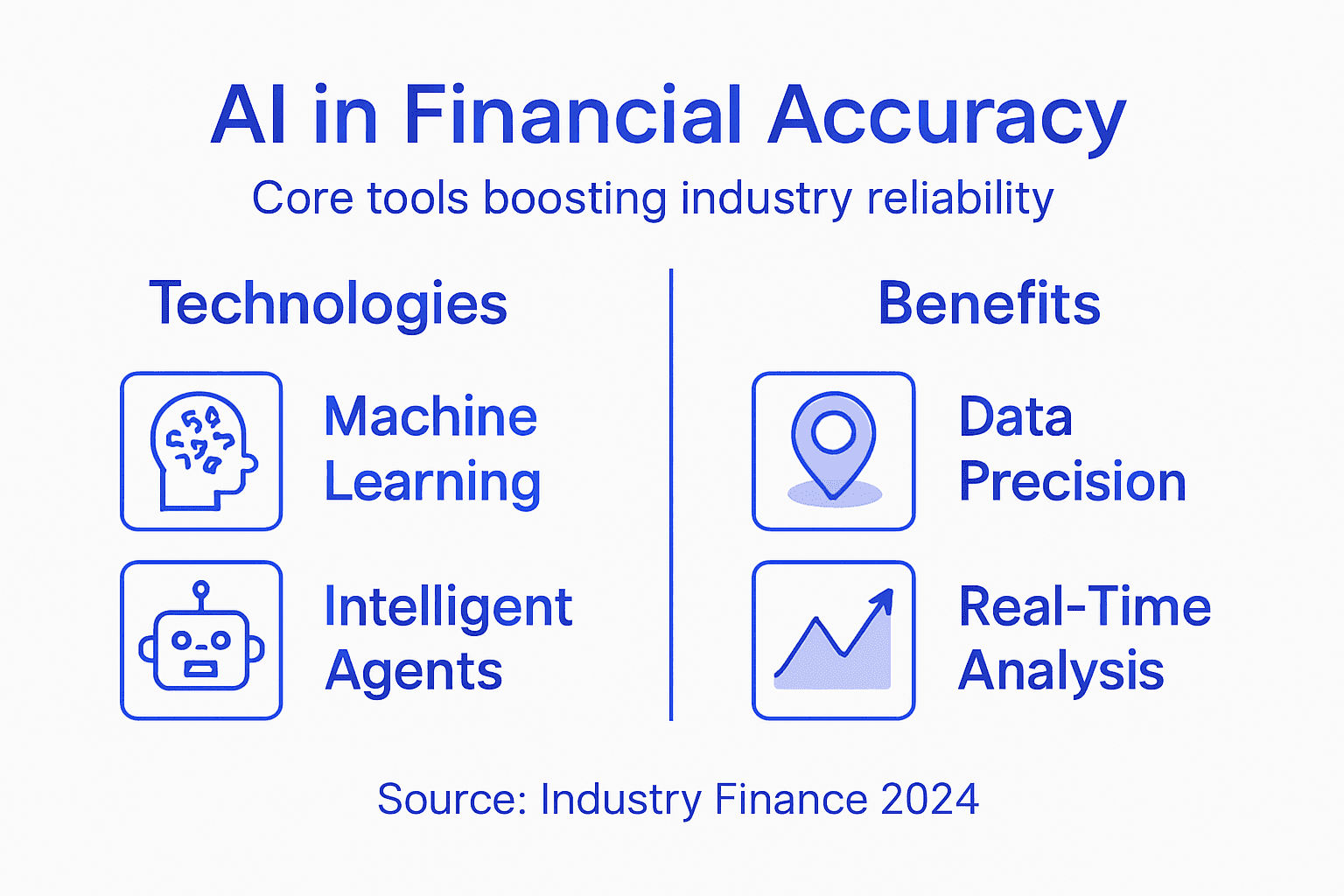
To better understand the variety of AI technologies impacting financial workflows, here’s a summary of their business effects:
| Technology | Primary Benefit | Typical Use Case |
|---|---|---|
| Predictive Analytics | Enhanced forecasting | Trend analysis, planning |
| NLP | Extracts key insights | Unstructured document review |
| ML Classification | Streamlines categorization | Automated document sorting |
| Generative AI | Scenario simulation | Risk modeling, portfolio design |
Pro tip: Implement a phased approach when integrating AI technologies, starting with pilot projects in specific financial domains to validate performance and gradually expand implementation.
Real-World Applications in Financial Workflows
AI technologies are dramatically transforming financial workflows by automating complex processes and delivering unprecedented insights. Financial workflow automation is reshaping how financial professionals approach critical tasks across multiple domains.
Key real-world applications of AI in financial workflows include:
- Compliance Monitoring: Automatically tracking regulatory requirements
- Fraud Detection: Identifying suspicious transactions in real-time
- Credit Risk Assessment: Analyzing borrower profiles with greater precision
- Investment Portfolio Management: Optimizing asset allocation strategies
- Expense Tracking: Automating document processing and categorization
These AI applications go beyond simple automation. They provide intelligent insights that augment human decision-making, allowing financial professionals to focus on strategic planning and complex problem-solving. By processing vast amounts of data simultaneously, AI systems can detect patterns and anomalies that human analysts might miss.

The most transformative aspect of AI in financial workflows is its ability to integrate disparate data sources. Machine learning algorithms can now synthesize information from multiple channels, creating a comprehensive view of financial performance that was previously impossible. This holistic approach enables more nuanced risk management and more accurate predictive modeling.
Pro tip: Conduct a thorough audit of existing workflows to identify the most repetitive and data-intensive processes where AI can deliver immediate, measurable improvements.
Ensuring Compliance and Security with AI
AI technologies are revolutionizing financial security and regulatory compliance by introducing sophisticated mechanisms for risk management and fraud prevention. AI regulatory compliance frameworks represent a critical evolution in how financial institutions protect sensitive data and maintain operational integrity.
Key security and compliance capabilities of AI include:
- Automated Regulatory Monitoring: Real-time tracking of changing compliance requirements
- Advanced Fraud Detection: Identifying suspicious patterns across complex transaction networks
- Secure Data Governance: Implementing robust privacy protections
- Risk Assessment: Dynamically evaluating potential financial and operational risks
- Transparent Decision Tracking: Creating comprehensive audit trails for regulatory review
These AI-driven approaches go beyond traditional compliance methods by providing intelligent, adaptive protection mechanisms. Machine learning algorithms can analyze vast datasets in milliseconds, detecting anomalies and potential security threats that human analysts might overlook. This continuous monitoring creates a proactive defense system that evolves alongside emerging financial risks.
The most significant advancement is AI’s ability to create predictive security models that anticipate potential compliance breaches before they occur. By synthesizing historical data, current regulatory frameworks, and emerging threat patterns, AI systems can generate sophisticated risk mitigation strategies that are both precise and dynamically responsive.
Pro tip: Implement a comprehensive AI governance framework that includes regular algorithmic audits, transparent decision-making protocols, and continuous model retraining to maintain compliance effectiveness.
Practical Challenges and Implementation Risks
Implementing AI technologies in financial workflows presents complex challenges that extend far beyond technical integration. Operational risks in AI deployment represent a critical consideration for financial institutions seeking to leverage advanced technologies effectively.
Key implementation challenges include:
- High Initial Investment Costs: Significant financial resources required for AI infrastructure
- Data Quality and Consistency: Ensuring accurate, comprehensive training datasets
- Technical Integration Complexity: Aligning AI systems with existing technological ecosystems
- Talent Acquisition: Finding skilled professionals who understand both finance and AI
- Regulatory Compliance: Navigating evolving legal frameworks for AI technologies
Machine learning models demand extensive preparation and ongoing maintenance. Financial institutions must develop robust governance frameworks that address potential biases, ensure transparency, and maintain rigorous performance standards. The complexity of these systems means that seemingly minor configuration errors can lead to significant operational risks.
Moreover, AI implementation introduces systemic risks that extend beyond individual organizational boundaries. Technological dependencies can create unexpected market correlations, potentially amplifying financial volatility if multiple institutions rely on similar AI models. This interconnectedness requires sophisticated risk management strategies that go beyond traditional technological safeguards.
Common challenges in AI integration can be addressed with specific strategies:
| Challenge | Impact on Operations | Suggested Mitigation |
|---|---|---|
| High Investment Cost | Delays adoption | Incremental deployment |
| Data Quality Issues | Reduces AI accuracy | Regular data audits |
| Talent Acquisition | Stalls innovation | Upskill existing staff |
| Technical Complexity | Risks system downtime | Modular system integration |
Pro tip: Develop a phased AI implementation strategy that includes continuous model auditing, incremental deployment, and mandatory human oversight to mitigate potential systemic risks.
Elevate Financial Accuracy with AI-Powered Document Processing
The article highlights the challenges financial teams face in achieving high accuracy and efficiency amidst complex workflows and evolving regulatory demands. Manual document handling, inconsistent data quality, and complex compliance requirements slow down operations and increase risk. These pain points resonate deeply with professionals striving for precision in AI-driven financial accuracy and seamless integration of diverse technologies.
BankStatementFlow directly addresses these critical challenges by delivering a SaaS platform that automates the extraction and structuring of data from unstructured financial documents with up to 99 percent accuracy. Leveraging advanced machine learning, it supports multiple languages and handles encrypted PDFs or simple images, removing barriers often encountered in financial document processing. This enables your team to focus on strategic decision-making instead of repetitive manual tasks.
Discover how AI-driven document processing can transform your financial workflows today.

Experience unmatched accuracy and speed while ensuring compliance with enterprise-grade security. Take control of your financial data by visiting BankStatementFlow now and start your journey toward smarter, error-free financial management. Implement AI solutions that grow with your business and reduce operational risks effectively.
Frequently Asked Questions
What is AI-driven document processing in finance?
AI-driven document processing uses advanced machine learning techniques to extract, classify, and analyze information from financial documents automatically, transforming unstructured data into structured formats with high accuracy.
How does machine learning improve financial accuracy?
Machine learning enhances financial accuracy by continuously learning from processed data, allowing systems to recognize complex patterns, detect anomalies, and provide insights that improve predictive capabilities over time.
What are the main applications of AI technologies in financial workflows?
AI technologies are applied in areas such as compliance monitoring, fraud detection, credit risk assessment, investment portfolio management, and expense tracking, helping streamline operations and provide valuable insights.
What challenges do financial institutions face when implementing AI?
Challenges include high initial investment costs, ensuring data quality, navigating technical integration complexities, acquiring skilled talent, and maintaining regulatory compliance, which require a robust governance framework to address effectively.
Recommended
- The Future of FinTech: How AI is Reshaping Financial Services - BankStatementFlow Blog
- 7 Practical Examples of AI in Banking for Accuracy - BankStatementFlow Blog
- How to Automate Financial Documents for Fast, Accurate Data - BankStatementFlow Blog
- Invoice Data Extraction: Boosting Accuracy With AI - BankStatementFlow Blog