Invoice Data Extraction: Boosting Accuracy With AI

Manual invoice data entry often slows down financial operations and leaves room for costly mistakes. For Financial Analysts in mid-sized companies, automating invoice data extraction can be the difference between delayed reports and timely, precise record management. By understanding automated data acquisition methods, you can select the right strategy to process diverse financial documents and achieve reliable results with less effort.
Table of Contents
- Defining Invoice Data Extraction Methods
- AI Technologies And Automation Processes
- Common Invoice Formats And Data Fields
- Business Benefits And Real-World Applications
- Risks, Compliance, And Avoidable Pitfalls
Key Takeaways
| Point | Details |
|---|---|
| Automation Enhances Efficiency | AI-powered invoice data extraction can significantly reduce manual processing time and costs by up to 80%. |
| Adaptability is Key | Implementing hybrid extraction strategies with machine learning can improve accuracy and accommodate diverse invoice formats. |
| Compliance and Risk Management | Organizations must develop robust AI governance frameworks to address potential risks and ensure compliance. |
| Real-World Benefits | AI technologies lead to faster processing, lower human error rates, and improved financial insights across various industries. |
Defining Invoice Data Extraction Methods
Invoice data extraction represents a critical financial process where businesses transform unstructured paper or digital documents into structured, machine-readable information. This method enables organizations to automatically capture, validate, and process financial transaction details without manual intervention.
Traditionally, invoice data extraction involved labor-intensive manual processes where accounting professionals would physically review and transcribe invoice information. Modern approaches leverage advanced technologies like Optical Character Recognition (OCR) and Artificial Intelligence to streamline this workflow. Automated data acquisition methods have dramatically transformed how financial teams handle document processing.
The primary invoice data extraction methods can be categorized into several key approaches:
- Manual Entry: Traditional method involving human data input
- Template-Based Extraction: Utilizing predefined document layout templates
- Rule-Based Extraction: Applying programmed logic to identify specific data fields
- Machine Learning-Powered Extraction: Advanced AI algorithms that learn and adapt to document variations
Each extraction method offers unique advantages and challenges. Template-based approaches work well for standardized documents but struggle with variability, while machine learning techniques provide more flexibility but require significant initial training.
Here’s a comparison of invoice data extraction methods and their key attributes:
| Extraction Method | Flexibility | Initial Setup Effort | Best Use Case |
|---|---|---|---|
| Manual Entry | Low | Minimal | Infrequent or unique invoices |
| Template-Based Extraction | Moderate | Moderate | Standardized, consistent layouts |
| Rule-Based Extraction | Moderate | High | Regulatory or field-specific data |
| Machine Learning-Powered | High | Significant | Large volumes, varied formats |
Machine learning algorithms can achieve up to 95% accuracy in invoice data extraction when properly trained and configured.
Pro tip: Implement a hybrid extraction strategy that combines multiple methods to maximize data capture accuracy and reliability.
AI Technologies and Automation Processes
AI technologies have revolutionized invoice data extraction by introducing sophisticated automation processes that dramatically improve accuracy and efficiency. Modern financial teams now leverage advanced machine learning algorithms to transform traditional document processing workflows.

The core technologies driving invoice data extraction include advanced AI data management techniques that enable intelligent document parsing. These technologies employ multiple sophisticated approaches to transform unstructured invoice data into actionable insights.
Key AI technologies for invoice data extraction include:
- Natural Language Processing (NLP): Enables understanding of contextual invoice language
- Computer Vision: Allows precise image and text recognition from various document formats
- Machine Learning Algorithms: Continuously improve extraction accuracy through iterative learning
- Deep Neural Networks: Detect complex patterns across diverse invoice layouts
The primary automation processes in AI-driven invoice data extraction involve several critical stages:
The following table summarizes how core AI technologies enhance the invoice extraction process:
| AI Technology | Role in Extraction Process | Business Impact |
|---|---|---|
| Natural Language Processing | Interprets invoice wording | Improves context understanding |
| Computer Vision | Identifies and reads document content | Enables non-text format extraction |
| Machine Learning | Learns from invoice variations | Increases extraction accuracy |
| Deep Neural Networks | Detects complex layout patterns | Adapts to diverse templates |
- Document Input and Preprocessing
- Image Enhancement and Noise Reduction
- Text and Data Recognition
- Validation and Error Checking
- Structured Data Output
AI-powered invoice processing can reduce manual data entry time by up to 80%, significantly lowering operational costs and minimizing human error.
Moreover, these technologies are not static. Adaptive AI systems continuously learn from each processed document, improving their recognition capabilities and expanding their understanding of diverse invoice formats and linguistic variations.
Pro tip: Invest in AI systems with robust machine learning capabilities that can adapt to your specific industry’s unique invoice structures and terminology.
Common Invoice Formats and Data Fields
Invoice formats represent critical documentation frameworks that capture essential financial transaction details across different industries and business contexts. Understanding these formats is fundamental to developing accurate data extraction strategies that can handle diverse document structures.
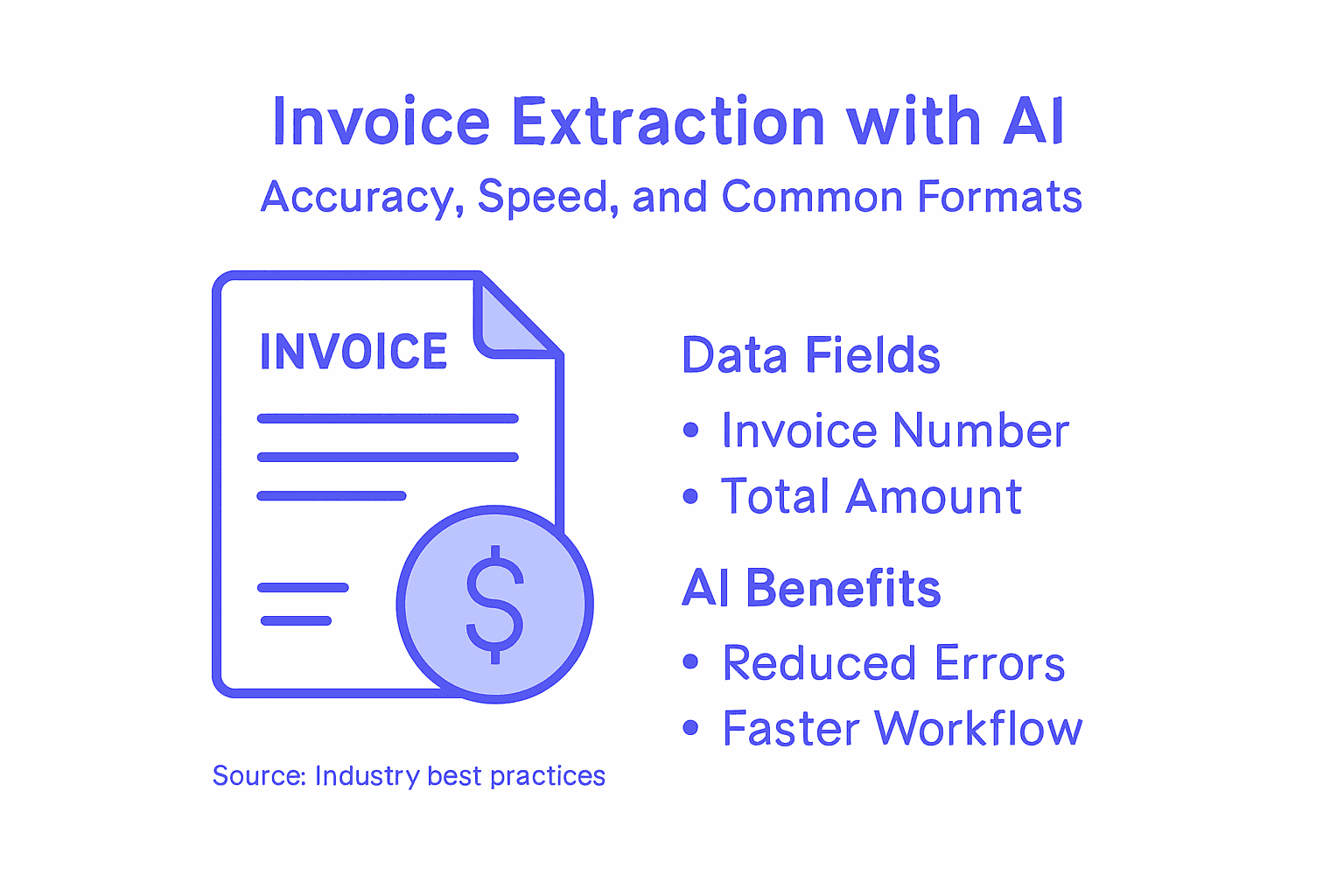
Commercial invoice standards encompass a wide range of document types with specific requirements for global financial processing. These formats typically include standardized sections that capture comprehensive transaction information, enabling precise data capture and analysis.
Common invoice formats include:
- Paper Invoices: Traditional physical document formats
- Digital PDFs: Electronically generated documents
- Structured XML Invoices: Machine-readable XML formats
- Image-based Invoices: Scanned or photographed documents
- Electronic Data Interchange (EDI) Invoices: Standardized computer-to-computer exchange formats
Key data fields typically found across invoice formats are:
- Seller Information
- Buyer Details
- Invoice Number
- Date of Issue
- Payment Terms
- Itemized Product/Service Descriptions
- Quantity and Unit Prices
- Total Amount Due
- Tax Calculations
- Currency Information
Successful invoice data extraction requires understanding the nuanced variations across different invoice format standards.
Modern AI technologies now enable intelligent parsing of these diverse formats, adapting to variations in layout, language, and structural complexity. The ability to recognize and extract data accurately across multiple invoice types represents a significant technological advancement in financial document processing.
Pro tip: Develop a flexible extraction strategy that can handle multiple invoice format variations by implementing adaptive machine learning algorithms.
Business Benefits and Real-World Applications
AI-powered invoice data extraction has transformed financial operations across multiple industries, delivering significant operational improvements and strategic advantages. Organizations are increasingly adopting these technologies to streamline complex document processing workflows and reduce administrative overhead.
Invoice processing platforms demonstrate remarkable efficiency gains by automating traditionally manual financial tasks. These advanced systems dramatically reduce processing times, minimize human error, and provide unprecedented accuracy in financial document management.
Key business benefits of invoice data extraction include:
- Cost Reduction: Lowering manual labor expenses
- Accuracy Improvement: Reducing human error rates
- Faster Processing: Accelerating financial workflows
- Compliance Enhancement: Ensuring regulatory adherence
- Real-Time Analytics: Enabling instant financial insights
Real-world applications span diverse industry sectors:
- Financial Services
- Healthcare Administration
- Retail Supply Chain Management
- Manufacturing Procurement
- Government Accounting
Automated invoice processing can reduce operational costs by up to 60% while improving data accuracy and processing speed.
The transformative potential of AI-driven invoice data extraction extends beyond traditional cost savings. By converting unstructured documents into actionable digital information, businesses can unlock strategic insights, improve vendor relationships, and make more informed financial decisions.
Pro tip: Select an AI-powered invoice extraction solution that offers flexible integration, scalable performance, and industry-specific customization capabilities.
Risks, Compliance, and Avoidable Pitfalls
AI-powered invoice data extraction technologies offer tremendous benefits, but they also introduce complex regulatory and operational risks that organizations must carefully navigate. Understanding these potential challenges is crucial for implementing successful and responsible document processing strategies.
AI risk management frameworks have become essential for businesses seeking to leverage advanced technologies while maintaining robust compliance standards. These frameworks help organizations identify, assess, and mitigate potential vulnerabilities in their automated document processing systems.
Key risks in invoice data extraction include:
- Data Privacy Violations: Potential unauthorized information exposure
- Algorithmic Bias: Unintended discrimination in data processing
- Security Vulnerabilities: Potential system breaches and data compromises
- Regulatory Non-Compliance: Failure to meet industry-specific legal requirements
- False Positive/Negative Errors: Inaccurate data extraction and interpretation
Critical compliance considerations for organizations:
- Implement rigorous data protection protocols
- Conduct regular AI system audits
- Establish transparent data handling procedures
- Develop comprehensive error reporting mechanisms
- Maintain detailed documentation of extraction processes
Organizations must proactively address AI-related risks to ensure responsible and ethical document processing.
Successful risk mitigation requires a holistic approach that balances technological innovation with stringent governance. Financial teams must develop adaptive strategies that can evolve alongside emerging regulatory requirements and technological capabilities.
Pro tip: Develop a comprehensive AI governance framework that includes regular risk assessments, transparent documentation, and continuous monitoring of extraction accuracy and compliance.
Transform Your Invoice Data Extraction with BankStatementFlow
The article highlights the challenges businesses face with invoice data extraction such as handling diverse invoice formats, ensuring high accuracy, and reducing manual effort. If you are striving to boost accuracy and automate complex financial document processing using AI-powered methods like machine learning and natural language processing, BankStatementFlow offers a perfect solution. Our platform specializes in automating extraction from invoices, bank statements, and receipts, all while supporting multiple languages and encrypted PDFs.
Experience the power of AI that adapts to your unique invoice layouts and scales with your business. Say goodbye to manual entry errors and slow workflows with up to 99% accuracy and rapid processing speeds. Seamlessly convert unstructured documents into Excel, CSV, JSON, and XML formats to drive faster and smarter financial decisions.
Ready to revolutionize your invoice processing and eliminate the risks of manual extraction? Visit BankStatementFlow to discover how our AI-powered platform can transform your financial data management today. Learn more about our capabilities for AI-powered financial document processing and optimize your workflow now.
Frequently Asked Questions
What are the methods of invoice data extraction?
The primary methods of invoice data extraction include manual entry, template-based extraction, rule-based extraction, and machine learning-powered extraction. Each method has its own advantages and challenges, catering to different business needs.
How does AI improve the accuracy of invoice data extraction?
AI technologies, such as machine learning and natural language processing, enhance the accuracy of invoice data extraction by learning from document variations, interpreting contextual language, and adapting to diverse invoice formats.
What are the main benefits of using AI for invoice processing?
Using AI for invoice processing offers numerous benefits, including reduced costs, improved accuracy, faster processing times, enhanced compliance, and the ability to derive real-time analytics from financial data.
What risks should businesses consider when implementing AI-powered invoice data extraction?
Businesses must be aware of risks such as data privacy violations, algorithmic bias, security vulnerabilities, regulatory non-compliance, and issues related to false positive/negative errors. Implementing a robust governance framework can help mitigate these risks.