Challenges in Processing Bank Statements – Impacts on Financial Teams

Manual bank statement entry can feel like an endless loop for finance teams in growing companies. The sheer variety in formats across institutions from North America, Europe, and Asia creates real headaches for anyone aiming for accuracy. Adapting to inconsistent layouts and terminology is not just frustrating, it drains valuable hours. This article lays out bank statement processing challenges, offering practical insights into why automated solutions are critical for improving efficiency and reliability worldwide.
Table of Contents
- Defining Bank Statement Processing Challenges
- Variations in Bank Statement Formats Worldwide
- Issues With Manual and Automated Data Extraction
- Managing Data Privacy and Regulatory Compliance
- Reducing Errors and Achieving High Accuracy
Key Takeaways
| Point | Details |
|---|---|
| Bank Statement Processing Challenges | Financial teams must address data volume, human error, and compliance risks in bank statement processing to enhance efficiency. |
| Automation Benefits | Implementing automated solutions can significantly reduce processing time and improve accuracy, freeing teams for higher-value tasks. |
| Global Format Variations | Diverse international bank statement formats require adaptive technologies to ensure accurate data extraction and processing. |
| Error Reduction Strategies | Combining advanced algorithms with human oversight is essential to minimize errors and achieve high accuracy in financial data extraction. |
Defining Bank Statement Processing Challenges
Financial teams today face increasingly complex challenges when processing bank statements, which require sophisticated strategies and technological interventions. Manual data extraction and reconciliation processes consume significant organizational resources and introduce substantial risks of human error. Bank statement processing demands precision, speed, and comprehensive data management capabilities that traditional methods struggle to deliver.
The primary challenges in bank statement processing can be categorized into several critical dimensions:
- Data Volume and Complexity: Modern financial institutions generate massive volumes of transaction data
- Manual Entry Limitations: Human-driven data extraction introduces significant error rates
- Time-Consuming Reconciliation: Matching transactions across multiple systems requires extensive manual effort
- Security and Compliance Risks: Sensitive financial information requires robust protection mechanisms
Specifically, financial analysts encounter nuanced obstacles that impede efficient workflow. bank statement automation benefits reveal that organizations lose approximately 15-20 hours per week on manual document processing tasks. These hours represent substantial productivity drain, preventing teams from engaging in higher-value strategic analysis and decision-making activities.
Technological advancements are rapidly transforming how financial teams approach document processing. Automated solutions now leverage machine learning algorithms to extract, validate, and structure bank statement data with unprecedented accuracy. These systems can process multiple document formats, handle complex transaction records, and integrate seamlessly with existing financial management platforms.

Here’s a comparison of manual versus automated bank statement processing approaches:
| Criteria | Manual Processing | Automated Processing |
|---|---|---|
| Accuracy | Prone to human error | Consistent, algorithm-driven |
| Speed | Slow, labor-intensive | Fast, scalable |
| Format Adaptability | Limited, reliant on templates | Flexible, supports variants |
| Audit Trail | Often inconsistent | Comprehensive tracking |
| Productivity Impact | Drains staff resources | Frees up analyst time |
| Security Controls | Basic protections | Advanced encryption possible |
Pro tip: Implement a systematic document processing workflow that combines automated extraction technologies with human oversight to maximize accuracy and efficiency.
Variations in Bank Statement Formats Worldwide
Bank statements represent a complex landscape of diverse formatting approaches that challenge financial processing technologies worldwide. challenges in bank statement extraction reveal significant variations across different regions, financial institutions, and banking systems that complicate automated document processing.
The global diversity of bank statement formats can be categorized into several key dimensions:
- Regional Regulatory Requirements: Different countries mandate unique reporting standards
- Institutional Design Preferences: Each bank develops its own visual communication approach
- Language and Terminology Variations: Transactional descriptions differ across cultures
- Digital vs. Physical Document Standards: Online and printed statements have distinct layout expectations
National Banking Systems demonstrate remarkable differences in document presentation. European banks typically use more compact, standardized layouts, while American institutions often prefer more detailed, expansive transaction records. Asian banking systems frequently incorporate multilingual elements and complex character sets that require advanced optical recognition technologies.
To help visualize global format variations, here’s how bank statements differ by region:
| Region | Statement Layout Style | Language Complexity | Typical Features |
|---|---|---|---|
| North America | Detailed, expansive | Single language, clear terms | Extensive transaction fields |
| Europe | Compact, standardized | Multiple languages possible | Fewer but dense records |
| Asia | Multilingual, complex | Scripts and symbols | Numerous character sets |
Technological solutions must now adapt to an incredibly complex ecosystem of document formats. Machine learning algorithms must be sophisticated enough to recognize and interpret diverse visual layouts, transaction descriptions, and data presentation styles across multiple international banking environments. This requires flexible, adaptive extraction technologies capable of understanding nuanced differences in document structure.
Pro tip: Develop flexible document processing algorithms that can dynamically adapt to multiple international bank statement format variations.
Issues With Manual and Automated Data Extraction
Financial teams confront significant challenges when processing bank statements through both manual and automated approaches. The extraction of accurate financial data represents a critical yet complex operational task that demands precision, efficiency, and robust technological capabilities. Data extraction methods fundamentally differ in their approach, each presenting unique limitations and potential performance gaps.
The primary challenges in data extraction can be categorized into several critical areas:
- Human Error Rates: Manual entry introduces substantial mistake potential
- Processing Speed: Automated systems struggle with complex document formats
- Contextual Understanding: Machine algorithms often miss nuanced transaction details
- Security Vulnerabilities: Both methods expose sensitive financial information to potential risks
Manual Data Extraction remains notoriously inefficient and error-prone. Financial professionals typically spend hours meticulously reviewing and transcribing transaction details, with error rates potentially reaching 3-5% across complex statements. These mistakes can cascade into significant financial discrepancies, potentially causing reconciliation challenges and audit complications.

Automated extraction technologies represent a promising alternative, leveraging machine learning and optical character recognition to streamline document processing. However, these systems are not infallible. They must navigate complex document layouts, handle multiple language variations, and interpret context-specific transaction descriptions. bank statement automation benefits demonstrate that while automated solutions can dramatically reduce processing time, they still require sophisticated algorithmic design to achieve near-perfect accuracy.
Pro tip: Implement a hybrid approach combining automated extraction with strategic human verification to maximize accuracy and efficiency.
Managing Data Privacy and Regulatory Compliance
Financial institutions face increasingly complex challenges in protecting sensitive financial data while maintaining operational efficiency. data privacy and regulatory challenges reveal the intricate balance between technological innovation and stringent regulatory requirements that modern financial teams must navigate.
The critical dimensions of data privacy and regulatory compliance include:
- Regulatory Framework Complexity: Multiple international standards governing data protection
- Cybersecurity Vulnerabilities: Continuous threat of data breaches and unauthorized access
- Customer Data Confidentiality: Protecting individual financial information
- Technological Compliance Requirements: Ensuring automated systems meet legal standards
Regulatory Compliance demands a multifaceted approach that goes beyond simple checkbox mechanisms. Financial teams must implement robust data protection strategies that incorporate advanced encryption technologies, comprehensive access controls, and continuous monitoring systems. This requires sophisticated technological infrastructure capable of adapting to rapidly evolving regulatory landscapes across different jurisdictions.
Modern financial institutions must develop comprehensive data governance frameworks that balance operational needs with strict privacy protections. This involves creating detailed data handling protocols, implementing advanced encryption methods, and developing transparent processes for data collection, storage, and usage. Machine learning and artificial intelligence technologies offer promising solutions for automating compliance monitoring and identifying potential regulatory risks before they escalate.
Pro tip: Develop a dynamic compliance framework that combines technological solutions with regular human-led audits to ensure comprehensive data protection.
Reducing Errors and Achieving High Accuracy
Accurate financial data extraction remains a critical challenge for modern financial teams, demanding sophisticated technological solutions that minimize human error and maximize precision. automated financial data processing has emerged as a transformative approach to addressing longstanding accuracy challenges in bank statement processing.
The key strategies for reducing errors and improving accuracy include:
- Multi-Layer Verification: Implementing multiple validation checkpoints
- Machine Learning Algorithms: Developing adaptive error detection mechanisms
- Contextual Analysis: Understanding transaction nuances beyond raw data
- Continuous Training Models: Regularly updating extraction algorithms
Error Reduction requires a comprehensive approach that combines technological sophistication with strategic human oversight. Financial teams must develop robust validation frameworks that leverage advanced machine learning techniques, optical character recognition, and natural language processing to identify and correct potential discrepancies. These systems must be capable of recognizing complex patterns, understanding contextual variations, and adapting to diverse document formats.
The most effective error reduction strategies integrate multiple technological approaches. Advanced algorithms can now cross-reference transaction details, validate historical data patterns, and flag potential inconsistencies with unprecedented accuracy. This multi-layered verification process dramatically reduces the likelihood of human error, providing financial teams with more reliable and consistent data extraction results.
Pro tip: Implement a dynamic error reduction strategy that combines machine learning algorithms with periodic human validation to maximize accuracy and reliability.
Overcome Bank Statement Processing Challenges with AI-Powered Automation
Manual bank statement processing drains valuable time and creates costly errors as detailed in the article. Financial teams struggle with diverse formats, complex data extraction, and maintaining high accuracy under tight regulatory pressures. The emotional toll of repetitive, error-prone tasks impacts productivity and focus. BankStatementFlow directly addresses these pain points by automating the extraction and structuring of financial data from multiple document types including encrypted PDFs and photos without the need for scanners. Its AI-driven algorithms adapt to global bank statement variations and achieve up to 99% accuracy, freeing teams from tedious manual work.
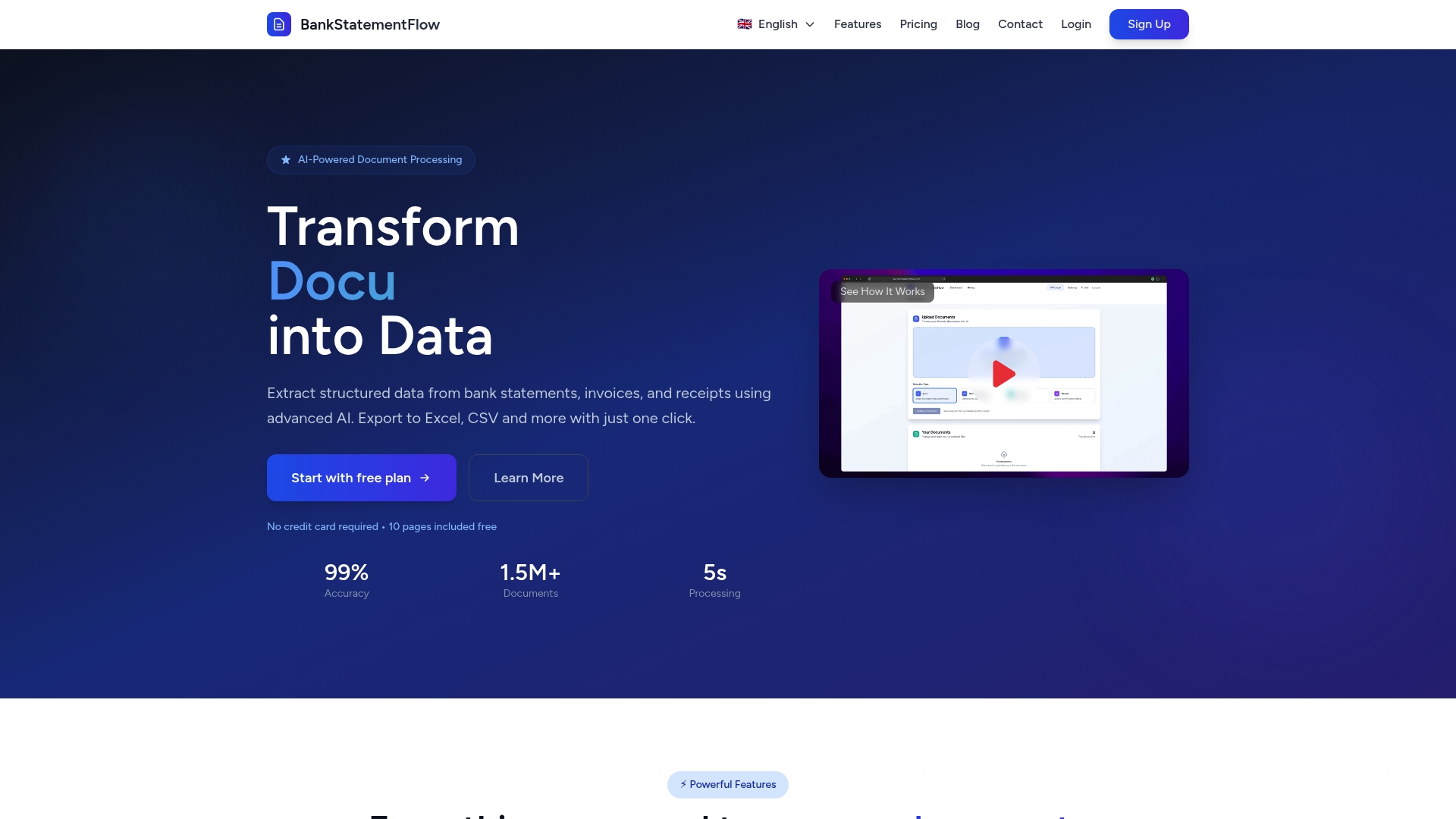
Discover how your financial team can transform challenges described in the article into streamlined workflows by visiting BankStatementFlow. Explore powerful solutions that integrate seamlessly through API access and support multi-language documents at BankStatementFlow’s AI-powered platform. Reduce errors, save hours per week, and ensure compliance today by taking advantage of automation designed for your exact needs. Act now to reclaim control over your financial data processing and empower your team for greater efficiency.
Frequently Asked Questions
What are the main challenges in bank statement processing?
The main challenges include handling large volumes of complex data, high human error rates due to manual entry, time-consuming reconciliation processes, and security and compliance risks related to sensitive financial information.
How can financial teams improve the accuracy of bank statement processing?
Financial teams can improve accuracy by implementing automated data extraction technologies, utilizing machine learning algorithms for validation, and establishing multiple verification checkpoints to catch discrepancies before finalizing the data.
What are the benefits of automating bank statement processing?
Automating bank statement processing offers benefits such as increased accuracy, faster processing speeds, reduced reliance on manual entry, improved productivity by freeing analysts for higher-value tasks, and enhanced security through advanced encryption methods.
How do variations in bank statement formats affect processing?
Variations in bank statement formats can complicate processing by requiring advanced OCR technologies to interpret diverse layouts, language differences, and varying transaction descriptions across different institutions, which can hinder the efficiency of automated systems.
Recommended
- Bank Statement Analysis: Best Practices for Financial Data Management - BankStatementFlow Blog
- 7 Essential Types of Financial Documents Explained - BankStatementFlow Blog
- 7 Key Bank Statement Automation Benefits for Analysts - BankStatementFlow Blog
- The AI Document Processing Revolution: How BankStatementFlow is Changing Business - BankStatementFlow Blog