Why Automate Expense Receipts: Boost Accuracy and Control

Staring at stacks of receipts and navigating tedious data entry leaves many financial professionals wrestling with wasted time and growing frustration. Manual processing often leads to errors and missed opportunities for deeper financial insights, putting a strain on accounting teams worldwide. With the adoption of automated expense receipt processing, accountants and analysts can replace repetitive tasks with intelligent solutions that deliver rapid, accurate results while strengthening control and compliance.
Table of Contents
- Defining Automated Expense Receipt Processing
- Manual Vs. Automated Receipt Management
- Key Features Of Ai-Powered Automation
- Fraud Reduction And Compliance Benefits
- Financial Impact And Roi Analysis
- Best Practices For Successful Implementation
Key Takeaways
| Point | Details |
|---|---|
| Automated Processing Enhances Efficiency | Automated expense receipt processing significantly reduces time and manual errors in financial documentation management. |
| Accuracy and Fraud Detection Improve | AI-powered systems can achieve up to 99% accuracy, proactively detecting fraud through real-time monitoring. |
| ROI Realization within Months | Organizations typically see a return on investment within 3-6 months due to decreased processing costs and improved efficiency. |
| Strategic Implementation is Crucial | A well-planned implementation strategy, including thorough assessment and training, is vital for the successful adoption of automated systems. |
Defining Automated Expense Receipt Processing
Automated expense receipt processing represents a sophisticated technological solution that transforms how businesses capture, analyze, and manage financial documentation. At its core, this approach leverages advanced machine learning algorithms to extract and structure critical financial data from various receipt formats automatically, eliminating manual data entry and reducing human error.
The primary goal of automated expense receipt processing is to convert unstructured financial documents into clean, standardized digital information. By understanding document processing techniques, businesses can dramatically improve their financial workflow efficiency. This technology goes beyond simple scanning, utilizing intelligent extraction methods that can:
- Capture detailed line-item information
- Recognize and classify different receipt types
- Extract key financial data with high accuracy
- Convert documents into multiple structured formats
- Integrate seamlessly with existing accounting systems
Modern automated receipt processing differs significantly from traditional manual methods. Instead of employees spending hours manually typing receipt details into spreadsheets, sophisticated AI algorithms can now:
- Instantly scan physical or digital receipts
- Identify and validate critical financial information
- Categorize expenses automatically
- Flag potential discrepancies or unusual transactions
- Generate comprehensive expense reports within minutes
Automated expense receipt processing transforms tedious administrative tasks into streamlined, intelligent workflows.
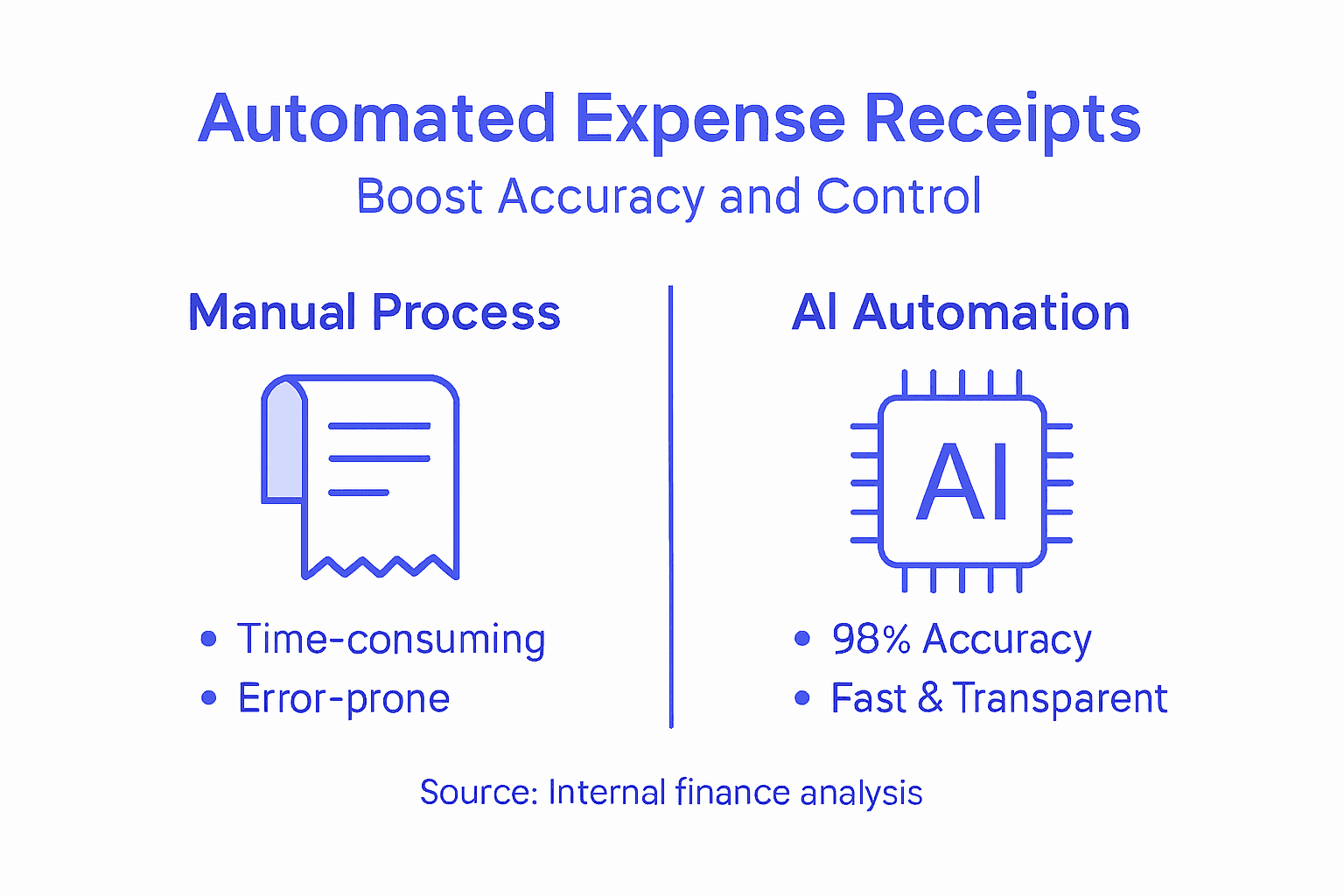
Accuracy and Speed are the primary advantages of this technology. Traditional manual data entry typically achieves 60-70% accuracy, whereas AI-powered systems can reach accuracy rates up to 99%. This precision not only reduces errors but also provides real-time insights into spending patterns and financial health.
Pro tip: Start by selecting a document processing solution that offers flexible integration and supports multiple receipt formats to maximize your automation potential.
Manual Vs. Automated Receipt Management
The landscape of expense receipt management has dramatically transformed with the advent of technological solutions, creating a stark contrast between traditional manual processes and modern automated systems. Optical character recognition technologies have revolutionized how businesses handle financial documentation.
Traditional manual receipt management involves time-consuming and error-prone processes that burden finance teams with repetitive tasks. Employees typically spend significant time:
- Collecting physical and digital receipts
- Manually entering data into spreadsheets
- Matching receipts with expense reports
- Verifying individual transaction details
- Reconciling discrepancies through manual review
In contrast, automated receipt management streamlines these workflows through intelligent technologies that offer several key advantages:
- Instant digital receipt capture
- Automatic data extraction
- Real-time expense categorization
- Immediate compliance checking
- Seamless integration with accounting systems
Automation transforms receipt management from a time-consuming administrative task into a strategic, efficient process.
The efficiency gains are substantial. While manual processes typically achieve 60-70% accuracy and require hours of human intervention, automated systems can process receipts with up to 99% accuracy in minutes. This dramatic improvement reduces administrative overhead, minimizes human error, and provides finance teams with more time for strategic financial analysis.

Key Performance Differences:
Here’s a concise overview comparing manual and automated receipt management across key dimensions:
| Aspect | Manual Receipt Management | Automated Receipt Management |
|---|---|---|
| Data Entry Accuracy | 60-70% (higher errors) | Up to 99% (minimal errors) |
| Time Required | Hours per batch | Minutes per batch |
| Labor Costs | High, due to manual input | Low, automated processing |
| Scalability | Limited by team size | Easily scales organization-wide |
| Fraud Risk | Frequently missed | Proactively detected |
| Real-time Insights | Not available | Provided instantly |
| Integration | Manual uploads | Seamless with accounting tools |
-
Manual Processing
- High error rates (60-70% accuracy)
- Slow processing times
- Labor-intensive
- Limited scalability
-
Automated Processing
- Near-perfect accuracy (99%)
- Rapid processing
- Minimal human intervention
- Easily scalable across organizations
Pro tip: Implement a pilot automated receipt management program with a small team to demonstrate tangible efficiency gains before full organizational rollout.
Key Features of AI-Powered Automation
Artificial intelligence has revolutionized expense receipt management through sophisticated technologies that transform traditional financial processes. AI advancements in expense management have created powerful tools that go far beyond simple data processing.
The core features of AI-powered automation represent a quantum leap in financial document handling. These intelligent systems leverage advanced machine learning algorithms to provide comprehensive capabilities:
- Smart receipt capture using optical character recognition (OCR)
- Automatic data extraction across multiple document formats
- Intelligent expense categorization
- Real-time compliance monitoring
- Predictive expense trend analysis
At the heart of these technologies lies an unprecedented ability to understand and interpret complex financial documentation. Modern AI systems can:
- Recognize handwritten and printed text with remarkable accuracy
- Understand contextual nuances in expense entries
- Learn from historical spending patterns
- Detect potential fraud or irregular transactions
- Generate comprehensive financial insights
AI transforms expense management from a reactive administrative task into a proactive strategic function.
Intelligent Data Processing represents the most significant advancement. Traditional manual systems relied on human interpretation, but AI-powered platforms can now:
- Analyze thousands of receipts simultaneously
- Extract data with 99% accuracy
- Standardize expense reporting across entire organizations
- Reduce processing time from hours to minutes
- Minimize human error and potential compliance risks
The sophisticated algorithms continuously improve, learning from each processed document and refining their understanding of complex financial terminology, formatting variations, and industry-specific expense categories.
Pro tip: Select an AI-powered expense management solution that offers machine learning capabilities and demonstrates continuous improvement in accuracy and insight generation.
Fraud Reduction and Compliance Benefits
Automated expense receipt processing has emerged as a powerful tool for organizations seeking to minimize financial risks and ensure rigorous regulatory compliance. Automated expense management systems provide sophisticated mechanisms to detect, prevent, and mitigate potential fraudulent activities.
Corporate Fraud Prevention represents a critical advantage of modern automated systems. These intelligent platforms employ multiple layers of protection by:
- Implementing real-time policy enforcement
- Detecting suspicious expense patterns
- Cross-referencing transactions against predefined rules
- Generating immediate compliance alerts
- Creating comprehensive digital audit trails
The technological capabilities extend far beyond traditional manual review processes. Automated systems can now:
- Validate receipt authenticity instantly
- Compare expenses against corporate policies
- Flag potential irregularities automatically
- Track regulatory requirement compliance
- Provide transparent documentation for audits
Automated expense management transforms financial oversight from reactive monitoring to proactive risk management.
Compliance Monitoring has become significantly more sophisticated with AI-driven technologies. Unlike manual systems that rely on sporadic human checks, these advanced platforms provide continuous, real-time compliance verification. They can instantly identify:
- Expenses outside approved spending limits
- Transactions inconsistent with company policies
- Potential duplicate or manipulated receipts
- Unusual spending patterns
- Regulatory standard violations
The digital audit trails generated by these systems offer unprecedented transparency. Financial teams can now trace every transaction’s origin, validate its authenticity, and maintain meticulous records that meet the most stringent regulatory requirements.
Pro tip: Implement a comprehensive expense management system that offers machine learning capabilities to continuously adapt and improve fraud detection mechanisms.
Financial Impact and ROI Analysis
Automated expense receipt processing delivers substantial financial benefits that extend far beyond simple cost reduction. Expense management automation represents a strategic investment with measurable, rapid returns for organizations of all sizes.
Financial Transformation occurs through multiple interconnected benefits that directly impact an organization’s bottom line:
- Reduced administrative labor costs
- Faster expense reimbursement cycles
- Minimized processing errors
- Enhanced spending visibility
- Improved budgeting accuracy
The quantifiable financial advantages can be categorized into several critical areas:
- Direct Labor Cost Savings
- Error Reduction Expenses
- Fraud Prevention Gains
- Operational Efficiency Improvements
- Compliance Risk Mitigation
Automated expense management transforms financial operations from cost centers to strategic value generators.
ROI Calculation typically reveals impressive financial outcomes. Most organizations experience a return on investment within 3-6 months, with ongoing benefits that compound over time. Companies frequently observe:
- 40-60% reduction in processing time
- 70-80% decrease in manual data entry costs
- 25-35% improvement in expense report accuracy
- Significant reduction in fraudulent expense claims
- Enhanced financial forecasting capabilities
The long-term financial impact extends beyond immediate cost savings. By freeing up financial team resources, organizations can redirect human capital toward more strategic initiatives that drive business growth and innovation.
The following table summarizes the financial impact and ROI drivers of automation:
| Benefit Area | Business Impact | Sample Improvement |
|---|---|---|
| Labor Cost Savings | Reduces administrative overhead | 70-80% decrease in expenses |
| Error Reduction | Fewer financial corrections needed | 25-35% accuracy improvement |
| Speed of Process | Faster reimbursements | 40-60% time reduction |
| Fraud Detection | Fewer unauthorized claims | Significant claim reduction |
| Strategic Insights | Better budgeting & forecasting | Enhanced visibility |
Pro tip: Calculate your potential ROI by tracking current manual processing costs, including labor hours, error correction expenses, and potential fraud losses, before implementing an automated system.
Best Practices for Successful Implementation
Implementing an automated expense receipt processing system requires strategic planning and a comprehensive approach. Successful automation implementation demands careful consideration of organizational needs and technological capabilities.
Implementation Strategy involves multiple critical components that ensure smooth adoption:
- Conduct thorough organizational needs assessment
- Define clear expense management policies
- Select technology with seamless integration capabilities
- Create comprehensive employee training programs
- Establish ongoing performance monitoring mechanisms
Organizations should approach implementation through a structured process:
- Develop detailed project scope
- Identify key stakeholders
- Select appropriate technological solution
- Design pilot testing program
- Create change management strategy
Successful automation transforms financial processes from bureaucratic challenges to strategic opportunities.
Change Management plays a crucial role in successful implementation. Financial teams must:
- Communicate benefits transparently
- Provide comprehensive user training
- Address potential employee concerns
- Demonstrate immediate value
- Create supportive transition environment
Technical considerations are equally important. Companies should prioritize solutions that offer:
- Flexible integration with existing systems
- Robust security protocols
- Scalable infrastructure
- User-friendly interfaces
- Continuous improvement capabilities
The transition requires patience and strategic execution. Most organizations experience optimal results by starting with limited-scope pilot programs that allow gradual adaptation and refinement of automated processes.
Pro tip: Select an automation solution that offers comprehensive onboarding support and provides dedicated implementation specialists to guide your organizational transition.
Empower Your Expense Management with BankStatementFlow
The article highlights the critical challenges many organizations face while managing expense receipts such as low accuracy, time-consuming manual entry, and compliance risks. If you want to eliminate errors, accelerate processing times, and gain real-time control over your financial documents using AI-powered automation, BankStatementFlow is the solution designed for you. Our platform leverages advanced machine learning algorithms to deliver up to 99 percent accuracy in data extraction from receipts, invoices, and bank statements—transforming unstructured financial data into clean, standardized formats effortlessly.
Explore how automated receipt processing can reduce manual efforts and strengthen your fraud prevention by visiting BankStatementFlow.
Take control of your expense management today. Experience faster reimbursements, enhanced accuracy, and seamless integration with your existing workflows. Discover why financial teams across industries trust BankStatementFlow to boost accuracy and enforce compliance. Get started now and see your organization’s expense processing transformed.
Learn more about automating financial document workflows at BankStatementFlow Automated Processing and unlock the power of AI for your business.
Frequently Asked Questions
What is automated expense receipt processing?
Automated expense receipt processing utilizes advanced machine learning algorithms to automatically capture, analyze, and manage financial data from various receipt formats, eliminating manual data entry and reducing errors.
How does automated receipt management improve accuracy compared to manual processes?
AI-powered systems can achieve up to 99% accuracy in data extraction, significantly reducing the common error rates of 60-70% typically seen with manual data entry.
What are the primary benefits of implementing automated receipt processing?
The key benefits include reduced administrative costs, faster reimbursement cycles, improved expense accuracy, enhanced financial insights, and more efficient fraud detection and compliance monitoring.
How can businesses ensure a successful implementation of automated receipt management systems?
Successful implementation involves conducting a needs assessment, defining clear policies, selecting the right technology, providing employee training, and establishing ongoing performance monitoring measures.
Recommended
- Automated Expense Tracking: Simplify Your Business Financial Management - BankStatementFlow Blog
- How Small Businesses Save 20+ Hours Weekly with Document Automation - BankStatementFlow Blog
- Invoice Processing Automation: From Chaos to Streamlined Workflows - BankStatementFlow Blog
- How to Automate Financial Documents for Fast, Accurate Data - BankStatementFlow Blog