Why Automate Document Processing for Finance Teams

Manually sorting through invoices, bank statements, and contracts can overwhelm even the most diligent finance team. In mid-sized organizations with expanding global operations, the pressure to deliver fast, accurate financial reporting grows each quarter. By embracing automated document processing powered by AI, teams can transform tedious data entry into organized, actionable insights and minimize the risk of costly human errors. Discover how advanced automation frees your analysts to focus on strategic financial analysis rather than endless paperwork.
Table of Contents
- What Automated Document Processing Means
- Types of Financial Document Automation Solutions
- Key Features and Workflow Integration Explained
- Benefits for Accuracy, Compliance, and Scalability
- Cost Considerations and Common Pitfalls
Key Takeaways
| Point | Details |
|---|---|
| Automated Document Processing Enhances Efficiency | Leveraging AI technologies streamlines the handling of financial documents, significantly reducing manual data entry tasks. |
| Integration of Advanced Technologies | Solutions utilize OCR, NLP, and Machine Learning to automate tasks like data extraction and document classification. |
| Significant Benefits for Organizations | Automation improves accuracy, compliance, and scalability, enabling finance professionals to focus on strategic decision-making. |
| Cautious Implementation Required | Organizations must consider costs, potential pitfalls, and change management for successful adoption of automated systems. |
What Automated Document Processing Means
Automated document processing represents a transformative approach to handling financial documents, leveraging advanced artificial intelligence to convert unstructured information into actionable insights. Unlike traditional manual methods, this technology systematically captures, interprets, and extracts critical data from complex financial documents with remarkable precision.
At its core, automated document processing involves using sophisticated AI technologies to streamline document management. Intelligent document processing systems utilize a combination of advanced technologies including:
- Optical Character Recognition (OCR) for text extraction
- Natural Language Processing for semantic understanding
- Machine Learning algorithms for continuous improvement
- Intelligent classification and categorization techniques
For finance teams, this means dramatically reducing the time and human effort required to handle paperwork. Instead of manually entering data from bank statements, invoices, and financial reports, AI-powered systems can automatically:
Here’s how major AI technologies in automated document processing contribute to financial operations:
| Technology | Key Role | Typical Business Impact |
|---|---|---|
| OCR (Optical Character Recognition) | Converts images to text | Enables digital capture of paper records |
| NLP (Natural Language Processing) | Interprets financial language | Extracts meaning from complex documents |
| Machine Learning | Learns patterns over time | Improves accuracy with usage |
| Intelligent Classification | Sorts and tags documents | Streamlines document routing and storage |
- Scan documents from multiple sources
- Extract relevant financial information
- Validate data accuracy
- Integrate information into existing financial systems
Automated document processing transforms tedious manual tasks into efficient, error-free workflows that enhance operational productivity.
The technology goes beyond simple data entry. AI-driven systems support complex financial processes like compliance checks, risk management, and real-time document translation. By eliminating repetitive tasks, finance professionals can focus on strategic analysis and decision-making.
Pro tip: Start by identifying the most time-consuming document processing tasks in your finance workflow and prioritize those for initial automation.
Types of Financial Document Automation Solutions
Financial document automation solutions have evolved dramatically, offering sophisticated technologies that transform how organizations manage complex financial paperwork. These advanced systems go far beyond simple data entry, providing intelligent capabilities that adapt to diverse document types and organizational needs.
Advanced financial document processing systems integrate multiple cutting-edge technologies to deliver comprehensive document management. The primary types of financial document automation solutions include:
-
Optical Character Recognition (OCR) Solutions
- Extract text from scanned documents
- Convert images to machine-readable formats
- Support multiple languages and document types
-
Machine Learning Classification Systems
- Automatically categorize financial documents
- Learn and improve document recognition over time
- Reduce manual sorting and classification efforts
-
Natural Language Processing (NLP) Platforms
- Understand semantic context of financial documents
- Extract nuanced information beyond simple text
- Support complex document interpretation
These solutions typically offer comprehensive features designed to streamline financial workflows:
- Automated data extraction
- Intelligent document classification
- Fraud detection mechanisms
- Seamless integration with existing financial systems
Modern financial document automation transforms complex, time-consuming processes into efficient, error-resistant workflows.
The most advanced solutions combine multiple technologies, creating hybrid systems that can handle heterogeneous document formats with remarkable accuracy. By leveraging artificial intelligence and machine learning, these platforms can process everything from bank statements and invoices to complex financial contracts, dramatically reducing manual processing time and minimizing human error.
Pro tip: Evaluate your current document processing bottlenecks and select an automation solution that offers the most comprehensive feature set matching your specific organizational needs.
Key Features and Workflow Integration Explained
Financial document automation represents a sophisticated approach to transforming complex document management processes, enabling organizations to streamline their workflow with unprecedented efficiency. Modern solutions go beyond simple data capture, offering intelligent systems that can adapt and optimize financial document processing in real-time.
Advanced workflow integration technologies provide finance teams with comprehensive tools for managing document lifecycles. The key features of these sophisticated systems include:
-
Intelligent Data Capture
- Extract data from multiple document formats
- Recognize complex financial terminology
- Minimize manual data entry errors
-
Automated Classification
- Automatically categorize financial documents
- Create intelligent routing mechanisms
- Support compliance and audit requirements
-
Real-Time Validation
- Cross-reference data against multiple sources
- Detect potential inconsistencies instantly
- Generate immediate validation reports
Workflow integration occurs through multiple strategic approaches:
- API connections with existing enterprise systems
- Seamless data transfer between platforms
- Automated compliance monitoring
- Intelligent exception handling
Effective document automation transforms complex financial processes into streamlined, error-resistant workflows.
The most advanced systems leverage AI-driven components to create adaptive, intelligent document processing platforms. These solutions can seamlessly integrate with existing enterprise resource planning systems, enabling real-time monitoring, rapid processing, and continuous improvement of document management strategies.

Pro tip: Conduct a comprehensive workflow audit before implementing document automation to identify the most critical integration points and potential optimization opportunities.
Benefits for Accuracy, Compliance, and Scalability
Financial document automation represents a transformative approach that fundamentally reimagines how organizations manage complex financial information. By leveraging advanced technologies, these solutions deliver unprecedented improvements across critical operational dimensions that matter most to finance teams.
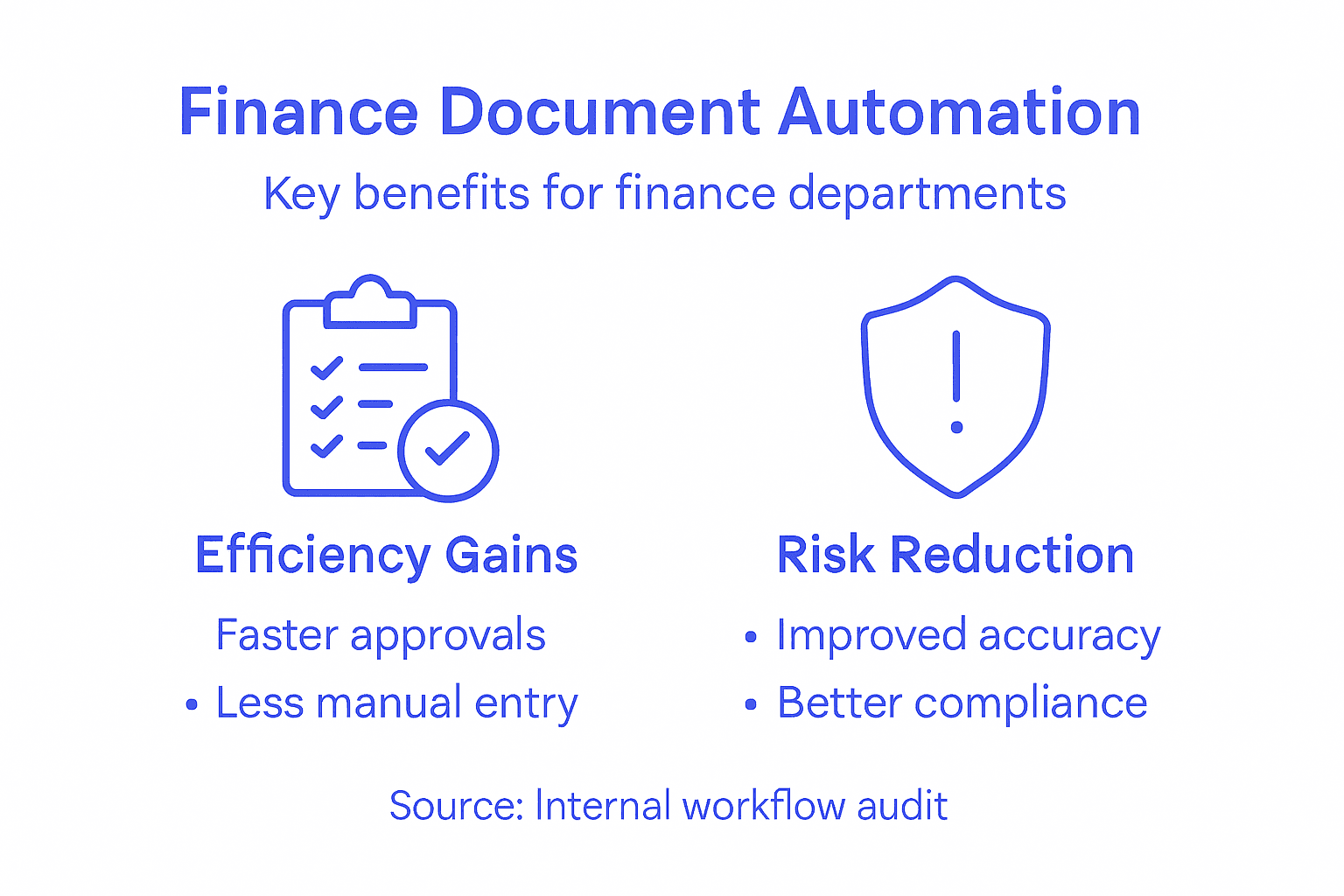
Financial document automation delivers significant improvements in accuracy, compliance, and operational efficiency through sophisticated technological capabilities. The key benefits span multiple critical areas:
-
Accuracy Enhancement
- Minimize manual data entry errors
- Apply AI-based validation techniques
- Ensure consistent data extraction
- Reduce human error probability
-
Compliance Management
- Generate comprehensive audit trails
- Automatically tag sensitive documents
- Ensure adherence to regulatory standards
- Maintain detailed version control
-
Scalability Advantages
- Handle high-volume document workflows
- Accelerate processing turnaround times
- Reduce operational costs
- Enable seamless expansion without additional headcount
The strategic implications of these benefits are profound. Automated systems can process complex financial documents with remarkable precision, transforming how organizations approach data management:
- Eliminate repetitive manual tasks
- Create standardized processing workflows
- Implement real-time error detection
- Support rapid decision-making processes
Automation transforms financial document processing from a labor-intensive burden into a strategic organizational asset.
These advanced solutions strengthen regulatory compliance mechanisms by providing centralized document management and detailed tracking capabilities. By mitigating risks and improving overall data integrity, finance teams can redirect their energy from administrative tasks to strategic analysis and value-generation activities.
Pro tip: Conduct a comprehensive audit of your current document processing workflow to identify the most impactful automation opportunities and prioritize implementation strategies.
Cost Considerations and Common Pitfalls
Financial document automation represents a strategic investment that requires careful planning and realistic expectations. While the potential benefits are significant, organizations must navigate complex implementation challenges and understand the nuanced financial implications of adopting these advanced technologies.
Implementing document automation involves substantial considerations that extend far beyond initial technology purchases. The key cost and implementation factors include:
-
Initial Technology Investment
- Software licensing fees
- Hardware infrastructure upgrades
- Integration consulting costs
- Professional implementation services
-
Ongoing Operational Expenses
- Regular software maintenance
- Continuous training programs
- System updates and upgrades
- Technical support subscriptions
-
Potential Hidden Costs
- Data migration expenses
- Legacy system compatibility challenges
- Workflow redesign efforts
- Change management initiatives
Most organizations encounter several critical challenges during implementation:
Below is a summary of common implementation pitfalls and their possible consequences:
| Common Pitfall | Potential Outcome | Suggested Mitigation |
|---|---|---|
| Inadequate change management | User resistance, workflow disruption | Invest in user training, clear communication |
| Insufficient integration testing | Data errors, system failures | Run comprehensive system tests |
| Poor data quality control | Reduced automation accuracy | Perform data cleansing before rollout |
| Overlooking scalability planning | System cannot handle growth | Plan for future needs during design |
- Underestimating change management requirements
- Neglecting comprehensive integration testing
- Failing to address data quality variations
- Overlooking scalability planning
Successful document automation demands a holistic approach that balances technological capabilities with organizational readiness.
Intelligent document processing solutions require strategic planning to mitigate risks and ensure smooth adoption. Finance teams must develop robust strategies that include phased rollouts, comprehensive data cleansing workflows, and proactive monitoring to maximize their automation investments.
Pro tip: Conduct a thorough cost-benefit analysis and pilot program to validate automation potential before full-scale implementation.
Revolutionize Your Financial Document Processing with BankStatementFlow
If you’re struggling with time-consuming manual entry, inconsistent data accuracy, or complex document integration, you are not alone. The article highlights how automated document processing can eliminate repetitive tasks, improve compliance, and scale alongside your business needs. BankStatementFlow addresses these challenges head-on by offering an AI-powered platform that guarantees up to 99% accuracy while converting unstructured financial documents like bank statements and invoices into structured data formats such as Excel, CSV, JSON, and XML.
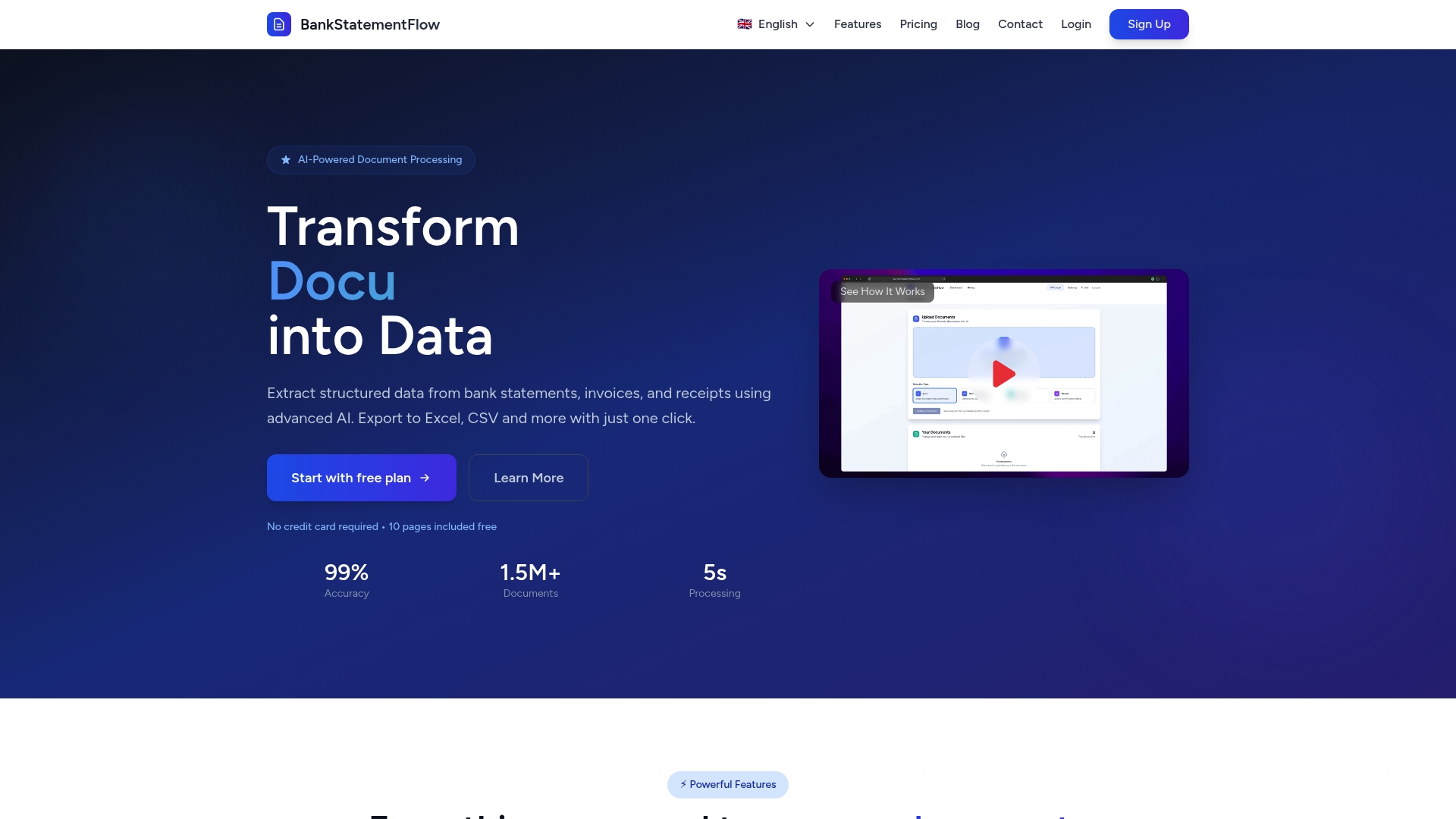
Discover how our advanced machine learning algorithms handle multiple languages, encrypted files, and images without requiring scanners, ensuring seamless workflow integration. Don’t let manual processes drain your team’s productivity. Visit BankStatementFlow now to explore how you can automate financial document extraction with precision. Start transforming your finance operations today and experience faster, error-free, and scalable document processing with BankStatementFlow.
Learn more about how intelligent automation can redefine your finance team’s workflow in the detailed insights covered at Financial Document Automation.
Frequently Asked Questions
What is automated document processing for finance teams?
Automated document processing uses advanced AI technologies to streamline the handling of financial documents. It captures, interprets, and extracts crucial data from unstructured information, significantly reducing manual effort and errors.
How can automating document processing improve accuracy in financial workflows?
Automation enhances accuracy by minimizing manual data entry errors and utilizing AI-based validation techniques. This ensures consistent data extraction and reduces the likelihood of human error, leading to more reliable financial records.
What are the benefits of automating financial document processing?
The primary benefits include improved accuracy, enhanced compliance with regulatory standards, increased operational efficiency, and scalability to handle high-volume document workflows without additional staffing costs.
What key technologies are involved in automated document processing?
Key technologies include Optical Character Recognition (OCR) for text extraction, Natural Language Processing (NLP) for understanding financial language, and Machine Learning for continuous improvement and intelligent classification of documents.
Recommended
- How to Automate Financial Documents for Fast, Accurate Data - BankStatementFlow Blog
- Trends in Financial Automation 2026: What CFOs Need - BankStatementFlow Blog
- 7 Key Bank Statement Automation Benefits for Analysts - BankStatementFlow Blog
- The AI Document Processing Revolution: How BankStatementFlow is Changing Business - BankStatementFlow Blog