Trends in Financial Automation 2026: What CFOs Need

Staying ahead in a rapidly changing financial world means rethinking the way your organization handles complexity and scale. As global economic pressure and ever-shifting compliance demands mount, the promise of advanced financial automation is no longer just about saving time or cutting costs. This overview helps clarify how the newest intelligent systems in 2026 offer not only efficiency but also strategic agility, resilience, and deeper operational precision for finance leaders.
Table of Contents
- Defining Financial Automation In 2026 Context
- Key Automation Technologies Redefining Finance
- Real-World Applications And Use Cases For Cfos
- Regulatory, Data Security, And Compliance Issues
- Risks, Implementation Challenges, And Best Practices
Key Takeaways
| Point | Details |
|---|---|
| Comprehensive Financial Automation | Financial automation in 2026 goes beyond digitization to create adaptive, resilient systems. |
| Adoption of Advanced Technologies | Technologies like AI, RPA, and machine learning transform how financial teams operate. |
| CFO Strategic Shift | CFOs are evolving from traditional tasks to strategic leadership through automation. |
| Focus on Compliance and Security | Automation must address regulatory compliance and data security with adaptive measures. |
Defining Financial Automation in 2026 Context
Financial automation in 2026 represents a profound technological transformation beyond traditional process digitization. It signifies a strategic reimagining of financial operations powered by intelligent, adaptive technologies that fundamentally reshape how organizations manage financial workflows. Advanced AI-driven automation platforms are now enabling companies to move from incremental improvements to comprehensive operational redesign.
At its core, financial automation encompasses several critical dimensions:
- Intelligent Process Automation: Utilizing machine learning algorithms to execute complex financial tasks
- End-to-End Workflow Optimization: Transforming entire financial processes rather than isolated tasks
- Predictive Analytics Integration: Embedding real-time insights into financial decision-making
- Regulatory Compliance Automation: Automatically adapting to changing compliance requirements
The strategic objective of financial automation extends far beyond cost reduction. Modern enterprises are leveraging these technologies to create more resilient, adaptive financial ecosystems that can rapidly respond to market dynamics. By shifting repetitive manual tasks to intelligent systems, financial teams can redirect human talent toward higher-value strategic initiatives.
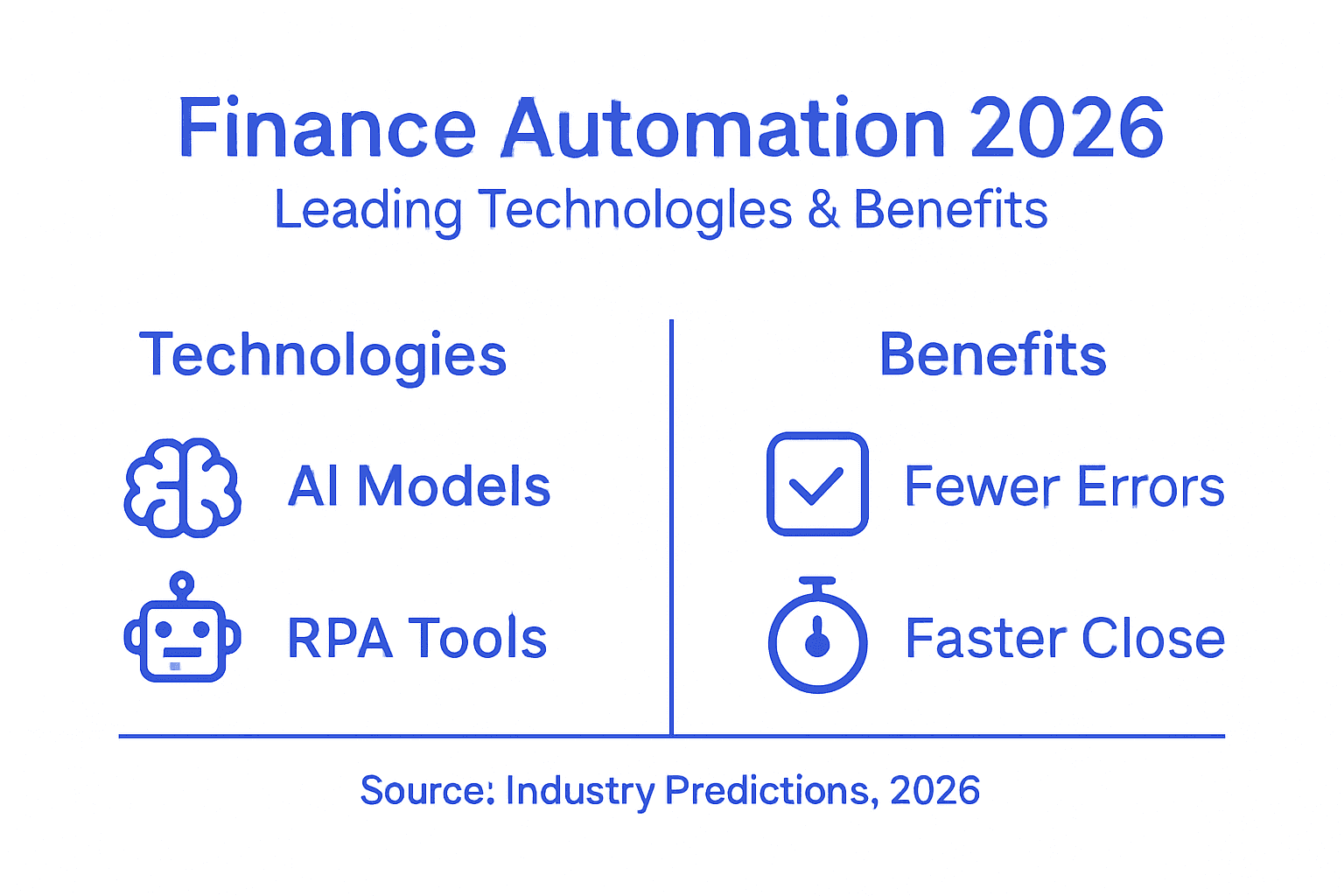
Technological Foundations driving this transformation include advanced AI capabilities, robotic process automation (RPA), and sophisticated machine learning models that can interpret complex financial documents with unprecedented accuracy. Finance automation platforms now support comprehensive end-to-end solutions spanning accounting, bookkeeping, financial analysis, and regulatory reporting.
Pro tip: Evaluate your financial automation strategy not just on cost savings, but on its potential to create strategic organizational agility and unlock innovative capabilities.
Key Automation Technologies Redefining Finance
The landscape of financial technologies is undergoing a radical transformation, driven by sophisticated automation solutions that are redefining how organizations manage complex financial processes. Generative AI and Agentic AI technologies are emerging as powerful tools that not only streamline operations but fundamentally reimagine financial workflow strategies.
Key automation technologies disrupting the financial sector include:
- Robotic Process Automation (RPA): Automating high-volume repetitive tasks
- Generative AI: Creating intelligent content and communications
- Machine Learning Models: Developing predictive financial insights
- Autonomous Decision Systems: Enabling real-time strategic responses
- Advanced Analytics Platforms: Transforming raw data into strategic intelligence
These technologies are not merely incremental improvements but represent a fundamental shift in how financial teams operate. By leveraging intelligent automation, organizations can dramatically reduce manual interventions, minimize error rates, and redirect human talent toward more strategic, high-value initiatives that require complex reasoning and creative problem-solving.
The integration of these technologies enables a new paradigm of financial intelligence where systems can learn, adapt, and make increasingly sophisticated decisions. Advanced machine learning algorithms can now predict financial trends, detect anomalies, and provide nuanced recommendations that were previously impossible through traditional analytical approaches.
Below is a comparison of key automation technologies shaping financial operations in 2026:
| Technology | Primary Benefit | Typical Use Case |
|---|---|---|
| Robotic Process Automation | Reduces manual effort | Invoice processing |
| Generative AI | Enhances communication | Automated report generation |
| Machine Learning | Delivers predictive insights | Cash flow forecasting |
| Autonomous Decision Systems | Enables real-time actions | Fraud detection decisions |
| Advanced Analytics Platforms | Provides strategic intelligence | Profitability trend analysis |
Pro tip: Prioritize automation technologies that offer not just efficiency, but adaptive learning capabilities that can evolve alongside your organization’s strategic objectives.
Real-World Applications and Use Cases for CFOs
As financial technology evolves, CFOs are strategically deploying automation technologies to transform traditional operational models. Finance professionals are targeting workflow automation to enhance efficiency, strategic influence, and organizational performance across multiple critical domains.
Practical applications of financial automation for CFOs include:
- Predictive Financial Forecasting: Using AI to generate more accurate revenue projections
- Automated Compliance Monitoring: Real-time tracking of regulatory requirements
- Intelligent Risk Management: Identifying potential financial vulnerabilities
- Strategic Cost Optimization: Analyzing spending patterns and recommending efficiencies
- Dynamic Financial Reporting: Generating comprehensive insights with minimal manual intervention
These use cases demonstrate how automation is shifting the CFO’s role from traditional number-crunching to strategic leadership. Advanced machine learning algorithms can now analyze complex financial datasets, detecting subtle patterns and anomalies that human analysts might overlook. This technological leap enables finance leaders to make data-driven decisions with unprecedented speed and precision.

The transformative potential extends beyond operational efficiency. By automating routine tasks, CFOs can redirect their teams’ cognitive resources toward high-value strategic initiatives, such as developing innovative financial strategies, exploring new market opportunities, and driving organizational growth. The result is a more agile, intelligent financial function that serves as a true strategic partner to the broader business.
Pro tip: Implement a phased automation strategy that prioritizes high-impact, low-complexity processes to build organizational confidence and demonstrate tangible value.
Regulatory, Data Security, and Compliance Issues
In the rapidly evolving landscape of financial technologies, regulatory compliance has become increasingly complex and critical. Financial automation platforms are crucial for meeting regulatory requirements, providing sophisticated mechanisms to navigate the intricate web of global financial regulations and data protection standards.
Key regulatory and data security considerations for CFOs include:
- Comprehensive Audit Trails: Maintaining transparent, trackable financial documentation
- Encryption and Data Protection: Implementing robust security protocols
- Regulatory Standard Adherence: Ensuring compliance with international frameworks
- Real-Time Compliance Monitoring: Continuous tracking of regulatory changes
- Risk Mitigation Strategies: Proactively identifying and addressing potential vulnerabilities
The digital transformation of financial processes demands a multifaceted approach to regulatory compliance. Advanced automation technologies now enable organizations to create dynamic compliance ecosystems that can adapt in real-time to changing regulatory landscapes. These systems go beyond simple rule-following, integrating intelligent monitoring capabilities that can anticipate and respond to potential compliance risks before they become critical issues.
Moreover, data security has become a paramount concern in financial automation. Sophisticated platforms now incorporate multi-layered security architectures that protect sensitive financial information through advanced encryption, secure access controls, and comprehensive monitoring systems. This approach ensures that while financial processes become more automated and efficient, they simultaneously become more secure and resilient against potential cyber threats.
Pro tip: Develop a comprehensive compliance automation strategy that integrates technological solutions with ongoing staff training and awareness programs.
Risks, Implementation Challenges, and Best Practices
Financial automation represents a transformative journey fraught with complex implementation challenges that demand strategic, nuanced approaches. While the potential benefits are substantial, organizations must navigate a sophisticated landscape of technological, cultural, and operational risks that can potentially derail their automation initiatives.
Key risks and challenges include:
- Technology Integration Complexity: Ensuring seamless compatibility with existing systems
- Data Migration Challenges: Preserving data integrity during transformation
- Skill Gap Uncertainties: Addressing workforce readiness and technological adaptation
- Change Management Resistance: Overcoming organizational inertia and cultural barriers
- Initial Investment Uncertainties: Managing high upfront technological costs
Successful financial automation requires a holistic approach that transcends mere technological deployment. Strategic implementation involves creating a comprehensive roadmap that addresses technological capabilities, human capital development, and organizational cultural transformation. This means developing adaptive strategies that view automation not as a one-time technological upgrade, but as a continuous organizational learning process.
Moreover, risk mitigation demands a proactive, multidimensional strategy. Organizations must develop robust governance frameworks that include continuous monitoring, regular skill assessments, and flexible technological architectures capable of evolving with emerging financial technologies. This approach ensures that automation initiatives remain aligned with broader organizational objectives while maintaining operational resilience and adaptability.
Here is a summary contrasting main risks with best-practice mitigation strategies in financial automation:
| Major Risk | Example Impact | Best-Practice Mitigation |
|---|---|---|
| Integration Complexity | System outages | Conduct phased rollouts |
| Data Migration Challenges | Data loss or errors | Employ secure migration validation |
| Skill Gaps | Staff inefficiency | Invest in targeted training |
| Change Resistance | Project delays | Foster open communication |
| High Upfront Costs | Budget overruns | Start with high-ROI pilot projects |
Pro tip: Conduct a comprehensive organizational readiness assessment before launching financial automation initiatives, focusing on technological infrastructure, workforce capabilities, and cultural adaptability.
Unlock Smarter Financial Automation with BankStatementFlow
CFOs and finance teams face growing challenges around managing complex financial documents efficiently while ensuring accuracy and compliance. The article highlights key pain points like reducing manual effort, accelerating financial workflows, and integrating intelligent automation technologies. If your organization strives to enhance predictive financial forecasting, automate compliance monitoring, and optimize cost through real-time data insights, embracing AI-powered document processing is essential. BankStatementFlow answers these needs by transforming unstructured financial data from bank statements, invoices, and receipts into clean, structured formats with up to 99% accuracy.
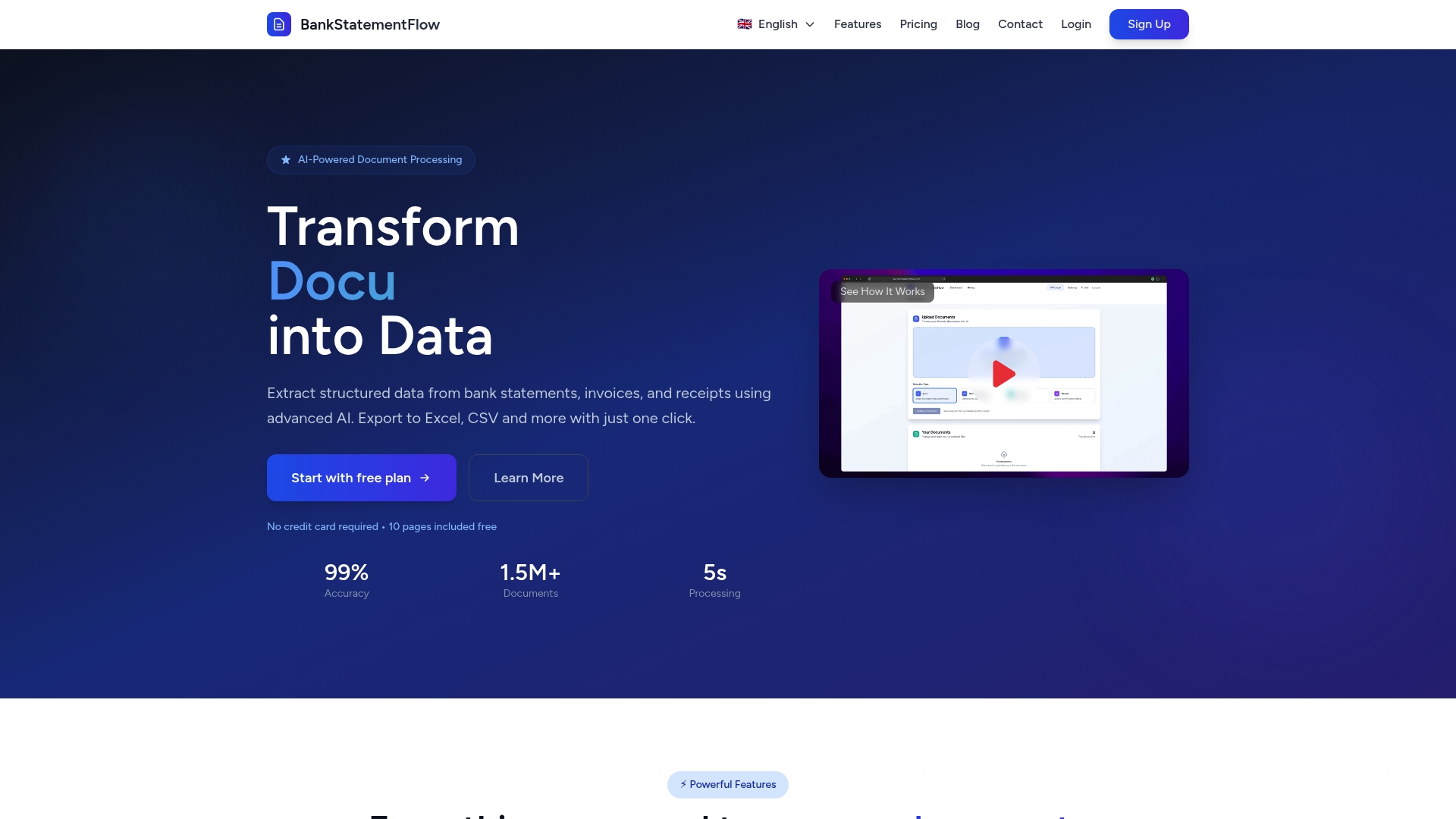
Explore how you can empower your finance team with a cutting-edge SaaS platform that supports encrypted PDFs, multiple languages, and phone photo imports without scanners. Harness advanced machine learning to eliminate errors and save precious time while increasing operational resilience. Discover more about financial automation solutions designed to address the challenges outlined in Trends in Financial Automation 2026 and learn why proactive finance leaders rely on BankStatementFlow. Take the next step toward financial agility and secure your competitive advantage today by visiting BankStatementFlow and seeing how intelligent document processing can transform your workflows.
Frequently Asked Questions
What is financial automation in 2026?
Financial automation in 2026 involves utilizing advanced technologies such as AI and machine learning to redefine financial operations, enabling organizations to optimize entire workflows instead of just automating isolated tasks.
What are the key technologies driving financial automation?
Key technologies include Robotic Process Automation (RPA), Generative AI, Machine Learning Models, Autonomous Decision Systems, and Advanced Analytics Platforms, each contributing to more efficient and intelligent financial processes.
How can CFOs benefit from financial automation?
CFOs can benefit from financial automation by improving predictive financial forecasting, automating compliance monitoring, enhancing risk management, optimizing costs, and generating dynamic financial reports, ultimately enabling more strategic decision-making.
What challenges do organizations face when implementing financial automation?
Organizations face challenges such as technology integration complexity, data migration issues, skill gaps within the workforce, resistance to change, and high upfront costs, which require careful planning and management to overcome.
Recommended
- Staying Compliant: Financial Automation and Regulatory Requirements - BankStatementFlow Blog
- How to Automate Financial Documents for Fast, Accurate Data - BankStatementFlow Blog
- 7 Key Bank Statement Automation Benefits for Analysts - BankStatementFlow Blog
- The Future of FinTech: How AI is Reshaping Financial Services - BankStatementFlow Blog