7 Practical Examples of AI in Banking for Accuracy

Banking professionals face growing pressure to process documents faster while keeping errors and fraud to a minimum. Manual methods can be slow, error-prone, and leave you vulnerable to missed details or security gaps. With advances in artificial intelligence, you now have access to powerful tools that automate extraction, detect suspicious activity, and provide actionable insights from even the most complex financial documents.
This guide reveals key ways AI improves banking workflows, from analyzing PDF statements with cutting-edge precision to spotting fraud patterns that humans might overlook. Get ready to discover practical methods you can start using right away to save time, reduce risk, and make smarter decisions in your daily banking operations.
Table of Contents
- Automating Data Extraction From Bank Statements
- Detecting And Preventing Fraud With AI Algorithms
- Streamlining Loan Approval Using Machine Learning
- Enhancing Customer Service With AI-Powered Chatbots
- Speeding Up Regulatory Compliance Checks
- Improving Financial Forecasting With Predictive Analytics
- Supporting Multi-Format Document Processing
Quick Summary
| Key Insight | Explanation |
|---|---|
| 1. AI reduces manual data entry by 90%. | Advanced AI technologies automate data extraction, significantly cutting down the time required for manual entries from bank statements. |
| 2. AI enhances fraud detection instantaneously. | Sophisticated AI algorithms analyze transactions in real-time, identifying potential fraudulent activities within milliseconds for improved security. |
| 3. Machine learning streamlines loan approval processes. | AI-powered systems evaluate borrower data rapidly, offering faster, more objective decisions that mitigate potential biases in traditional lending. |
| 4. AI chatbots transform customer interactions. | Chatbots provide 24/7 support, addressing routine inquiries quickly while freeing human agents to tackle more complex issues. |
| 5. AI accelerates regulatory compliance monitoring. | Machine learning technologies facilitate swift processing of regulatory data, ensuring adherence to complex financial regulations in real-time. |
1. Automating Data Extraction from Bank Statements
Bank statement processing has long been a tedious manual task filled with potential human errors. However AI technologies are transforming this landscape by enabling rapid and accurate data extraction from complex financial documents.
Modern AI systems can now automatically read and analyze bank statements using advanced optical character recognition (OCR) and machine learning algorithms. These sophisticated technologies can extract structured data from heterogeneous documents with remarkable precision, eliminating the need for time-consuming manual data entry.
The key capabilities of AI-powered data extraction include:
- Handling multiple document formats (PDF, scanned images, encrypted files)
- Converting unstructured financial data into structured spreadsheets
- Identifying and categorizing transactions automatically
- Recognizing complex bank statement layouts from different financial institutions
For financial analysts and accounting professionals, this technology offers significant benefits:
- Reduces manual data entry time by up to 90%
- Minimizes human error in financial record keeping
- Accelerates financial reporting and reconciliation processes
- Enables real-time financial insights and analysis
AI-powered document extraction transforms bank statement processing from a time-consuming task into a seamless, accurate workflow.
Python libraries like PDF Statement Reader have made these advanced extraction techniques more accessible. By using configuration settings tailored to specific bank statement formats, organizations can now automate their financial document processing with unprecedented accuracy.
Pro tip: Always validate your AI extraction results with a random sample check to ensure maximum accuracy and catch any potential edge cases.
2. Detecting and Preventing Fraud with AI Algorithms
Traditional fraud detection methods are rapidly becoming obsolete in an increasingly complex digital financial landscape. AI algorithms have emerged as a powerful solution for identifying sophisticated financial fraud patterns.
Modern banking institutions are leveraging advanced machine learning techniques to create intelligent fraud prevention systems that analyze transactions in real time. These AI-driven systems go beyond simple rule-based detection by understanding complex behavioral patterns and anomalies that might indicate potential fraudulent activity.
Key AI fraud detection strategies include:
- Real-time transaction monitoring
- Behavioral pattern analysis
- Anomaly detection across multiple data points
- Predictive risk scoring
- Continuous learning and model adaptation
The technical mechanisms behind these AI systems involve sophisticated approaches:
- Preprocessing transaction data for analysis
- Applying machine learning classification models
- Creating dynamic fraud risk profiles
- Generating instant alerts for suspicious activities
AI fraud detection algorithms can identify potential threats milliseconds after a transaction occurs, providing unprecedented protection for financial institutions and consumers.
Machine learning models like logistic regression, decision trees, and neural networks are particularly effective in managing complex fraud detection challenges. These models can handle class imbalance issues and continuously improve their accuracy by learning from new data.
Pro tip: Regularly update your AI fraud detection models with recent transaction data to maintain high accuracy and adapt to emerging fraud techniques.
3. Streamlining Loan Approval Using Machine Learning
Traditional loan approval processes have long been plagued by slow decision-making and potential human bias. Machine learning is revolutionizing this critical banking function by transforming credit risk assessment strategies.
AI-powered loan approval systems leverage advanced algorithms to analyze complex borrower data far more comprehensively than human underwriters ever could. These intelligent systems can rapidly evaluate multiple variables simultaneously including credit history, income stability, financial behaviors, and predictive risk factors.
Key advantages of machine learning in loan approvals include:
- Dramatically reduced processing times
- More objective decision-making
- Enhanced predictive accuracy
- Comprehensive risk assessment
- Reduced operational costs
The technical mechanisms powering these AI systems involve:
- Data preprocessing and normalization
- Feature engineering and selection
- Machine learning model training
- Continuous model performance evaluation
- Real-time decision generation
Machine learning algorithms can assess loan applications with unprecedented speed and accuracy, transforming traditional banking risk management.
Central banks worldwide are recognizing the potential of these advanced technologies to create more fair and efficient lending practices. By minimizing human bias and analyzing vast datasets, machine learning models provide more nuanced and reliable credit assessments.
Pro tip: Implement hybrid AI models that combine machine learning insights with human oversight to balance technological efficiency with contextual understanding.
4. Enhancing Customer Service with AI-powered Chatbots
Customer service in banking is undergoing a radical transformation through artificial intelligence. Modern financial institutions are now leveraging advanced chatbot technologies to revolutionize customer interactions.
AI-powered chatbots represent a quantum leap in customer support by providing instant, intelligent, and personalized communication channels. These sophisticated digital assistants use natural language processing to understand complex customer inquiries and generate contextually appropriate responses in real time.
Key capabilities of AI chatbots in banking include:
- 24/7 customer support availability
- Instant response to routine banking queries
- Multilingual communication support
- Personalized financial recommendations
- Seamless transaction assistance
The technological mechanisms powering these intelligent assistants involve:
- Natural language understanding algorithms
- Machine learning model training
- Continuous interaction refinement
- Sentiment analysis capabilities
- Secure data processing protocols
AI chatbots transform customer service from a reactive process to a proactive, intelligent interaction platform.
Banking chatbots significantly reduce operational costs while maintaining high service quality. By handling routine inquiries automatically, these digital assistants free human representatives to focus on more complex customer needs that require nuanced understanding.
Pro tip: Design your AI chatbot with clear escalation paths to human representatives for handling complex or emotionally sensitive customer interactions.
5. Speeding Up Regulatory Compliance Checks
Regulatory compliance has traditionally been a complex and time-consuming process for financial institutions. AI is now transforming this landscape by accelerating compliance monitoring capabilities.
Machine learning algorithms have emerged as powerful tools that enable banks to process vast amounts of regulatory data with unprecedented speed and accuracy. These intelligent systems can automatically review transactions, detect potential anomalies, and ensure adherence to complex regulatory frameworks in near real-time.
Key advantages of AI in regulatory compliance include:
- Rapid transaction screening
- Automatic pattern recognition
- Reduced human error
- Continuous monitoring capabilities
- Adaptive risk assessment
The technological mechanisms driving these compliance innovations involve:
- Advanced data preprocessing
- Machine learning model training
- Anomaly detection algorithms
- Automated reporting systems
- Continuous regulatory standard updates
AI transforms regulatory compliance from a reactive process to a proactive, intelligent risk management strategy.
Specifically, AI helps banks navigate critical regulatory requirements like anti-money laundering (AML) and know-your-customer (KYC) protocols by analyzing complex datasets faster and more accurately than traditional manual methods.
Pro tip: Implement a hybrid compliance approach that combines AI-powered monitoring with periodic human expert reviews to maintain maximum accuracy and regulatory alignment.
6. Improving Financial Forecasting with Predictive Analytics
Traditional financial forecasting methods are rapidly becoming obsolete in an increasingly complex global economy. AI-powered predictive analytics are revolutionizing how banks and financial institutions generate accurate economic predictions.
Machine learning algorithms can now analyze vast amounts of historical and real-time data to generate remarkably precise financial forecasts. These sophisticated models go beyond traditional statistical techniques by identifying intricate patterns and relationships that human analysts might overlook.
Key advantages of AI-driven predictive analytics include:
- Rapid processing of complex datasets
- Reduced human bias in forecasting
- Dynamic model adaptation
- Enhanced risk assessment capabilities
- Comprehensive scenario modeling
The technological mechanisms powering these predictive systems involve:
- Data preprocessing and normalization
- Advanced machine learning algorithm selection
- Feature engineering and selection
- Continuous model performance evaluation
- Real-time forecast generation
Predictive analytics transform financial forecasting from a static projection to a dynamic, intelligent prediction engine.
By integrating multiple data sources and applying sophisticated machine learning techniques, these AI models can generate insights that help financial professionals make more informed strategic decisions.
Pro tip: Regularly retrain your predictive models with recent data to maintain high accuracy and adapt to evolving economic conditions.
7. Supporting Multi-format Document Processing
Document processing in banking has traditionally been a complex and time-consuming challenge, with financial institutions struggling to manage diverse document formats. AI technologies are now transforming multi-format document extraction.
Advanced artificial intelligence systems can now seamlessly process documents across multiple formats including PDFs, scanned images, handwritten notes, screenshots, and encrypted files. These intelligent platforms use sophisticated computer vision and natural language processing techniques to extract structured data accurately.
Key capabilities of multi-format AI document processing include:
- Handling diverse document structures
- Extracting data from complex layouts
- Supporting multiple languages
- Processing encrypted and password-protected files
- Interpreting different image and text qualities
The technological mechanisms enabling these capabilities involve:
- Advanced optical character recognition (OCR)
- Machine learning model training
- Computer vision algorithms
- Natural language processing techniques
- Adaptive learning frameworks
AI document processing transforms unstructured data into actionable, structured information across any format.
Modern AI systems can now handle heterogeneous documents with remarkable accuracy, reducing manual data entry efforts and minimizing human error in financial record keeping.
Pro tip: Regularly update your AI document processing models with diverse document samples to improve recognition accuracy across different formats and languages.
Below is a comprehensive table summarizing the key technologies, strategies, and benefits discussed in the article regarding AI advancements in banking operations.
| Topic | Details | Advantages |
|---|---|---|
| Automating Data Extraction | AI systems utilizing OCR and machine learning automate reading and structuring data from bank statements. | Eliminates manual entry, saves time, reduces errors. |
| Fraud Detection | Advanced algorithms monitor transactions and analyze behavioral patterns to identify anomalies signaling fraud. | Enhances security, provides proactive protection. |
| Loan Approval Process | Machine learning evaluates borrower data comprehensively, reducing time and bias in credit risk assessments. | Simplifies approvals, enables fairer decision-making. |
| Customer Service with Chatbots | AI chatbots provide instant multilingual customer support and personalized assistance through real-time natural language processing. | Improves customer satisfaction, optimizes resource allocation. |
| Regulatory Compliance | AI tools screen transactions and ensure adherence to regulations like AML and KYC through anomaly detection algorithms. | Accelerates monitoring, maintains strict compliance. |
| Financial Forecasting | Predictive analytics employ machine learning to generate accurate forecasts by analyzing varied datasets. | Enhances decision-making, ensures robust economic predictions. |
| Multi-format Document Processing | Intelligent systems process various document types using OCR and NLP techniques. | Improves data handling from diverse sources efficiently. |
Transform Your Banking Accuracy with AI-Powered Document Processing
The article highlights key challenges in banking such as manual errors, slow workflows, and the complexity of handling diverse financial documents. If you are looking to eliminate human error, accelerate data extraction, and automate multi-format financial document processing then BankStatementFlow offers the precise solution you need. Our AI-driven platform turns unstructured data from bank statements, invoices, and receipts into highly accurate structured data formats rapidly and securely.
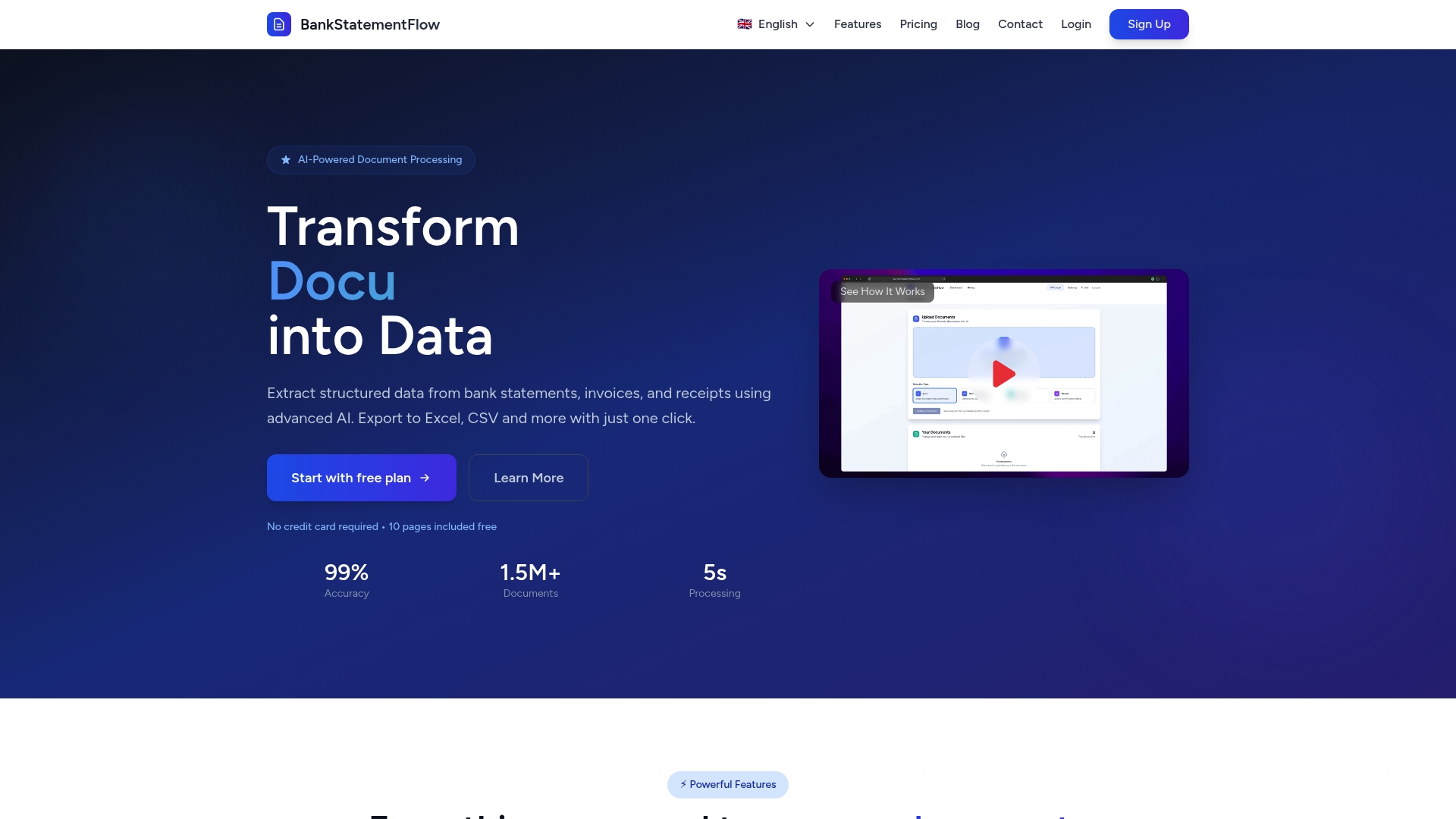
Experience how BankStatementFlow’s advanced machine learning algorithms can save you time and boost accuracy by automating the extraction process described in the article. Start transforming your financial data management today by visiting BankStatementFlow. Explore how our platform supports encrypted files, multiple languages, and API integration to fit seamlessly within your existing workflow. Don’t let manual financial document processing hold your team back any longer. Visit BankStatementFlow now and unlock the power of AI for your banking accuracy needs.
Frequently Asked Questions
How can AI improve data extraction accuracy from bank statements?
AI can significantly enhance data extraction accuracy by using advanced optical character recognition (OCR) and machine learning algorithms. Implement AI solutions to automate the processing of bank statements, which can reduce manual data entry time by up to 90% and minimize human error.
What role does AI play in detecting financial fraud?
AI plays a crucial role in detecting financial fraud by analyzing transactions in real-time to identify suspicious patterns and anomalies. Implement AI-driven fraud detection systems to continuously learn and adapt, enabling faster identification of threats and improving security measures.
How does machine learning streamline loan approval processes in banking?
Machine learning streamlines loan approval processes by analyzing borrower data more comprehensively than traditional human assessments. Use machine learning algorithms to quickly evaluate multiple risk factors, which can reduce processing times significantly and enhance decision-making accuracy.
What benefits do AI-powered chatbots offer for customer service in banking?
AI-powered chatbots enhance customer service by providing instant and personalized responses to customer inquiries at any time. Implement chatbots to handle routine questions, which can improve overall customer satisfaction and free human representatives to address more complex issues.
How is AI changing the approach to regulatory compliance checks in banking?
AI is transforming regulatory compliance by automating the review of transactions and ensuring adherence to complex regulations more efficiently. Incorporate AI systems to conduct continuous monitoring, which can significantly reduce human error and improve compliance accuracy.
What impact does predictive analytics have on financial forecasting?
Predictive analytics powered by AI significantly improves financial forecasting by analyzing large datasets to generate precise predictions. Utilize AI-driven models for forecasting to enhance decision-making capabilities, resulting in actionable insights that can adjust to evolving economic conditions.
Recommended
- The Future of FinTech: How AI is Reshaping Financial Services - BankStatementFlow Blog
- 7 Key Bank Statement Automation Benefits for Analysts - BankStatementFlow Blog
- Trends in Financial Automation 2026: What CFOs Need - BankStatementFlow Blog
- How to Automate Financial Documents for Fast, Accurate Data - BankStatementFlow Blog