7 Essential Types of Financial Documents Explained

Sorting through crucial financial documents like bank statements, invoices, and receipts can quickly become overwhelming. One missed detail or misplaced record can lead to costly mistakes, headaches during audits, or compliance issues that leave your finances at risk.
You deserve a clear strategy for handling every key document with accuracy and confidence. This guide delivers actionable solutions to keep your financial records organized, improve transparency, and support better decision making.
Get ready to discover proven tips for managing the documents that matter most. Each section will bring you one step closer to mastering financial organization and safeguarding your business or personal finances.
Table of Contents
- Understanding Bank Statements for Data Accuracy
- Using Invoices for Efficient Transaction Tracking
- Processing Receipts to Validate Expenses
- Managing Credit Card Statements for Reconciliation
- Automating Payroll Documents for Compliance
- Structuring Tax Forms for Reporting Ease
- Handling Loan Agreements for Risk Assessment
Quick Summary
| Takeaway | Explanation |
|---|---|
| 1. Understand your bank statement components | Recognizing the core elements helps in verifying transaction accuracy and tracking cash flow efficiently. |
| 2. Automate invoice tracking for efficiency | Implementing automation reduces manual errors and streamlines the invoice processing workflow, enhancing financial transparency. |
| 3. Digitize receipts for tax compliance | Organizing and securely storing digital receipts ensures proper expense validation and simplifies future audits. |
| 4. Schedule timely credit card reviews | Reviewing statements promptly helps identify discrepancies and prevents potential fraud or financial mismanagement. |
| 5. Automate payroll to ensure compliance | Utilizing advanced payroll automation minimizes errors and supports adherence to regulatory requirements effectively. |
1. Understanding Bank Statements for Data Accuracy
Bank statements represent critical financial documents that capture every monetary transaction within a specific period. These comprehensive records provide an essential snapshot of account activity, enabling precise financial tracking and analysis for individuals and businesses alike.
Understanding bank statements involves recognizing their core components and potential complexities. Financial professionals rely on these documents to:
- Verify transaction accuracy
- Track cash flow patterns
- Detect potential fraudulent activities
- Prepare accurate tax documentation
- Reconcile accounting records
Modern bank statements often present challenges due to inconsistent transaction narrations. Bank statement automation technologies can help streamline data extraction and categorization, reducing manual processing errors.
Precise data interpretation starts with understanding every detail on your bank statement.
Companies and financial analysts frequently encounter narration entries that require sophisticated interpretation. These entries contain critical transaction details but traditionally demand extensive manual review. Advanced tools now leverage machine learning to automatically clean, categorize, and map transaction remarks with remarkable accuracy.
To maximize data accuracy, professionals should:
- Cross-reference physical and digital statements
- Use automated extraction tools
- Verify transaction descriptions
- Flag unusual or unrecognized entries
- Maintain consistent reconciliation practices
Pro tip: Always download and securely store digital bank statements monthly to maintain a comprehensive financial audit trail.
2. Using Invoices for Efficient Transaction Tracking
Invoices serve as fundamental financial documents that capture critical transaction details between buyers and sellers. These records are essential for tracking business expenses and maintaining accurate financial records.
Companies process numerous invoices daily which can quickly become overwhelming without strategic management. Invoice processing automation transforms how organizations handle these critical financial documents.
Accurate invoice tracking is the backbone of financial transparency and operational efficiency.
Understanding invoice management involves recognizing key elements that drive effective transaction documentation. Modern businesses benefit from advanced extraction techniques that streamline data collection and reduce manual processing time.
Effective invoice tracking requires focusing on:
- Capturing precise transaction details
- Verifying vendor information
- Maintaining consistent record-keeping
- Implementing automated data extraction
- Establishing clear approval workflows
Research indicates that companies can significantly improve efficiency by adopting advanced data extraction technologies. Deep learning methods like Faster R-CNN and natural language processing can automatically extract critical invoice fields with high accuracy.
Key strategies for efficient invoice management include:
- Digitize all incoming invoices
- Implement automated data validation
- Create standardized processing workflows
- Use AI-powered extraction tools
- Establish multi-level verification processes
Pro tip: Develop a consistent digital filing system for invoices to ensure quick retrieval and maintain a comprehensive financial audit trail.
3. Processing Receipts to Validate Expenses
Receipts are more than just paper trails. They represent critical financial documents that validate business expenses and ensure accurate accounting and tax reporting.
Automated expense tracking has transformed how organizations manage and process these essential financial records. By digitizing and streamlining receipt management businesses can significantly reduce manual errors and improve financial oversight.
Every receipt tells a financial story that requires careful documentation and verification.
To be considered valid for tax and reimbursement purposes receipts must include specific key elements. These critical components ensure transparency and compliance with organizational and governmental financial regulations.
Essential receipt validation components include:
- Vendor name and contact information
- Transaction date
- Detailed description of goods or services
- Total amount paid
- Payment method used
- Unique transaction identifier
Effective receipt processing requires a systematic approach. Robust documentation practices help organizations maintain financial integrity and prepare for potential audits.
Strategic steps for receipt management:
- Digitize receipts immediately after purchase
- Categorize expenses consistently
- Store digital copies securely
- Cross-reference with bank statements
- Establish clear submission guidelines
Pro tip: Create a dedicated digital folder system and scan receipts within 24 hours of purchase to prevent loss and simplify future financial tracking.
4. Managing Credit Card Statements for Reconciliation
Credit card statements are comprehensive financial records that track every transaction, providing critical insights into spending patterns and financial health. These documents serve as essential tools for both personal and business financial management.
Data security in financial documents plays a crucial role in protecting sensitive transaction information during the reconciliation process. Understanding how to effectively review and validate these statements can prevent potential financial discrepancies.
Reconciliation transforms raw transaction data into meaningful financial intelligence.
The reconciliation process involves meticulously comparing credit card statements against internal records to ensure accuracy and identify any unauthorized or incorrect charges. This systematic review helps maintain financial integrity and prevents potential fraud.
Key elements to examine during credit card statement reconciliation:
- Transaction dates and amounts
- Merchant names and locations
- Recurring charges and subscriptions
- Potential duplicate charges
- Unusual or unexpected transactions
- International transaction fees
Effective reconciliation requires a structured and consistent approach. Businesses and individuals must develop reliable verification protocols to catch potential errors or fraudulent activities early.
Step-by-step reconciliation strategy:
- Download monthly credit card statements
- Compare transactions with receipt records
- Flag and investigate any discrepancies
- Document all reviewed transactions
- Maintain a detailed reconciliation log
Pro tip: Schedule your credit card statement review within 48 hours of receiving the statement to ensure timely detection of any potential issues.
5. Automating Payroll Documents for Compliance
Payroll document management represents a complex landscape of regulatory requirements and critical financial processes. Automating these documents can significantly reduce errors and ensure precise compliance with federal and state regulations.
Compliance with financial automation transforms how organizations handle sensitive employee compensation information. Modern businesses must navigate intricate legal frameworks while maintaining accurate and secure payroll records.
Payroll automation bridges the gap between complex regulatory requirements and operational efficiency.
Effective payroll document management encompasses multiple critical components that extend far beyond simple salary calculations. Organizations must track detailed employment classifications, tax withholdings, reporting requirements, and employee compensation structures.
Key areas requiring meticulous documentation include:
- Employee classification status
- Tax withholding information
- Hours worked and compensation rates
- Benefit and retirement contributions
- Overtime and special payment calculations
- Compliance with state and federal regulations
Implementing advanced payroll automation technologies helps organizations maintain precise financial record keeping. This approach minimizes human error and provides comprehensive documentation for potential audits.
Strategic steps for payroll document automation:
- Select robust payroll management software
- Standardize document capture processes
- Implement multi-level verification protocols
- Establish secure data storage mechanisms
- Create consistent reporting frameworks
Pro tip: Conduct quarterly compliance audits of your payroll automation system to ensure ongoing accuracy and regulatory alignment.
6. Structuring Tax Forms for Reporting Ease
Tax forms represent complex financial documents that require precision and careful organization. Effective management of these critical records can significantly simplify the reporting process and reduce potential compliance risks.
How to automate financial documents has transformed traditional approaches to tax form management. Understanding the nuanced requirements of various tax documents helps individuals and businesses streamline their financial reporting.
Structured tax documentation is the foundation of accurate financial transparency.
Modern tax reporting demands comprehensive attention to detail across multiple form types and regulatory requirements. Taxpayers must navigate intricate documentation standards while ensuring complete and accurate information disclosure.
Critical components of effective tax form structuring include:
- Organizing income documentation
- Tracking deduction-eligible expenses
- Maintaining comprehensive supporting records
- Understanding form-specific requirements
- Preserving historical tax documentation
- Implementing secure digital storage systems
Successful tax form management requires strategic document preparation and proactive compliance strategies. This approach minimizes errors and supports seamless interaction with tax authorities.
Step-by-step tax form structuring process:
- Collect all relevant financial records
- Categorize income and expense documents
- Verify information accuracy
- Create systematic digital filing system
- Cross-reference supporting documentation
Pro tip: Develop a consistent digital archiving strategy that allows quick retrieval of tax documents for at least seven years.
7. Handling Loan Agreements for Risk Assessment
Loan agreements represent complex financial contracts that require meticulous scrutiny and comprehensive risk management strategies. Understanding the nuanced elements of these documents is crucial for protecting financial interests and minimizing potential exposure.
Compliance with financial automation has transformed how organizations approach loan agreement risk assessment. Modern financial professionals leverage advanced technologies to analyze and mitigate potential lending risks.
Effective risk management transforms loan agreements from potential liabilities into strategic financial opportunities.
Comprehensive loan agreement risk assessment involves multiple interconnected evaluation processes. Financial institutions must develop robust frameworks that systematically analyze borrower capabilities and potential vulnerabilities.
Key risk assessment components include:
- Borrower credit history evaluation
- Income and financial stability verification
- Comprehensive collateral assessment
- Debt-to-income ratio analysis
- Market condition impact assessment
- Potential default scenario modeling
Successful risk management requires strategic document analysis and proactive compliance strategies. This approach enables financial institutions to make informed lending decisions while protecting their economic interests.
Step-by-step loan agreement risk assessment process:
- Gather comprehensive borrower documentation
- Perform detailed credit background checks
- Analyze financial stability indicators
- Evaluate collateral and security provisions
- Develop risk mitigation strategies
Pro tip: Implement a dynamic risk scoring model that continuously updates based on real-time financial data and changing market conditions.
The following table summarizes the essential points and strategies discussed in the article regarding the effective management and automation of financial documents and processes, emphasizing accuracy, transparency, and operational efficiency.
| Financial Document | Purpose and Significance | Best Practices |
|---|---|---|
| Bank Statements | Records financial transactions enabling activity tracking. | Cross-reference with digital counterparts, use automation for data extraction, flag unusual entries. |
| Invoices | Facilitates buyer-seller transaction tracking and record-keeping. | Digitize invoices, implement AI extraction tools, create structured workflows. |
| Receipts | Validates business expenses, ensuring compliance and accurate reporting. | Scan after purchase, categorize expenses, cross-reference with statements, maintain digital records securely. |
| Credit Card Statements | Provides insights into spending patterns and aids reconciliation for accuracy. | Download statements promptly, compare with receipts, investigate discrepancies, and document review processes. |
| Payroll Documents | Manages complex employee compensation records ensuring legal compliance. | Automate processes, establish secure data retention systems, conduct quarterly audits. |
| Tax Forms | Ensures comprehensive documentation for transparent and accurate financial reporting. | Categorize and verify income/expenses, implement secure digital filing systems, maintain a seven-year archive. |
| Loan Agreements | Assesses borrower financial health and mitigates potential risks. | Perform credit/financial stability checks, evaluate collateral, develop and update risk models integrating real-time data. |
Streamline Your Financial Document Management with AI-Powered Automation
Managing the seven essential types of financial documents can be overwhelming due to their complexity and the risk of manual errors. Whether you are dealing with bank statements, invoices, receipts, credit card statements, payroll documents, tax forms, or loan agreements, ensuring data accuracy and compliance is crucial. Common challenges like inconsistent transaction narrations, time-consuming manual extraction, and risk of non-compliance demand a smarter approach.
BankStatementFlow offers an advanced SaaS platform that automates the extraction and structuring of data from diverse financial documents with up to 99% accuracy. Supported by powerful machine learning algorithms, our solution handles everything from password-protected PDFs to images, eliminating tedious manual work and accelerating your financial workflows. Experience seamless integration with your existing systems through our flexible APIs and benefit from enhanced data security tailored for financial professionals.
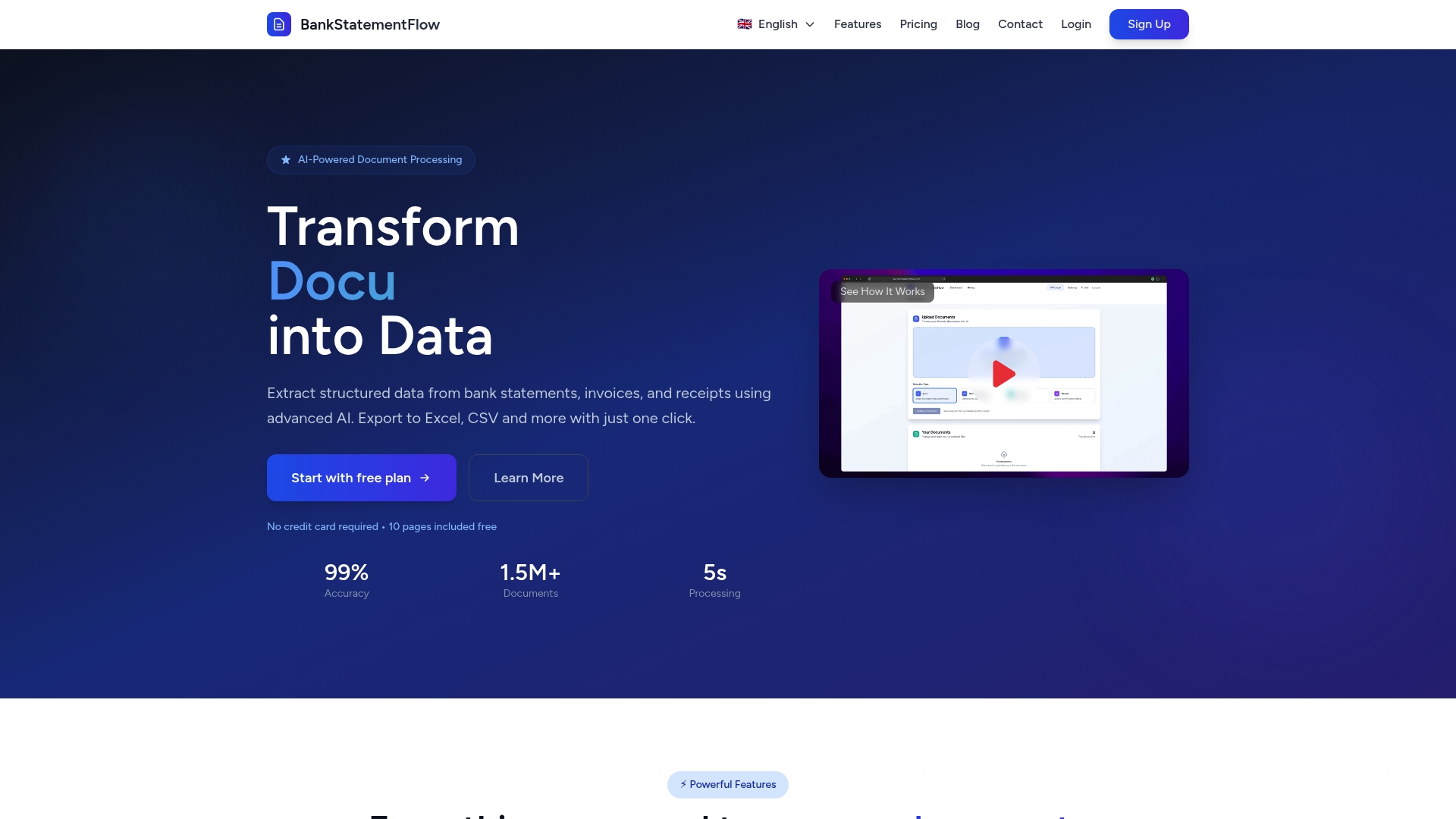
Take control of your financial document processing today. Discover how BankStatementFlow can transform your workflow by automating bank statement analysis, enhancing invoice processing automation, and boosting overall financial accuracy. Visit our website now to streamline your data management and reduce costly errors with AI-driven precision.
Frequently Asked Questions
What are the key components of a bank statement?
Bank statements typically include transaction dates, amounts, descriptions, and balance information. Review these details each month to ensure accurate financial tracking and identify any discrepancies.
How can I track invoices more efficiently?
To track invoices effectively, digitize all incoming invoices, implement automated data extraction, and maintain a clear approval workflow. Establishing these practices can significantly reduce manual processing time by up to 30%.
What essential information should be present on a receipt for it to be valid?
A valid receipt should include the vendor’s name, transaction date, detailed description of goods or services, total amount paid, and the payment method. Always scan and categorize your receipts immediately after purchase to maintain accurate records.
How do I reconcile my credit card statements correctly?
To reconcile credit card statements, download your monthly statements, compare transactions to your receipts, and document any discrepancies. Aim to complete this process within 48 hours of receiving the statement to promptly address potential issues.
What steps should I take for effective payroll document management?
For effective payroll document management, select robust payroll software, standardize document capture, and implement multi-level verification processes. Conduct quarterly audits to ensure ongoing accuracy and compliance with regulations.
How can I prepare my tax forms to simplify the reporting process?
To prepare tax forms effectively, organize income documentation, track eligible expenses, and verify the accuracy of all information. Set up a systematic digital filing system to allow for quick retrieval of tax documents when needed.
Recommended
- Data Security in Financial Document Processing: What You Need to Know - BankStatementFlow Blog
- Bank Statement Analysis: Best Practices for Financial Data Management - BankStatementFlow Blog
- Staying Compliant: Financial Automation and Regulatory Requirements - BankStatementFlow Blog
- How to Automate Financial Documents for Fast, Accurate Data - BankStatementFlow Blog
- 7 Essential Steps for a High-Impact Sales Skills Checklist