Enhance regulatory compliance with AI by 2026

AI-powered document processing can achieve accuracy rates as high as 99% in financial compliance tasks. As US corporations face mounting regulatory pressures in 2026, compliance officers and financial managers must understand how AI transforms document workflows. This guide explains AI’s core capabilities, real-world benefits, implementation strategies, and practical steps to integrate AI into your compliance operations effectively.
Table of Contents
- Introduction To AI In Regulatory Compliance
- Core AI Capabilities For Regulatory Compliance
- Efficiency And Accuracy Benefits Of AI Deployment
- Challenges, Limitations, And Common Misconceptions
- Comparing AI-Powered And Traditional Compliance Processes
- Implementation Best Practices And Integration Guidelines
- Conclusion And Future Outlook
- Discover AI-Powered Solutions For Compliance Document Processing
Key takeaways
| Point | Details |
|---|---|
| AI accuracy | AI achieves up to 99% accuracy in regulatory document processing, far exceeding manual methods. |
| Time savings | AI reduces manual compliance processing time by 70-90%, enabling faster regulatory response. |
| Human oversight | Human validation remains essential for interpreting complex or ambiguous regulatory requirements. |
| Implementation planning | Successful AI integration requires careful attention to data privacy, system compatibility, and staff training. |
| Cost reduction | AI-powered compliance cuts operational costs and reduces risk of regulatory penalties significantly. |
Introduction to AI in regulatory compliance
AI adoption is growing rapidly as financial firms face increasing regulatory complexity in 2026. Compliance officers and financial managers in US corporations now process thousands of regulatory documents monthly, from transaction records to audit trails. Manual processing creates bottlenecks that delay compliance reporting and increase error risk.
Rising volumes and varieties of regulatory documents overwhelm traditional workflows. Financial institutions must handle bank statements, invoices, contracts, and specialized regulatory filings across multiple formats and languages. The US regulatory landscape demands precision and speed that human teams struggle to maintain consistently.
Understanding AI’s capabilities is no longer optional for compliance leadership. AI transforms how organizations extract, validate, and structure data from financial documents. Key drivers for AI adoption include:
- Exponential growth in document volumes requiring compliance review
- Increasing complexity of regulations across federal and state jurisdictions
- Need for real-time monitoring and faster regulatory response times
- Pressure to reduce operational costs while maintaining accuracy
- Demand for audit-ready documentation and transparent compliance trails
The strategic advantage goes to organizations that deploy compliance financial automation proactively. AI enables compliance teams to focus on high-value interpretation and decision-making rather than repetitive data entry.
Core AI capabilities for regulatory compliance
AI excels at automatic data extraction with near-perfect accuracy. Advanced machine learning algorithms identify and extract specific data fields from unstructured documents in seconds. This capability eliminates manual transcription errors that plague traditional compliance workflows.
AI-powered processing supports 99% accurate extraction across multi-format, multi-language, encrypted, and image-based regulatory documents. Modern AI systems handle PDFs, Word documents, spreadsheets, scanned images, and even smartphone photos without requiring specialized scanners. Password-protected and encrypted files pose no barrier to sophisticated AI processing engines.
Multi-language and regional format support is critical for global corporations. AI recognizes date formats, currency symbols, and language-specific terminology across dozens of languages. This flexibility ensures consistent processing regardless of document origin or format variation.
Machine learning and natural language processing enable AI to extract complex regulatory information effectively. These technologies include:
- Optical character recognition (OCR) for converting images to structured text
- Natural language processing (NLP) for understanding context and extracting meaning
- Machine learning models trained on millions of financial documents
- Pattern recognition algorithms that identify document types automatically
- Custom field extraction tailored to specific regulatory requirements
AI systems learn and improve over time. As they process more documents, accuracy increases and edge cases are handled more effectively. This continuous improvement distinguishes AI from static rule-based automation.
Pro Tip: When evaluating AI solutions, prioritize platforms that support custom field extraction. Generic AI tools may miss organization-specific compliance requirements that custom configurations can capture.
Integration capabilities extend AI’s value beyond standalone processing. Modern platforms offer AI to improve accuracy in finance through API access, enabling seamless connection to existing compliance systems. This connectivity allows AI to feed validated data directly into audit trails, reporting dashboards, and regulatory filing systems. Organizations considering the role of AI in accounting to automate documents should evaluate integration flexibility early.
Efficiency and accuracy benefits of AI deployment
AI significantly shortens document processing cycles, allowing faster response to compliance requirements. Tasks that took days or weeks under manual review now complete in hours. AI reduces manual processing time by 70-90%, and compliance errors drop by 25-40% according to industry analyses.
Error rates plummet because AI eliminates manual data entry mistakes. Human reviewers fatigue and make transcription errors, especially with repetitive high-volume tasks. AI maintains consistent accuracy regardless of document volume or processing duration. This reliability proves especially valuable during audit periods when document volumes spike.

Real-time monitoring and alerts improve proactive regulatory adherence. AI systems can flag anomalies, missing documents, or potential compliance issues as they arise rather than during quarterly reviews. Early detection enables corrective action before violations occur.
| Metric | Manual Processing | AI-Powered Processing | Improvement |
|---|---|---|---|
| Processing time per document | 15-30 minutes | 1-3 minutes | 90% faster |
| Accuracy rate | 85-90% | 98-99% | 10-15% improvement |
| Daily document capacity | 20-30 documents | 100-150 documents | 400% increase |
| Cost per document | $8-12 | $1-2 | 85% cost reduction |
| Error detection speed | Days to weeks | Real-time | Immediate |
Cost savings accrue from reduced labor and lower regulatory penalty risk. Organizations redirect compliance staff from data entry to analytical work that requires human judgment. The cost per processed document drops dramatically while throughput increases.
Additional efficiency gains include:
- Elimination of document scanning and manual filing steps
- Automatic routing of extracted data to appropriate systems
- Reduced time spent on audit preparation and document retrieval
- Lower storage costs through digital-first processing
- Faster regulatory reporting cycle completion
Pro Tip: Calculate your organization’s baseline processing time and error rate before AI deployment. These metrics become powerful ROI evidence when justifying continued investment.
Organizations implementing AI to improve accuracy in finance report measurable compliance improvements within the first quarter. The AI document processing revolution delivers immediate operational benefits while building long-term strategic advantage.
Challenges, limitations, and common misconceptions
AI requires human validation to handle ambiguous or changing regulatory requirements. While AI excels at structured data extraction, complex regulatory interpretations demand human judgment. New regulations or unusual document formats may require manual review until AI models retrain on updated examples.
AI complements but does not replace compliance officers; ongoing human oversight is essential. This represents the most critical misconception about AI in compliance. AI automates repetitive tasks but cannot replace the strategic thinking, ethical judgment, and regulatory interpretation that experienced compliance professionals provide.
Integration with legacy systems can be complex and time-consuming. Organizations with decades-old compliance databases or proprietary software face technical hurdles. API compatibility, data format conversions, and security protocols require careful planning and testing.
Data privacy and regulatory compliance must be considered carefully in AI deployments. Processing sensitive financial documents through AI systems raises questions about data residency, encryption, access controls, and third-party vendor security. Organizations must ensure AI platforms meet SOC 2, GDPR, and industry-specific requirements.
Common misconceptions compliance teams should address:
- Myth: AI eliminates all processing errors immediately
- Reality: AI reduces errors significantly but requires validation protocols
- Myth: AI implementation is plug-and-play
- Reality: Successful deployment requires planning, testing, and training
- Myth: AI will replace compliance staff
- Reality: AI augments staff by handling repetitive tasks
- Myth: All AI solutions offer equivalent accuracy
- Reality: Platform capabilities vary widely based on training data and algorithms
- Myth: AI works perfectly with all document types from day one
- Reality: Custom configurations and ongoing refinement improve performance
Organizations pursuing automation compliance financial oversight must balance automation benefits with appropriate human oversight. Establishing clear escalation protocols for edge cases ensures AI enhances rather than compromises compliance quality.
Comparing AI-powered and traditional compliance processes
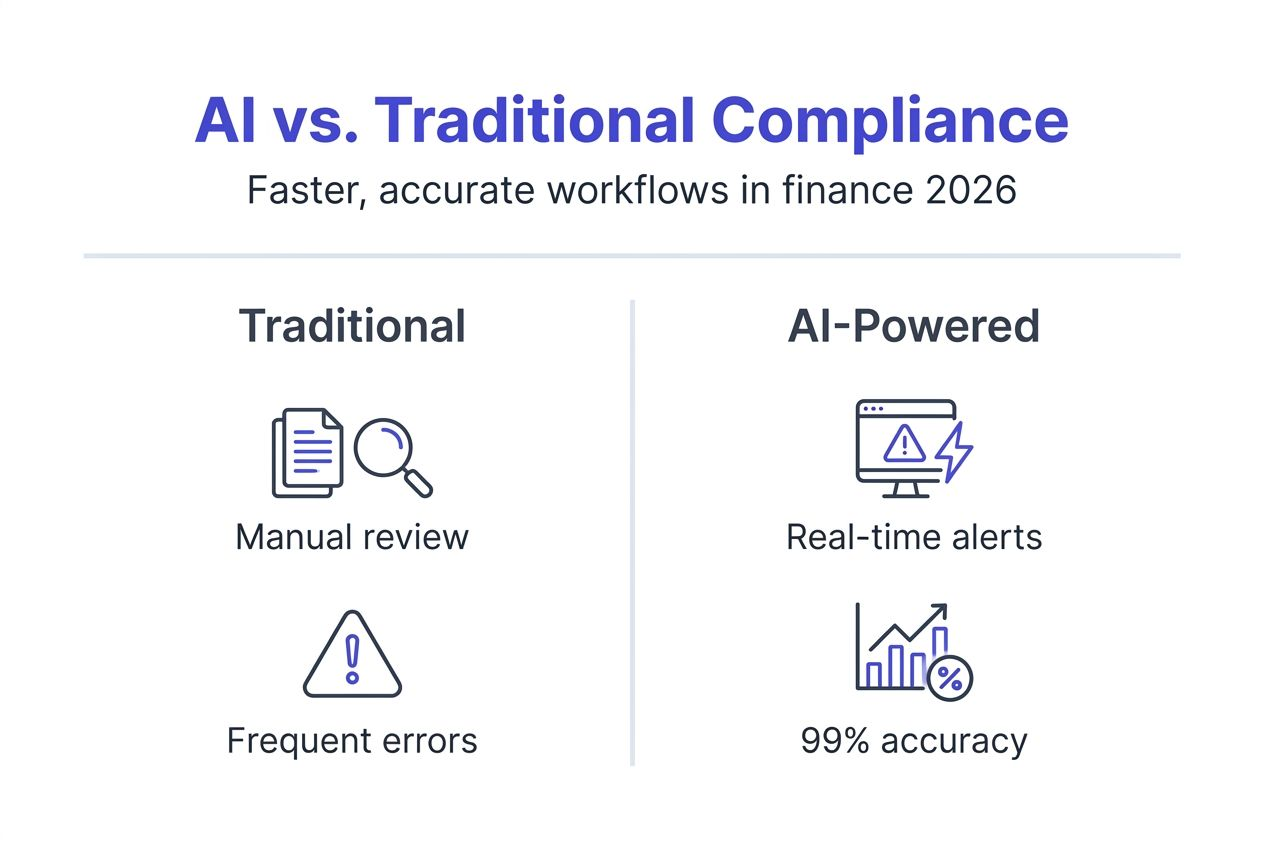
AI achieves 99% accuracy compared to 85% accuracy with manual processing and can handle five times more documents daily. This performance gap makes AI adoption a competitive necessity rather than a luxury. Side-by-side comparison reveals AI’s superior capabilities across critical metrics.
| Process Aspect | Traditional Manual | AI-Powered | Key Difference |
|---|---|---|---|
| Data extraction accuracy | 85-90% | 98-99% | AI reduces errors by 60-80% |
| Processing speed | 15-30 min/doc | 1-3 min/doc | AI processes 10x faster |
| Daily capacity | 20-30 documents | 100-150 documents | AI scales to 5x volume |
| Scalability | Limited by staff | Virtually unlimited | AI handles volume spikes easily |
| Consistency | Varies by individual | Uniform standards | AI eliminates human variability |
| Cost per document | $8-12 | $1-2 | AI cuts costs by 85% |
| Error detection | Retrospective | Real-time | AI flags issues immediately |
| Compliance monitoring | Periodic reviews | Continuous | AI enables proactive oversight |
Manual compliance workflows suffer from inherent limitations. Human reviewers tire, make transcription errors, and process documents inconsistently. Peak periods like quarter-end create backlogs that delay regulatory reporting. Staff turnover disrupts institutional knowledge and processing standards.
AI-powered workflows maintain consistent quality regardless of volume or timing. Processing standards remain uniform across all documents. System capacity scales instantly to handle regulatory deadline crunches without hiring temporary staff or imposing overtime.
Real-time compliance monitoring represents AI’s most transformative advantage. Traditional processes identify issues only during periodic audits, often weeks or months after problems arise. AI flags anomalies, missing fields, or potential violations instantly, enabling immediate corrective action.
The future of fintech and AI clearly favors organizations that embrace automation now. Early adopters gain competitive advantages in cost efficiency, processing speed, and regulatory responsiveness that compound over time.
Implementation best practices and integration guidelines
Start by assessing current compliance workflows to identify processing bottlenecks. Document baseline metrics for processing time, error rates, and resource allocation. This assessment reveals where AI delivers maximum impact and provides ROI benchmarks.
Select AI vendors based on accuracy, compliance features, and integration abilities. Evaluate platforms on these criteria:
- Proven accuracy rates on documents similar to yours
- Support for your required document formats and languages
- API availability and compatibility with existing systems
- Security certifications relevant to your industry
- Custom field extraction capabilities for specialized needs
- Vendor responsiveness and implementation support quality
Pilot AI on a subset of documents with thorough validation before full deployment. Choose a representative document sample that includes common formats and edge cases. Run pilot processing in parallel with existing workflows to compare results directly.
Typical AI integration timeframe ranges from 3-6 months with ongoing human oversight necessary. Phased deployment reduces risk and allows refinement based on real-world performance. Implementation stages typically include:
- Workflow assessment and requirement definition (2-4 weeks)
- Vendor selection and contract negotiation (3-6 weeks)
- System configuration and custom field setup (4-8 weeks)
- Pilot testing with validation protocols (6-8 weeks)
- Staff training and change management (4-6 weeks)
- Full deployment with monitoring (2-4 weeks)
- Ongoing optimization and refinement (continuous)
Ongoing monitoring and trained human oversight are vital for success. Establish clear protocols for:
- Regular accuracy audits comparing AI output to manual review samples
- Escalation procedures for documents requiring human interpretation
- Performance tracking against baseline metrics
- Continuous improvement based on error pattern analysis
- Security monitoring and access control reviews
Address data privacy compliance considerations proactively. Ensure AI platforms encrypt data in transit and at rest. Verify vendor compliance with relevant regulations including SOC 2, GDPR, and industry-specific requirements. Document data handling procedures for audit purposes.
Provide comprehensive training to compliance and technical staff. Effective training covers AI capabilities, limitations, validation procedures, and escalation protocols. Cross-functional teams need clear understanding of how AI fits into overall compliance strategy.
Pro Tip: Create a dedicated AI governance committee with representatives from compliance, IT, legal, and operations. This cross-functional oversight ensures balanced decision-making and smooth implementation.
Organizations embracing the AI document processing revolution should view implementation as a strategic transformation rather than a technology upgrade. Success requires cultural change alongside technical deployment.
Conclusion and future outlook
AI will continue augmenting compliance by improving accuracy and efficiency throughout 2026 and beyond. The technology matures rapidly as machine learning models train on ever-larger document datasets. Compliance teams that master AI integration today position themselves for sustained competitive advantage.
Emerging trends include explainable AI and RegTech integration. Explainable AI provides transparent reasoning for extraction decisions, addressing audit and regulatory scrutiny concerns. RegTech platforms increasingly embed AI capabilities, creating seamless compliance ecosystems that span document processing, monitoring, and reporting.
Proactive AI adoption is essential for maintaining competitive edge and compliance excellence. Organizations delaying deployment fall further behind in cost efficiency and processing capacity. The gap between AI-enabled and manual compliance operations widens monthly as AI technology advances.
Compliance officers should embrace AI as a strategic tool, not a threat. AI elevates compliance roles from data entry to strategic oversight, regulatory interpretation, and risk management. The future belongs to professionals who combine regulatory expertise with AI proficiency.
Discover AI-powered solutions for compliance document processing
Ready to transform your regulatory compliance workflows with AI? BankStatementFlow provides enterprise-grade AI tools that convert complex financial documents into structured, audit-ready data in minutes. Our platform handles bank statements, invoices, receipts, and regulatory filings with 99% accuracy across multiple formats and languages.
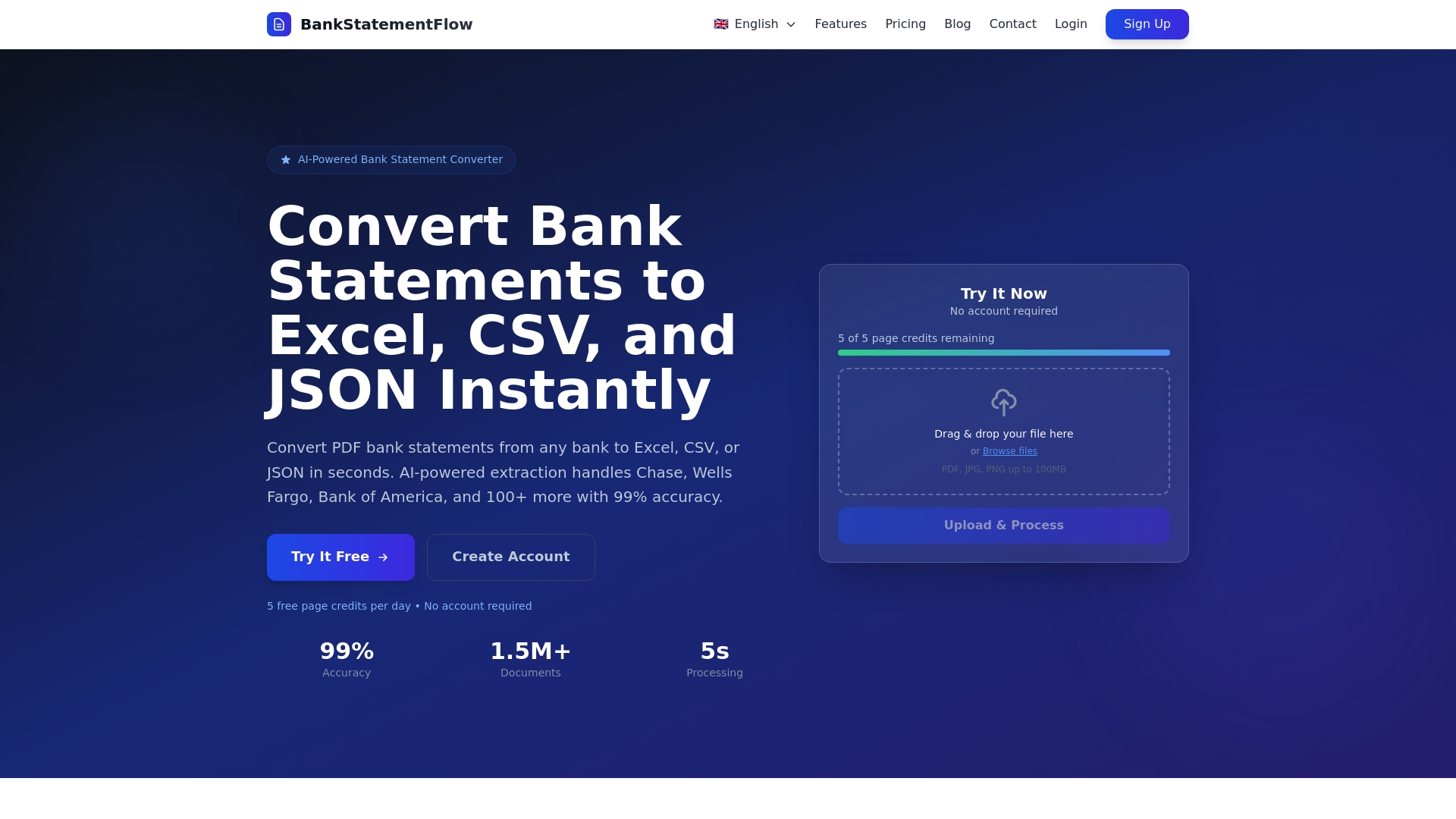
Start with our AI-powered bank statement conversion platform to experience intelligent document processing firsthand. Try our free bank statement converter to see AI accuracy on your own documents, or explore specialized tools like our PDF bank statement to CSV converter for instant data transformation. These solutions integrate seamlessly into existing compliance workflows, cutting processing time by up to 90% while maintaining rigorous accuracy standards.
FAQ
What challenges does AI face in regulatory compliance?
AI faces integration complexity with legacy systems, data privacy requirements, and the need for ongoing human oversight. These challenges are manageable through phased implementation, clear protocols, and thorough privacy assessments. Organizations that plan carefully mitigate risks while capturing AI’s substantial benefits.
Can AI fully replace human compliance officers?
AI is designed to augment compliance officers by automating repetitive tasks, not replace them. Human expertise remains essential for interpreting complex regulations, making judgment calls on ambiguous situations, and providing strategic oversight. AI handles data extraction while professionals focus on analysis and decision-making.
How quickly can AI be integrated into existing compliance workflows?
AI integration usually takes between 3 to 6 months, including pilot testing and training. Timeline depends on workflow complexity, legacy system compatibility, and vendor support quality. A phased approach with thorough testing ensures smooth adoption and minimizes disruption.
What accuracy rates can organizations expect from AI document processing?
Organizations typically achieve 98-99% accuracy with properly configured AI systems, compared to 85-90% with manual processing. Accuracy improves over time as AI models learn from corrections and handle more document variations. Custom field configurations further enhance precision for organization-specific requirements.
How does AI handle encrypted or password-protected compliance documents?
Modern AI platforms process encrypted and password-protected PDFs seamlessly once authorized access is provided. The AI extracts data with the same accuracy as unprotected files while maintaining security protocols. This capability eliminates manual decryption steps that slow traditional workflows.
Recommended
- The Future of FinTech: How AI is Reshaping Financial Services - BankStatementFlow Blog
- Role of Automation in Compliance: Transforming Global Financial Oversight - BankStatementFlow Blog
- AI in Finance: Unlocking Unmatched Accuracy - BankStatementFlow Blog
- Staying Compliant: Financial Automation and Regulatory Requirements - BankStatementFlow Blog