AI in Finance: 99% Accuracy Transforms Document Processing

Financial teams processing thousands of documents monthly face a stark reality: manual data entry produces error rates of 5 to 10 percent, creating compliance risks and operational bottlenecks. AI-powered document processing achieves accuracy rates up to 99%, transforming how North American finance teams handle bank statements, invoices, and receipts. This article explores the core technologies, tangible benefits, persistent myths, and practical implementation strategies enabling financial teams to optimize data management through AI automation.
Table of Contents
- Introduction To AI In Financial Document Processing
- Core AI Technologies Enabling Financial Document Processing
- Benefits Of AI For Financial Teams
- Common Misconceptions About AI In Finance
- Comparing Manual Vs AI-Powered Document Processing
- Case Studies And Real-World Applications
- Practical Implementation Considerations
- Conclusion: Embracing AI For Optimized Financial Data Management
- Discover AI-Powered Financial Document Solutions
Key Takeaways
| Point | Details |
|---|---|
| Error Reduction | AI reduces financial document processing errors from 5-10% to under 1%, dramatically improving data reliability. |
| Core Technologies | Machine learning and OCR handle diverse formats including encrypted PDFs, scanned images, and multi-language documents. |
| Operational Benefits | Financial teams gain faster processing, enhanced compliance, and stronger data security through AI automation. |
| Misconceptions Addressed | AI complements rather than replaces human oversight, delivering proven reliability when properly implemented. |
| Implementation Path | Practical steps enable smooth AI integration through phased adoption, stakeholder involvement, and validation protocols. |
Introduction to AI in Financial Document Processing
AI-driven financial document processing uses machine learning to automatically extract, structure, and validate data from unstructured sources. For financial teams managing accounts payable, bank reconciliations, and audit compliance, this technology addresses fundamental challenges that manual workflows cannot solve at scale.
Typical financial documents requiring processing include:
- Bank statements with transaction histories
- Vendor invoices with variable formats
- Expense receipts from diverse sources
- Tax forms and regulatory filings
Manual data entry creates persistent problems. Human operators transcribing financial data introduce errors through fatigue, misreading, and inconsistent interpretation of document formats. These mistakes cascade into reconciliation failures, audit complications, and compliance violations. Processing times stretch as document volumes grow, creating bottlenecks during month-end closes and tax deadlines.
Machine learning algorithms enable AI systems to extract and structure data from unstructured financial documents such as scanned PDFs, images, and encrypted files with high reliability, eliminating the need for manual data entry. Advanced systems learn from corrections, continuously improving accuracy as they process more documents. This capability transforms bank statement parsing accuracy from a manual bottleneck into an automated advantage.
AI reduces manual workload by handling repetitive extraction tasks, freeing financial professionals to focus on analysis, exception handling, and strategic decisions. The technology operates continuously without fatigue, maintaining consistent accuracy across thousands of documents.
Core AI Technologies Enabling Financial Document Processing
Several interconnected technologies power modern AI document processing systems, each addressing specific challenges financial teams encounter with diverse document formats.
Optical Character Recognition (OCR) forms the foundation, converting scanned images and PDFs into machine-readable text. Advanced OCR engines handle poor scan quality, handwritten notes, and mixed content types. Decryption modules automatically process password-protected files, eliminating manual unlocking steps that slow workflows.
Machine learning models trained on millions of financial documents recognize patterns and extract specific fields regardless of document layout. These models identify:
- Transaction dates, amounts, and descriptions
- Vendor names and payment terms
- Account numbers and routing information
- Currency types and exchange rates
Multi-language support enables processing of international documents without manual translation. Machine learning algorithms for finance adapt to regional date formats, currency symbols, and naming conventions automatically. Custom field recognition allows teams to define specialized data points unique to their industry or workflow, extending AI capabilities beyond standard financial fields.
Modern systems handle documents captured via phone cameras, eliminating scanner requirements. Image enhancement algorithms correct perspective distortion, improve contrast, and remove shadows before OCR processing. This flexibility supports field operations where formal scanning infrastructure is unavailable.
Pro Tip: When evaluating AI solutions, prioritize platforms supporting your existing document formats including encrypted PDFs and images. Verify multi-language capabilities if processing international transactions, as format differences significantly impact extraction accuracy.
The integration of these technologies creates systems that AI improving financial accuracy by handling document variability that traditionally required human judgment. Machine learning continuously refines extraction rules based on validation feedback, improving performance over time without manual reconfiguration.
Benefits of AI for Financial Teams
Financial teams adopting AI document processing realize measurable improvements across accuracy, efficiency, compliance, and operational capacity.
Accuracy improvements represent the most significant benefit. Comparative analysis indicates that manual data entry typically results in 5-10% error rates, whereas AI automation reduces this error margin to less than 1%. This dramatic reduction eliminates costly reconciliation cycles and audit findings. Teams spend less time investigating discrepancies and more time on value-added analysis.

Processing speed accelerates dramatically. Tasks requiring hours of manual entry complete in minutes with AI automation. Month-end closes finish faster as bank statements, invoices, and receipts process simultaneously rather than sequentially. This speed advantage compounds during peak periods like tax season or year-end audits.
Key efficiency gains include:
- 80-90% reduction in manual data entry time
- Same-day processing of incoming invoices
- Real-time bank reconciliation capabilities
- Automated categorization and coding
Compliance risks decrease as consistent processing eliminates human oversights. AI systems apply validation rules uniformly, flagging exceptions for review before data enters financial systems. Audit trails capture every extraction decision, providing documentation regulatory bodies require. Enhanced data security emerges from eliminating manual document handling, reducing exposure to loss or unauthorized access.
Seamless integration into existing workflows prevents disruption. Modern AI platforms connect with accounting systems, ERPs, and data warehouses through APIs, automatically routing extracted data to appropriate destinations. Teams maintain familiar interfaces while gaining AI capabilities behind the scenes.
Bank statement digitization benefits extend beyond accuracy to include searchability, version control, and disaster recovery. Digital archives replace physical filing systems, reducing storage costs and improving information retrieval during audits or legal discovery.
Key Statistic: Financial teams using AI document processing report accuracy improvements from typical 5-10% error rates with manual entry to less than 1% with automation, according to industry benchmarks.
Common Misconceptions About AI in Finance
Several persistent myths prevent financial teams from adopting AI document processing despite its proven benefits. Addressing these misconceptions clarifies AI’s actual role and capabilities.
Myth: AI is unreliable or prone to errors
This misconception stems from early automation failures and confusion between different AI maturity levels. Modern AI routinely surpasses human accuracy in extracting financial data when properly trained and validated. Systems achieve 99% accuracy on standard financial documents, with error rates dropping further as machine learning models process more examples. Reliability concerns often reflect implementation issues like insufficient training data or poor document quality rather than fundamental AI limitations.
Myth: AI replaces human oversight entirely
AI automates repetitive extraction tasks but does not eliminate the need for human judgment. Financial professionals remain essential for:
- Validating unusual transactions
- Resolving extraction ambiguities
- Making strategic decisions based on data
- Ensuring regulatory compliance
The human-AI collaboration optimizes outcomes by assigning tasks to whichever party handles them most effectively. AI processes routine documents while humans address exceptions requiring contextual understanding.
Myth: AI cannot handle encrypted or image-based documents
Modern AI systems routinely process password-protected PDFs, phone photos, and low-quality scans. Advanced preprocessing automatically enhances image quality, corrects perspective distortion, and handles encryption without manual intervention. Teams no longer need dedicated scanners or manual file preparation, as AI handles format variability that previously required human preprocessing.
“The key to successful AI implementation is understanding it augments rather than replaces financial expertise. Teams that embrace AI for automation while maintaining human oversight achieve the best outcomes.”
Recognizing AI as a collaborative tool rather than a replacement technology helps financial teams approach implementation with appropriate expectations. Validation workflows that combine AI speed with human judgment deliver superior results compared to either approach alone.
Comparing Manual vs AI-Powered Document Processing
Quantifying differences between manual and AI-driven approaches clarifies the value proposition for financial teams evaluating automation investments.
| Metric | Manual Processing | AI-Powered Processing |
|---|---|---|
| Error Rate | 5-10% typical | Less than 1% |
| Processing Speed | 50-100 documents/day per person | 1,000+ documents/hour |
| Scalability | Linear with headcount | Scales without proportional cost increase |
| Cost per Document | $2-5 including labor | $0.10-0.50 depending on volume |
| Audit Trail | Manual documentation required | Automatic comprehensive logging |
Comparative analysis indicates manual data entry typically results in 5-10% error rates, whereas AI automation reduces this to less than 1%. This accuracy improvement alone justifies adoption for teams prioritizing compliance and data quality.
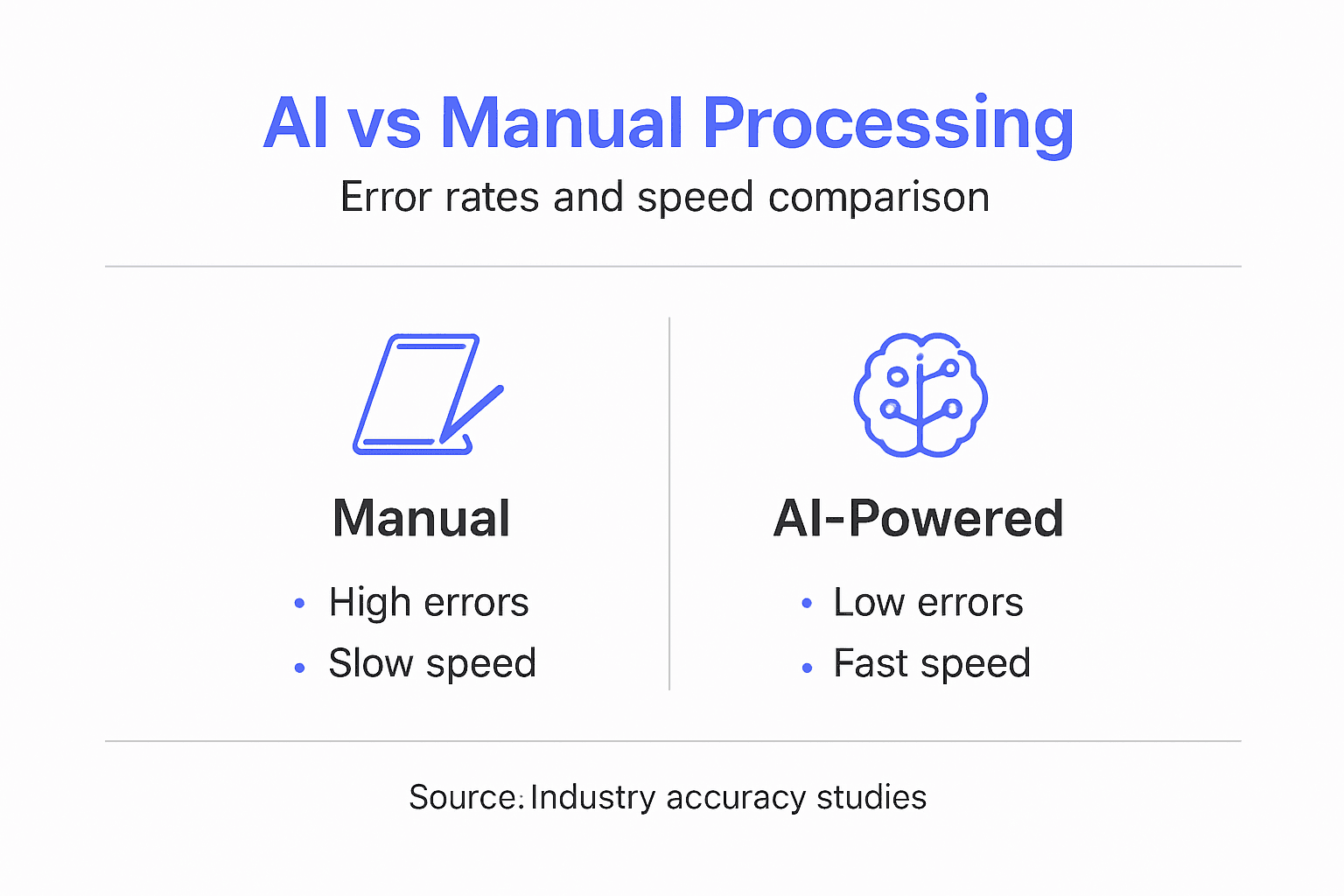
Processing speed differences create competitive advantages during time-sensitive periods. While manual teams struggle with month-end volume spikes, AI systems maintain consistent throughput regardless of document quantity. This reliability eliminates overtime costs and deadline pressure.
Scalability represents a strategic benefit. Manual processing requires hiring additional staff as document volumes grow, creating recruitment delays and training overhead. AI platforms scale instantly through additional processing capacity, supporting business growth without proportional cost increases.
Cost-benefit analysis reveals favorable ROI timelines:
- Initial implementation: 2-4 weeks
- Break-even point: 3-6 months for mid-sized teams
- Annual savings: 60-80% of manual processing costs
- Ongoing accuracy improvements through machine learning
Pro Tip: Measure implementation success through specific KPIs including error rate reduction, processing time improvements, and cost per document. Establish baseline metrics before AI adoption to quantify improvements and justify continued investment.
The AI vs manual document processing comparison consistently favors automation for routine financial documents, while human expertise remains valuable for complex exceptions and strategic analysis.
Case Studies and Real-World Applications
Real-world implementations demonstrate how financial teams across various sizes achieve measurable improvements through AI document processing adoption.
A mid-sized accounting firm processing 500 client bank statements monthly reduced error rates from 8% to 0.5% after implementing AI automation. The accuracy improvement eliminated reconciliation cycles that previously consumed 40 hours monthly, allowing staff redeployment to advisory services. Audit compliance improved as comprehensive extraction logs provided documentation that manual processes lacked.
A corporate finance team managing accounts payable for 200 vendors accelerated month-end close by three days through AI invoice processing. Automatic extraction and coding eliminated the data entry bottleneck that delayed financial reporting. Real-time processing enabled earlier payment discount capture, generating additional annual savings of $50,000.
Small business applications prove equally valuable. A solo accounting practitioner serving 30 small business clients adopted AI document processing to handle tax preparation volume without hiring additional staff. Processing time per client decreased from six hours to 90 minutes, expanding client capacity by 60% without proportional cost increases.
Key lessons from successful implementations include:
- Start with high-volume, standardized documents for quick wins
- Involve end users early to address workflow concerns
- Establish validation protocols combining AI speed with human oversight
- Monitor accuracy metrics to identify improvement opportunities
Practical AI finance examples show consistent patterns across implementations: teams achieve dramatic time savings, accuracy improvements, and cost reductions regardless of size or industry. The technology adapts to diverse workflows while delivering similar benefit profiles.
Large enterprise deployments processing tens of thousands of documents monthly demonstrate AI scalability advantages. One financial institution reduced statement processing staff from 15 to 3 while improving accuracy and turnaround time, reallocating 12 positions to customer service roles that generate revenue rather than performing data entry.
Practical Implementation Considerations
Successful AI document processing adoption requires careful planning, stakeholder alignment, and phased deployment to maximize benefits while minimizing disruption.
Prerequisites for implementation success include:
- Executive sponsorship and budget allocation
- Clear documentation of current workflows and pain points
- Representative sample documents for testing and training
- Integration requirements with existing systems
- Validation protocols ensuring accuracy before production use
The recommended adoption sequence follows a phased approach:
- Assess current document volumes, formats, and processing costs to establish ROI targets
- Evaluate AI solutions based on accuracy claims, security certifications, and integration capabilities
- Conduct proof-of-concept testing with actual documents to verify performance
- Implement pilot deployment with limited document types and volumes
- Establish validation workflows combining AI automation with human review
- Scale gradually across additional document types as confidence builds
- Monitor performance metrics and refine extraction rules based on feedback
Selection criteria should prioritize:
- Accuracy: Verify claimed performance with your specific document types
- Security: Ensure SOC 2, GDPR, and industry-specific compliance
- Integration: Confirm API availability and compatibility with existing systems
- Customization: Evaluate support for custom fields and validation rules
- Scalability: Assess capacity to handle volume growth without performance degradation
Common failure points include unrealistic accuracy expectations, insufficient training data, and inadequate validation protocols. Teams expecting 100% accuracy without human review encounter frustration when edge cases require intervention. Starting with standardized, high-quality documents builds confidence before tackling challenging formats.
Integration challenges emerge when AI platforms cannot connect with legacy systems. Prioritize solutions offering flexible APIs and pre-built connectors for common accounting platforms. Manual data transfer between systems eliminates automation benefits and creates new bottlenecks.
Pro Tip: Involve accounting staff, IT teams, and compliance officers early in the selection process to address workflow, technical, and regulatory concerns proactively. User buy-in significantly impacts adoption success as staff must trust AI outputs to reduce validation overhead.
The automate financial documents implementation guide provides detailed workflows for phased deployment, helping teams avoid common pitfalls while accelerating time to value.
Conclusion: Embracing AI for Optimized Financial Data Management
AI-powered document processing delivers transformative benefits for financial teams seeking accuracy improvements, operational efficiency, and competitive advantages. The technology reduces error rates from 5-10% with manual entry to less than 1% through automation, while dramatically accelerating processing speeds and enabling scalability without proportional cost increases.
Successful adoption requires understanding AI as a collaborative tool that complements human expertise rather than replacing it. Financial professionals remain essential for validation, exception handling, and strategic decision-making, while AI handles repetitive extraction tasks that consume time and introduce errors.
The strategic importance of AI adoption grows as document volumes increase and compliance requirements intensify. Teams delaying implementation fall behind competitors who gain efficiency and accuracy advantages. Starting practical implementation with standardized documents and phased deployment minimizes risk while building organizational confidence.
Future AI innovations promise enhanced capabilities including predictive analytics, anomaly detection, and natural language processing for unstructured financial communications. Early adopters position themselves to leverage these advances as they mature, maintaining competitive advantages in data management and decision support.
Discover AI-Powered Financial Document Solutions
BankStatementFlow delivers the AI-powered bank statement conversion and financial document processing capabilities discussed throughout this article. The platform achieves up to 99% extraction accuracy while supporting diverse formats including encrypted PDFs, scanned images, and multi-language documents.
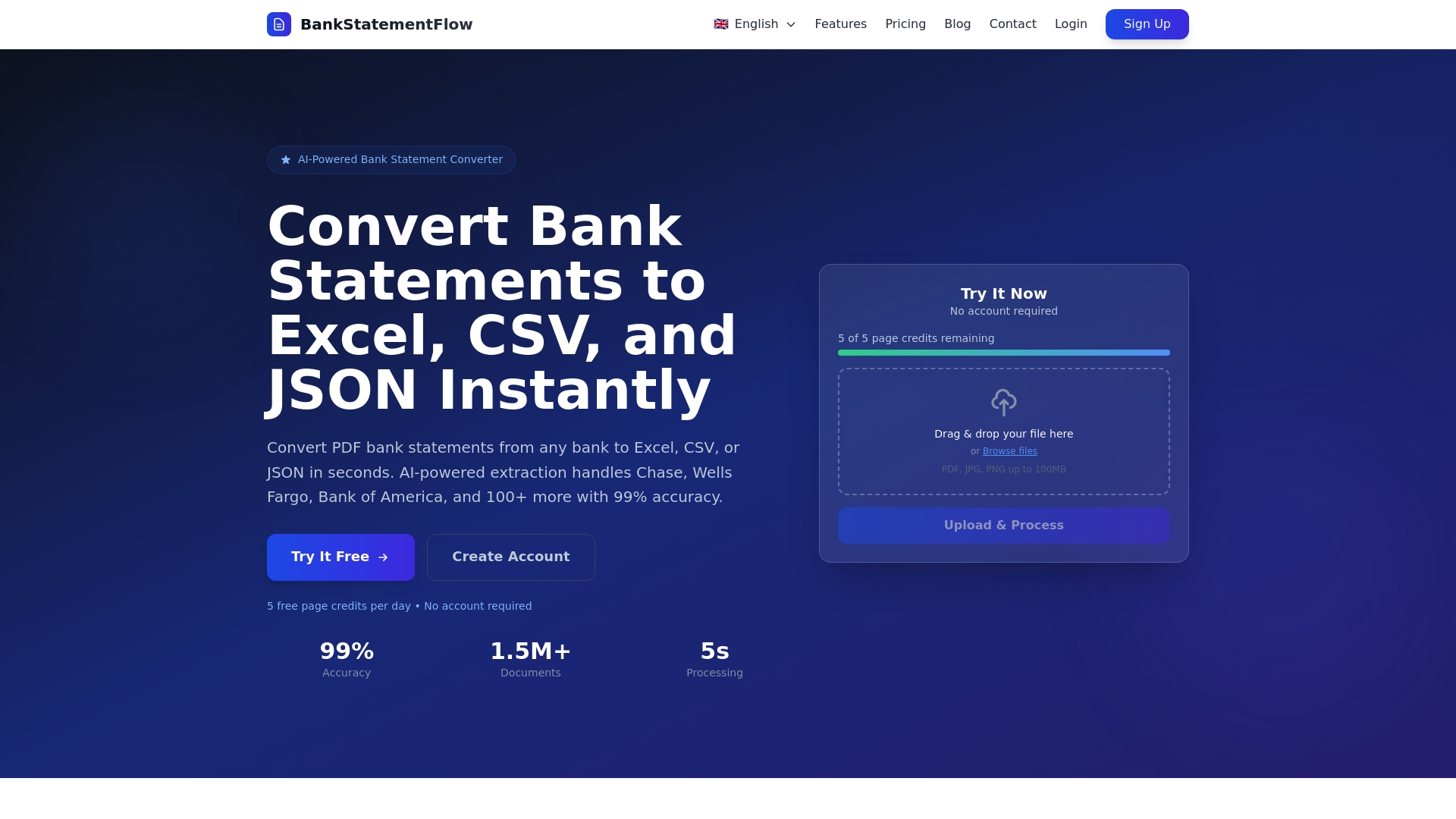
Key features include enterprise-grade security, custom field extraction, and seamless API integration with existing accounting systems. Financial teams gain faster processing, improved compliance, and reduced operational costs through automated workflows that complement human expertise.
Explore detailed implementation guidance in our automate financial documents guide or discover broader benefits of document processing automation across financial workflows. Start optimizing your document management today with proven AI technology designed specifically for financial teams.
FAQ
What types of financial documents can AI process accurately?
AI systems accurately process bank statements, invoices, receipts, tax forms, and financial reports across multiple formats. Modern platforms handle scanned PDFs, encrypted files, and phone-captured images without requiring specialized scanning equipment. Multi-language and regional format support enables processing of international documents automatically.
How much can AI reduce errors compared to manual financial data entry?
AI reduces error rates from typical 5-10% with manual entry to less than 1% through automated extraction and validation. This dramatic improvement eliminates costly reconciliation cycles and audit findings. Accuracy gains compound over time as machine learning models continuously refine extraction rules based on validation feedback.
Does AI replace human oversight in financial document management?
AI automates repetitive extraction tasks but human oversight remains essential for compliance validation and exception handling. Financial professionals focus on analyzing extracted data, resolving ambiguities, and making strategic decisions rather than performing manual data entry. The collaboration between AI automation and human expertise delivers optimal accuracy and efficiency.
What should financial teams consider when choosing an AI document processing solution?
Key evaluation factors include extraction accuracy on your specific document types, security certifications for regulatory compliance, and integration capabilities with existing accounting systems. Assess customization support for unique fields, scalability to handle volume growth, and vendor reputation through customer references. Conduct proof-of-concept testing with actual documents before committing to ensure performance meets requirements.
Recommended
- AI in Finance: Unlocking Unmatched Accuracy - BankStatementFlow Blog
- The AI Document Processing Revolution: How BankStatementFlow is Changing Business - BankStatementFlow Blog
- Blog - BankStatementFlow | AI Document Processing Insights
- Why Convert Financial Documents to Excel? - BankStatementFlow Blog